QUICK TAKE | What Is the Story Behind the APEC Leaders’ Scarves? Seven Things to Know
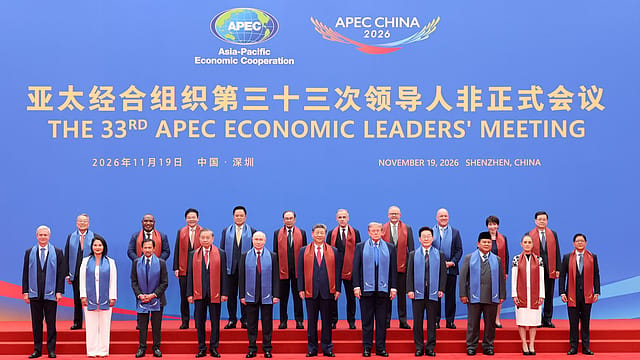
1. What did the leaders wear?
For Thursday’s group photograph, leaders were offered Chinese-style scarves in two colours, red and blue. Chinese President Xi Jinping chose red, as did most participants. US President Donald Trump and Russian President Vladimir Putin wore blue. The colours were options, not an announced political code.
2. What was on the scarf?
The scarves carried the “Kunpeng spreads its wings” emblem associated with Shenzhen’s APEC identity. Kunpeng is a mythical giant bird in Chinese literature, often used to evoke ambition, scale and soaring flight. The motif linked the accessory to the host city’s visual identity for global audiences.
3. Why is Kunpeng linked to Shenzhen?
Shenzhen is often nicknamed Pengcheng, or “City of the Roc”. The roc is the giant bird associated with the Kunpeng image. Using it on the summit scarf gave the group photograph a distinctly local reference, rather than relying only on generic Chinese motifs.
4. What do the colours mean?
The scarves were offered in red and blue. No political meaning was announced for individual colour choices.

The Wealth Issue 2026
06 Nov 2026 - Vol 05 | Issue 45
Portraits of Dreamers and Doers under 35
5. Why do APEC leaders wear host-inspired clothing?
The group-photo custom began in 1993, when US President Bill Clinton gave leaders leather jackets at the first APEC leaders’ meeting in Seattle. Indonesia’s 1994 summit helped establish the practice of using clothing to showcase the host economy’s culture.
6. Have scarves replaced traditional outfits?
Not entirely, but the format has become more understated. APEC leaders have worn traditional garments such as Chinese jackets, Vietnamese ao dai and Korean-inspired attire. Recent hosts, including Peru in 2024 and South Korea in 2025, used scarves instead of full outfits.
7. Why does this small detail matter?
The photograph is ceremonial, not a record of policy agreement. But it gives the host an opportunity to present its culture and identity to a global audience. In Shenzhen, the scarf turned a familiar diplomatic ritual into a showcase for the city’s symbolism.