Poll Deadlock: Israel Exit Polls Put Netanyahu & Eisenkot Blocs Level
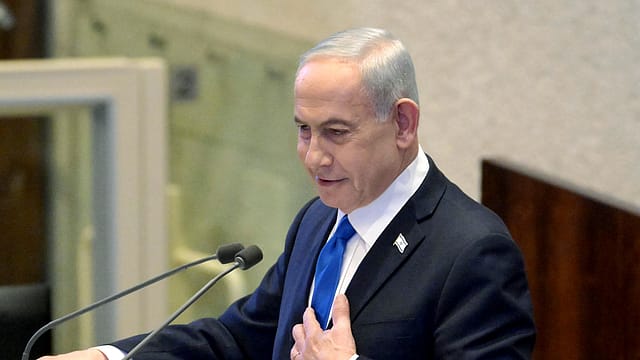
Israel faced an uncertain path to a new government on Wednesday after updated exit polls put Prime Minister Benjamin Netanyahu’s bloc level with the opposition led by former military chief Gadi Eisenkot, leaving both short of a parliamentary majority.
Public broadcaster Kan 11 projected 51 seats for each camp in the 120-member Knesset. Its earlier projection had given the opposition 52 seats and Netanyahu’s alliance 50. A governing majority requires 61 seats.
Other projections differed considerably. Direct Polls put Netanyahu’s bloc at 55 seats, Eisenkot’s grouping at 49 and Arab parties at 16. The Channel 14 projection cited by ANI gave Netanyahu’s alliance 60 seats, the opposition 43 and Arab parties 17. These were exit-poll estimates, with the final seat distribution yet to be established.

Look Who's Talking Regime Change
23 Oct 2026 - Vol 05 | Issue 43
Eisenkot, who heads the Yashar party, described the initial projections as evidence of “a total lack of confidence in Netanyahu and the ‘October 7th government’”.
“If these are the final results, it is a victory for the mainstream Zionist majority in Israel,” he wrote on X.
He said he would move immediately to replace Netanyahu’s government and form what he called “a Zionist government of national mobilisation”.
The coalition arithmetic, however, remained difficult. The opposition grouping includes Yashar, B’Yachad, Yisrael Beytenu and the Democrats. Arab parties oppose Netanyahu but are counted separately from this bloc, and several Zionist opposition parties have rejected governing alongside them.
Ra’am chairman Mansour Abbas said representatives from both political camps had approached his party following the exit polls.
“Everyone is speaking with us, not just from the ‘change bloc’,” Abbas told Channel 12, according to The Times of Israel.
Abbas signalled a willingness to join an Eisenkot-led administration, while stressing that the numbers would first have to support such an arrangement. At the stage when the opposition was projected to win 52 seats, Ra’am’s anticipated seven would have taken their combined tally to 59, still two short of a majority.
The Joint List and Ra’am were together projected to secure 17 to 18 seats in the main broadcasters’ initial exit polls, giving Arab parties potential influence over government formation. Political resistance to cooperation with them could nevertheless prolong negotiations.
Turnout reached 77.7 per cent when polling stations closed at 10 pm, compared with 70.6 per cent at the same hour in 2022, according to figures attributed to the Central Elections Committee.
The election was Israel’s first since the Hamas-led attacks of October 7, 2023, and took place amid divisions over security failures, political accountability and the independence of democratic institutions.
With inputs from ANI