Poland to Receive 5,000 More US Troops After Karol Nawrocki Election. Here’s Why
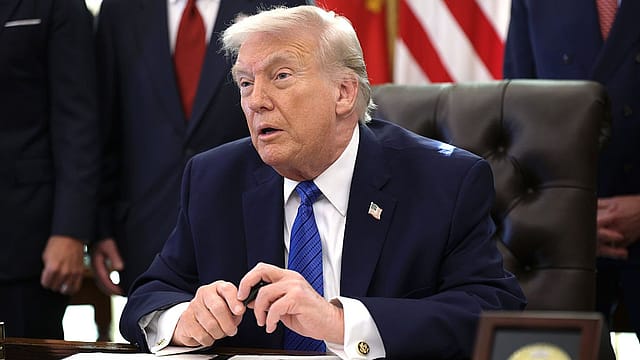
Donald Trump announced that the United States will deploy an additional 5,000 troops to Poland following the election of Karol Nawrocki as the country’s new president.
Trump linked the deployment directly to Nawrocki’s victory and highlighted his own support for the Polish leader during the election campaign.
“Based on the successful Election of the now President of Poland, Karol Nawrocki, who I was proud to Endorse, and our relationship with him, I am pleased to announce that the United States will be sending an additional 5,000 Troops to Poland. Thank you for your attention to this matter! President DONALD J. TRUMP,” Trump wrote on Truth Social.

Zeroing In on ECI
09 Oct 2026 - Vol 05 | Issue 41
Constitutional legitimacy versus political opportunism
The announcement signals a potentially deeper military partnership between Washington and Warsaw at a time of heightened security concerns across Eastern Europe.
Why Did the Announcement Surprise NATO and Polish Officials?
The announcement reportedly caught both Polish and NATO officials off guard.
According to Politico, a Polish official and a NATO representative said they were “flabbergasted” because the United States had not consulted allies before making the announcement publicly.
The surprise stemmed partly from the fact that Poland had only recently been informed about a planned reduction in American troop deployments.
Last week, Polish military authorities were reportedly told that the Pentagon had decided to cancel a planned 4,000-troop deployment to the country, a move that also shocked US defence officials.
The sudden shift from cancelling troop rotations to announcing an additional deployment has raised questions about coordination within the Trump administration’s defence and foreign policy structure.
What Had the Pentagon Announced Earlier?
Just days before Trump’s statement, the Pentagon confirmed plans to reduce America’s Brigade Combat Team presence in Europe.
In a statement posted on X, Assistant to the Secretary of War for Public Affairs and Pentagon spokesperson Sean Parnell said the decision followed “a comprehensive, multilayered process focused on US force posture in Europe.”
“The Department of War has reduced the total number of Brigade Combat Teams (BCTs) assigned to Europe from four to three. This returns us to the levels of BCTs in Europe in 2021,” the statement said.
The Pentagon also acknowledged that the decision would affect troop deployments to Poland.
The statement added that the decision has resulted in “a temporary delay of the deployment of US forces to Poland,” while emphasising that Poland remains “a model US ally.”
According to Fox News, the affected formation was the 2nd Armoured Brigade Combat Team, 1st Cavalry Division, which had been scheduled for a routine nine-month NATO rotational deployment across Poland and other eastern flank positions.
Why Is Poland Strategically Important for the US and NATO?
Poland has become one of NATO’s most important frontline states since tensions with Russia escalated in recent years.
Located on NATO’s eastern flank, Poland plays a critical role in hosting allied troops, military infrastructure and logistics operations aimed at deterring potential Russian aggression.
Warsaw has also emerged as one of Washington’s closest European defence partners, consistently increasing military spending and purchasing advanced US weapons systems.
The additional troop deployment announced by Trump could therefore be viewed as both a political gesture toward Nawrocki’s administration and a broader strategic signal about continued US commitment to Eastern European security.
What Questions Does the Announcement Raise?
Trump’s decision has also created uncertainty about the direction of overall US military strategy in Europe.
On one hand, the Pentagon has been reducing rotational troop presence to return to 2021 force levels. On the other hand, Trump’s announcement suggests a willingness to deepen the US military footprint in Poland specifically.
The contrast between the Pentagon’s reduction plans and Trump’s troop pledge may fuel further debate within NATO about coordination, long-term American commitments and Washington’s evolving security priorities in Europe.
For Poland, however, the announcement is likely to reinforce its status as one of the United States’ closest strategic partners on the continent.
(With inputs from ANI)