Piyush Goyal at G20: ‘Food should remain a source of security’; what India said on trade, US deal and more
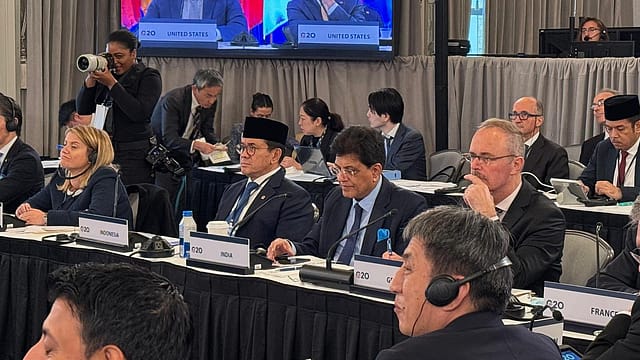
The G20 Trade Ministers’ meeting in Milwaukee was supposed to be about global trade. But listen closely to what Piyush Goyal said there, and a broader picture emerges: food security, trade rules, India’s policy space, the EU, the US and the future of global supply chains. India’s Commerce and Industry Minister was in Milwaukee for the two-day G20 Trade Ministers’ meeting on September 30 and October 1, hosted by the United States under its 2026 G20 presidency. Alongside the formal discussions, Goyal held bilateral meetings with counterparts and US business leaders.
So, what exactly did Goyal say?
What did Piyush Goyal say about food security at the G20?
Food was one of the most closely watched subjects at the meeting, particularly after the US put the “weaponisation” of food trade on the G20 agenda. Speaking at a session titled “Weaponization of Food through Coercive Trade Action”, Goyal said India wanted food to remain linked to security and cooperation rather than become a tool of coercion. “Highlighted that our shared objective must be to ensure that food remains a source of security, stability and cooperation,” Goyal said in a post on X, as reported by ANI.

Losing Memory
16 Oct 2026 - Vol 05 | Issue 42
The making of a medical and social emergency
He also stressed that there should be a distinction between countries using legitimate measures to protect domestic food security and the weaponisation of food supply chains. “Also, underlined that we must clearly distinguish between the weaponisation of food supply chains and legitimate measures adopted by countries to pursue domestic policy objectives and address food-security needs,” he said.
The distinction matters because food and agricultural trade can intersect directly with a country’s domestic food-security policies. India has also consistently sought policy space for developing countries in multilateral trade negotiations. The Commerce Ministry said ahead of Goyal’s visit that India would push for a rules-based, open, inclusive and non-discriminatory trading system with the WTO at its core.
What did Goyal say about the India-EU FTA?
The G20 meeting was also an opportunity for India to take stock of its trade negotiations beyond the US. Goyal met European Commissioner for Trade and Economic Security Maroš Šefčovič on the sidelines and said the two sides reviewed progress on the India-EU Free Trade Agreement. “Reviewed progress towards the signing and entry into force of the India-EU FTA,” Goyal said.
He added that they discussed the India-EU Trade and Technology Council, WTO reform and shared G20 priorities. The EU track was also visible in Goyal’s meeting with Polish Finance and Economy Minister Andrzej Domański. Goyal said the two discussed ways to strengthen India-Poland trade and investment and how the proposed India-EU FTA could create new business opportunities.
What did Piyush Goyal say about the India-US trade deal?
Then came the issue likely to attract the most attention in Washington and New Delhi: the India-US trade agreement. Goyal met US Trade Representative Jamieson Greer on the sidelines of the G20 meeting and described the discussion as productive. “Had a productive discussion with USTR Greer towards early conclusion of a mutually beneficial interim agreement under the India-US Bilateral Trade Agreement,” Goyal said in a post on X. He also said the two sides exchanged views on the G20 discussions under the US chairship.
The meeting came as India and the US continue negotiations on an interim arrangement under the broader Bilateral Trade Agreement. The Commerce Ministry had said before Goyal’s visit that his US engagements would focus on advancing a “balanced and mutually beneficial” agreement.
What did Goyal say about India’s relationship with US businesses?
Goyal’s G20 schedule was not limited to ministers and negotiating tables. Before the trade ministers’ meeting, he met CEOs and senior executives of American manufacturing and technology companies at a National Association of Manufacturers roundtable in Milwaukee.
The message was that India-US economic ties should go beyond simply buying and selling goods. According to the Commerce Ministry, Goyal highlighted investment, manufacturing, technology, innovation, resilient supply chains and the creation of high-value capabilities in both countries. He also said the Indian government was ready to facilitate companies looking to operate, expand and invest in India.
What did Goyal discuss with Poland and Brazil?
The G20 also became a platform for India’s wider trade diplomacy. Goyal met Poland’s Domański and Brazilian Foreign Minister Mauro Vieira on the sidelines. With Poland, he discussed trade and investment and the opportunities that could emerge from the India-EU FTA. With Brazil, the focus was on strengthening bilateral trade and economic cooperation.
That is important because the Milwaukee meeting was not only about the formal G20 agenda. For India, it also provided a setting to engage several major trading partners at a time when global trade rules, tariffs and supply chains are being renegotiated.
What was the bigger message from Goyal at the G20?
Put the remarks together and the thread is fairly clear. Goyal’s G20 interventions touched on food security, trade rules, the WTO, India-EU trade, the India-US trade agreement, investment and resilient supply chains. India’s stated position going into the meeting was that the multilateral trading system should remain rules-based and that developing countries should retain adequate policy space. At the same time, Goyal used the US visit to pursue bilateral opportunities with Washington, Brussels-linked partners, Brazil and American businesses. And that may be the most revealing part of his Milwaukee visit.
The G20 meeting was about global trade. Goyal’s schedule showed how India is trying to navigate that changing landscape on several fronts at once — from food and WTO rules to the EU, the US and the companies that want to build their next supply chains in India.
(With inputs from agencies)