Palestine envoy's message to India: Use Israel ties to push for a two-state solution
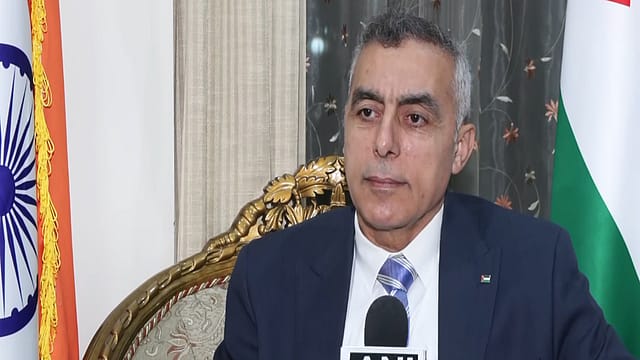
India does not have to choose between Israel and Palestine. That, in essence, is the message Palestinian Ambassador to India Abdullah M Abu Shawesh has delivered amid a debate over New Delhi's foreign policy following Rahul Gandhi's recent remarks on the Gaza conflict.
In an interview with ANI, Abu Shawesh said Palestine had never objected to India's sovereign decision to maintain diplomatic and strategic relations with Israel. In fact, he argued, those very ties could become an opportunity to advance Palestinian interests, revive the peace process and work towards a two-state solution.
His intervention offers an interesting counterpoint to the familiar argument that India's growing partnership with Israel necessarily comes at the expense of Palestine.
Why Palestine wants India to use its relationship with Israel
Abu Shawesh said Palestine's position had remained consistent across successive Indian governments: New Delhi should use its relationship with Tel Aviv to help secure a political settlement. “Our opinion used to be, still is, and will continue to be that India is a great country. India having good relations with Israel, we will and we can utilise it,” he told ANI, referring to the two-state solution and the broader peace process.

Anatomy Of A Stillborn Revolution
20 Nov 2026 - Vol 01 | Issue 01
Whatever Happened To The Cockroach Janta Party?
The ambassador also recalled that when India established full diplomatic relations with Israel in January 1992, the Congress government under Prime Minister PV Narasimha Rao had consulted Palestinian leader Yasser Arafat. India's Ministry of External Affairs had subsequently stated that the decision was taken in consultation with Palestinian leadership.
The point Abu Shawesh was making was clear: Palestine respects India's right to determine its foreign policy and does not expect New Delhi to abandon a relationship it considers strategically important.
What Rahul Gandhi said about India's Israel policy
The ambassador was responding to Rahul Gandhi's November 19 interaction with political scientist Robert Pape at the University of Chicago, titled The Iran War and India's Role in the World. The Leader of the Opposition said India should maintain strong relations with Israel, including defence cooperation, but should not allow those ties to dictate its position on Gaza.
Gandhi condemned the October 7, 2023 Hamas attacks and Israel's subsequent military campaign, arguing that one act of violence could not justify another. He also said India's foreign policy should be guided by its national interests rather than the preferences of other countries.
Abu Shawesh said he respected the right to condemn the October 7 attacks, but argued that the Palestinian conflict could not be understood by beginning its history on that date.
Gaza, genocide allegations and the West Bank crisis
The ambassador strongly rejected descriptions of Israel's campaign in Gaza as simply military action or violence, calling it a “textbook genocide”.
His characterisation comes amid serious findings by international investigators. In September 2025, the UN Independent International Commission of Inquiry concluded that Israeli authorities and security forces had committed genocide against Palestinians in Gaza. Its October 2026 report said genocidal acts were continuing. Israel has rejected genocide accusations. The separate case brought by South Africa against Israel at the International Court of Justice remains pending; the court has not issued a final ruling on whether genocide occurred.
Abu Shawesh also pointed to escalating settler violence in the occupied West Bank. His remarks came days after Israeli opposition leader Gadi Eisenkot condemned attacks on Palestinian villages as “Jewish terrorism”, according to Reuters.
Can India's strategic ties become a diplomatic advantage?
For Abu Shawesh, India's relationship with Israel is not the obstacle to Palestinian statehood. The question is whether New Delhi can turn its diplomatic access and strategic influence into meaningful pressure for peace.
It is an argument that places India's long-standing support for a two-state solution alongside its expanding defence and diplomatic partnership with Israel. Whether that influence can translate into progress remains uncertain, but the ambassador has made his preference clear: he wants India to use its connections.
(With inputs from ANI)