Trump warns Democrats could undo US gains against Iran, says war funding secured till January
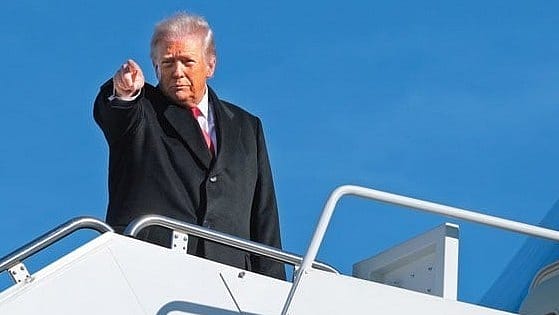
Donald Trump says the United States has the financial backing to sustain its military campaign against Iran until the end of January, but warned that political opposition in Congress could threaten what he calls a military victory. The remarks come amid renewed uncertainty over Washington's next move in the conflict, with diplomacy and the possibility of further strikes both in play.
In an interview with the New York Post, Trump said Democrats could turn what he described as a “total win” into a “loss” if they attempt to restrict or halt the military campaign after gaining control of Congress. “We're funded through January,” Trump said, suggesting that the administration has a window to pursue its objectives before congressional opposition could potentially complicate its plans.
Anatomy Of A Stillborn Revolution
20 Nov 2026 - Vol 01 | Issue 01
Whatever Happened To The Cockroach Janta Party?
Trump warns Democrats could turn Iran military victory into a defeat
Trump argued that the US military had inflicted significant damage on Iran's military infrastructure and leadership, claiming that the campaign had substantially weakened Tehran's capabilities.
He cautioned that a change in congressional political dynamics could undermine the progress Washington believes it has made. His comments come as the administration faces questions about how it intends to balance military pressure with negotiations to end the conflict.
Trump has maintained that preventing Iran from acquiring nuclear weapons, rather than overthrowing its government, is the primary objective of the American campaign.
Speaking to the New York Post, he said regime change was not a central consideration for him, even as he acknowledged that Israel's objective of removing the Iranian leadership could potentially be achieved.
Trump insists Iran nuclear deal must be permanent
Despite the military rhetoric, Trump has repeatedly signalled that he remains open to a negotiated settlement with Tehran.
In a Fox News interview on Saturday, he said any agreement would have to ensure that Iran could not acquire nuclear weapons, regardless of who occupies the White House in the future. “I'm going to make a deal that is going to be permanent. I’m not going to let somebody allow them to have a nuclear weapon,” Trump said.
He also described Iran's new leadership as more rational than its predecessors, while questioning whether Tehran could be trusted to honour an agreement. Trump alleged that Iranian officials had previously entered into agreements only to subsequently violate them.
Trump links Iran negotiations to gasoline prices
Trump has also tied the outcome of the conflict and negotiations with Iran to the cost of gasoline in the United States, an issue with direct implications for American households.
Following his visit to China, Trump criticised Tehran's negotiating approach, arguing that Washington wanted a substantive agreement rather than one that failed to address its concerns. “The prices of gasoline now, that also depends on how we settle up with Iran. They want to make a deal, but they don't want to make a deal that's acceptable to me. We want a real deal, not a fake deal that they've been doing for 51 years,” he said.
Trump also argued that Iran should bear the financial costs arising from the confrontation, countering Tehran's position on compensation.
Netanyahu reportedly pushes Washington towards renewed strikes
The diplomatic uncertainty is accompanied by reports of renewed military planning. Israeli Prime Minister Benjamin Netanyahu has reportedly urged the US administration to consider further military action against Iran, amid concerns over Tehran's military capabilities.
Reports by CBS News have also indicated that Washington and Israel have been weighing the possibility of another assault, although Trump has offered no definitive timeline for any fresh offensive.
The US president's latest remarks suggest that the administration is keeping both military pressure and negotiations on the table, while the funding timeline and political dynamics in Washington could become increasingly important in determining how the conflict unfolds.
(With inputs from ANI)