Pakistan’s March to Doom: Deadly Crackdown in PoJK Protests Exposes Economic Crisis and Political Unraveling
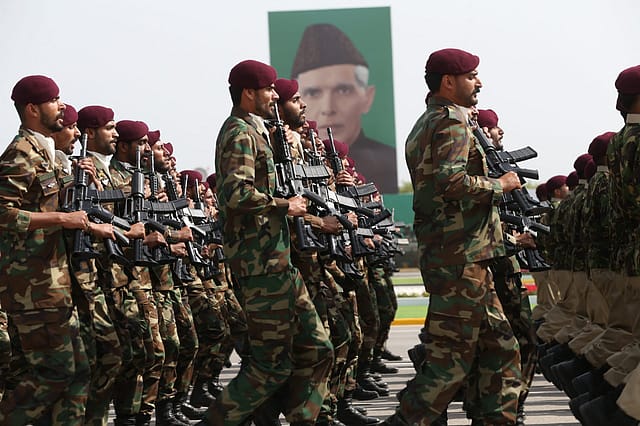
The killing of 30 protesters in Rawalakot in Pakistan Occupied Jammu and Kashmir (PoJK) last week marks another turning point in Pakistan’s-blood stained history. To make matters worse, Islamabad chose to hold elections in the region even as its shock troops were massacring protesters. The formula of musical chairs—replacing a discredited set of local elites—even as a vicious crackdown eliminates “mischief mongers” is a patented Pakistani invention.
In Rawalakot and elsewhere in PoJK, the task of channelling popular demands fell to the Joint Awami Action Committee (JAAC); the local elite, not truly representative of local opinion and political choice, atrophied a while ago. The JAAC has now been described as an Indian creation. Never mind the fact that JAAC has been at the forefront of highlighting economic problems since 2024.
The Vanguard
21 Aug 2026 - Vol 05 | Issue 34
BJP Rearmed for 2029
The immediate cause for the protests was the high inflation in the prices of flour, electricity and other items of daily consumption. Inflation, however, is never a cause for mass unrest; it is only a topping to more severe economic problems that often go unnoticed. Danish Khan, a Pakistan scholar, recently noted how systematically PoJK diverges from the formal, recognised, provinces of Pakistan. The distinction is important. Khan noted that PoJK has a labour force participation rate (LFPR) of just 22.9 per cent, half of Pakistan’s national average. LFPR is defined as is the percentage of the working-age population that is either employed or actively seeking employment. For women in PoJK, the LFPR stands at 7.9 per cent against Pakistan’s national average of 23 per cent. In effect, there is no work available in PoJK. The mainstay of its economy, unsurprisingly, is agriculture. Migration, remittances, and discretionary fiscal transfers from Islamabad then acquire a lifeline like characteristics.
High unemployment, the domination of a low productivity sector (agriculture in this case) and an inflationary shock are a classic recipe for political unrest. This is a well-known and empirically established pattern across the world. That is why governments everywhere take care to crease out these factors from day-to-day life. In places where unemployment cannot be sorted out—due to the persistence of low productivity sectors or inability to switch to higher productivity sectors—governments take care to ensure that flow of goods remains unimpeded and price shocks don’t affect people in such regions. Elevated levels of subsidies are often necessary for political stability (especially in non-democracies).
Is this protest different?
Normally, political volatility due to economic reasons can be sorted by a mix of economic and political means. Powers that be can smooth the flow of goods and services to affected areas even as careful outreach to local political elites can restore normalcy.
In today’s Pakistan, both options are absent. Pakistan’s long-standing economic problems are well-known. The country follows a pattern of moderate economic growth followed by a spell of elevated inflation. Usually, such cycles are followed by an approach to the International Monetary Fund (IMF) that supplies a stabilisation package followed by reduced economic growth. The cycle then begins all over again. These cycles have become progressively shorted in the last one-odd decade even as the country’s debt has zoomed out of control. External shocks like Covid19 and now the war in West Asia are now coeval with political upheaval in the country. The ouster of Imran Khan in 2022 and the violence by supporters of the Pakistan Tehreek-e-Insaaf (PTI) supporters on 9th May, 2023 took place during the penumbra of the Covid19 pandemic. The protests in PoJK are occurring during the war in West Asia. It is obvious that cause and effect are often complicated in such events, but the correlation between external shocks and political upheaval in Pakistan is unmistakable.
The real trouble for Pakistan is its inability to solve political problems by political means. This is a deep pattern in the country’s history that goes back all the way to its birth. Its elite ultimately resorts to use of military means to solve political problems. This is never a formula for stability.
This trend remained masked for a while, at least until leaders with real political experience were around. To give two famous turning points: On 24th March, 1948, Muhammad Ali Jinnah told an audience in Dhaka that Urdu would be the national language of Pakistan. This did not go well with Bengalis who were proud of their language and marked the beginning of the quest for preserving their identity. Three days later, when he was back in West Pakistan, Mir Ahmad Yar Khan, the Khan of Kalat was forced to sign the Instrument of Accession, forcing the merger of his state—the largest part of Balochistan—into Pakistan. The Khan of Kalat was primus inter pares among the sirdars of Balochistan. That single week proved monumental in Pakistan’s history. East Pakistan seceded in 1971 while Balochistan has remained ungovernable for the most part since 1947. In both cases, a “military solution” was sought where a political solution was required. That did not work.
That lesson was never learnt. Now the same mistake is being made in the case of PoJK, an area that should ideally have been the most inalienable part of the geographic area that Pakistan controls. PoJK was famously held out not just as a physical frontier but an “ideological frontier” that separated Pakistan from India. And yet, here we are: the JAAC is now being called a creation of India even as the bullets are being used to silence voices there. The contrast with India could not be starker. The single largest agitation in recent memory in New Delhi passed away without loss of life. The people of Jammu and Kashmir (J&K) remain absorbed in their own life and are moving forward, barring the occasional disturbance by terrorists dispatched from Pakistan. The homeland for the Muslims of the Subcontinent was an illusory idea back in 1947; it is now unravelling, one piece of territory at a time.