Over 10,000 Troops, Dozens of Ships Enforce US Blockade of Iranian Coastline: CENTCOM
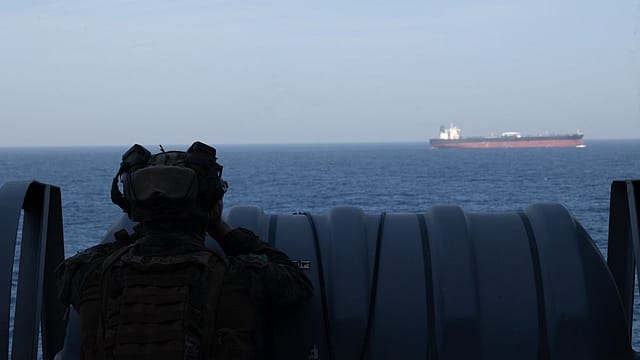
The US Central Command (CENTCOM) on Thursday (US time) said that US forces are actively enforcing a large-scale maritime blockade targeting Iran's ports and coastline, involving more than 10,000 personnel, over a dozen naval vessels, and upwards of 100 aircraft.
In a post on X, CENTCOM said, "USS Abraham Lincoln (CVN 72) transits the Arabian Sea as the United States blockades Iran's ports and coastline.”
The deployment includes the USS Abraham Lincoln (CVN 72) operating in the Arabian Sea, highlighting the scale of the US naval presence in the Iranian waters amid escalating tensions.

Zeroing In on ECI
09 Oct 2026 - Vol 05 | Issue 41
Constitutional legitimacy versus political opportunism
In another update, CENTCOM added, "Sailors aboard guided-missile destroyer USS Delbert D Black (DDG 119) stand watch as US forces remain vigilant and enforce the blockade against ships attempting to enter or depart Iranian ports and coastal areas."
What Did US President Trump Say About the Iran Blockade in the Strait of Hormuz?
The USS Delbert D Black (DDG 119) is among the warships tasked with monitoring and intercepting vessels in the vicinity of Iranian waters.
Meanwhile, US President Trump highlighted ongoing US military measures in the region, particularly the blockade in the Strait of Hormuz.
"We're doing very well with the blockade. It's very routine for us. The Navy's incredible, and I think the blockade is doing very well. No ship is even thinking about entering. No ship is going past our Navy," he said.
Earlier on Thursday, the United States categorically said that its naval blockade in West Asia applies to Iranian ports and coastline and is not a blockade of the Strait of Hormuz.
The remarks were made by Chairman of the Joint Chiefs of Staff, Air Force Gen. Dan Caine, while speaking to the media.
Does the US Blockade on Iran Apply to All Ships Regardless of Nationality?
Gen Caine underlined that the blockade applies to all ships- irrespective of their nationalities.
"Let me be clear- this blockade applies to all ships, regardless of nationality, heading into or from Iranian ports,” Gen. Dan Caine said.
“The US action is a blockade of Iran's ports and coastline, not a blockade of the Strait of Hormuz. Enforcement will occur inside Iran's territorial seas and in international waters,” he added.
He said that, along with the blockade, the joint force would actively pursue any Iranian-flagged or any vessel attempting to provide material support to Iran, which would include dark fleet vessels carrying Iranian oil.
In addition to this, the blockade, the joint force, through operations and activities in other areas of responsibility- like the Pacific area of responsibility under the command of Admiral Paparo, will actively pursue any Iranian-flagged or any vessel attempting to provide material support to Iran. This includes dark fleet vessels carrying Iranian oil.
As most of you know, dark fleet vessels are those illicit or illegal ships evading international regulations, sanctions or insurance requirements.
He emphasised that during this pause, the United States joint force remains postured and ready to resume major combat operations at "literally a moment's notice".
(With inputs from ANI)