Nirmal Purja Climbed to Prove Nothing was Impossible. A Nation Ran to say Thank You
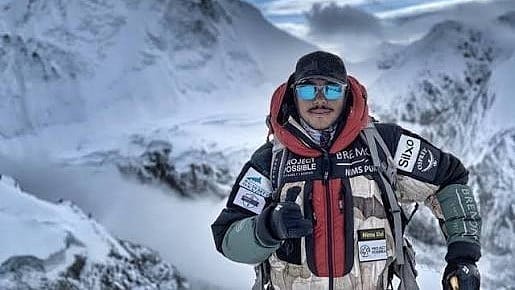
Nobody won Saturday's race. Hundreds ran through the streets of Kathmandu.
But when they reached the finish line at the Boudhanath Stupa, nobody celebrated. Instead, they lit butter lamps. They stood in silence. Before them were photographs of six men who had spent their lives climbing towards the sky but never came home from Broad Peak. For two minutes, an entire city stood still.
The "Tribute Run 5K", organised in Kathmandu on Saturday morning, was unlike any marathon. It began at Baluwakhani Community Park and ended at the UNESCO World Heritage Site of Boudhanath Stupa, where runners gathered before portraits of British-Nepali mountaineer Nirmal Purja, Nima Sherpa, Nawang Thindu Sherpa, Pur Bahadur Gurung, Kili Pemba Sherpa and Gyalu Sherpa. They lit butter lamps, observed a two-minute silence and remembered the climbers who died in the Broad Peak avalanche at the end of July.

Losing Memory
16 Oct 2026 - Vol 05 | Issue 42
The making of a medical and social emergency
"We will be remembering all our heroes throughout our lives," Ayush Tamang, a member of the organising committee, told ANI.
For Nepal, that word carried weight: Heroes. Because these were not just mountaineers. They were men who carried Nepal's flag to the highest places on Earth.
Even now, the tragedy remains unfinished. According to ANI, seven bodies have been recovered from Broad Peak. Three still remain on the mountain. Only one climber, ten-time Everest summiteer Pur Bahadur Gurung, has so far been brought home and given a funeral. Others are still waiting to return to the country they represented with such pride.
To understand why Nepal gathered to mourn, however, one has to understand the man who stood at the centre of this expedition.
Nirmal "Nims" Purja never liked the word impossible. Long before the world knew him as one of history's greatest mountaineers, he had already lived one extraordinary life. He joined the British Gurkhas as a teenager before becoming the first Gurkha to enter Britain's elite Special Boat Service, one of the world's toughest special forces units, according to BBC Sport.
Most people would have called that enough. Purja was just getting started. When he announced his audacious plan to climb all 14 of the world's mountains above 8,000 metres in less than seven months, almost everyone thought he was chasing fantasy. The existing record had taken nearly eight years.
So, he named the expedition Project Possible. Not because it was. Because he intended to prove it was. To finance the dream, he mortgaged his own house after struggling to convince sponsors that the challenge could be done, Reuters reported in 2019. Six months and six days later, he had rewritten mountaineering history. The achievement transformed him into a global icon and inspired the Netflix documentary 14 Peaks: Nothing Is Impossible. Yet, if you listened to Purja, the mountains were never really the point. "It's not about mountain climbing," he told BBC Sport in 2021. "It's about following your goals."
Perhaps his greatest mission wasn't breaking records. It was changing perceptions. For decades, Sherpas were celebrated only in passing, often reduced to anonymous figures in someone else's adventure. Purja wanted the world to know their names. "What I have heard most of the time is, 'My Sherpa helped me'," he told the BBC. "That is wrong, because he has a name." That philosophy shaped everything he did. His famous Everest photograph exposing the dangerous traffic jam near the summit forced the world to confront overcrowding on the mountain. The image became one of the defining photographs in modern mountaineering, sparking a global conversation about safety on Everest.
Even after rewriting history, Purja never stopped climbing. Broad Peak became his final mountain. Last week, an avalanche swept through his expedition team on the world's 12th-highest peak in Pakistan. Reuters reported that Purja and nine fellow climbers from Nepal, Pakistan, China, Oman and the United States were killed in one of the deadliest Himalayan disasters in recent years.
The loss reverberated far beyond Nepal. Tributes arrived from governments, mountaineers and military veterans across the world. Many remembered not only his extraordinary achievements but also the inspiration he gave to an entire generation that had grown up believing limits existed only until someone challenged them.
Back in Kathmandu, though, grief looked quieter. There were no speeches filled with statistics. No grand declarations. Just runners. Butter lamps. Prayer. And silence.
"All those who died in the Broad Peak avalanche are our national heroes," Ayush Tamang told ANI. "They have contributed a lot in terms of tourism as well as made Nepal and Nepali proud. They will live in our lives forever."
By the time the ceremony ended, the runners slowly drifted away. The butter lamps kept burning. The photographs remained. And somewhere, high on Broad Peak, the mountain still held on to some of the men Nepal is waiting to bring home. Nirmal Purja once set out to prove that nothing was impossible.
On Saturday, Nepal reminded the world that some journeys never truly end.
(With inputs from ANI)