New Species, Ancient Bones: Inside the Ocean's Largest Whale Graveyard
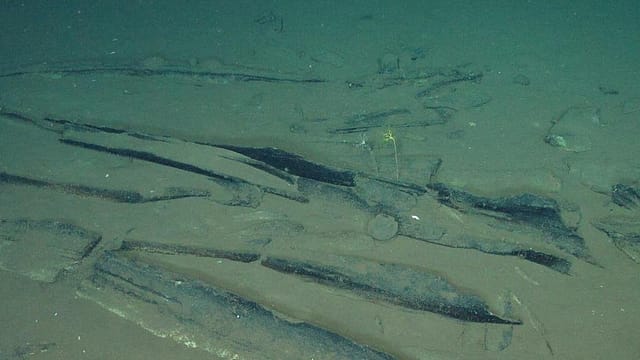
Chinese researchers have discovered the world's largest whale graveyard at the bottom of the Indian Ocean.
Stretching across a vast underwater corridor west of Australia, the site holds nearly 500 fossil sites, creatures potentially new to science, and bones dating back millions of years.
It is one of the most significant oceanographic finds in modern history.
What Is a Whale Graveyard?
When whales die at sea, their bodies sink to the ocean floor in an event scientists call a whale fall.
These carcasses become self-contained ecosystems, feeding deep-sea creatures for decades.
A whale graveyard is where large numbers of these falls accumulate, creating an unusually rich biological zone on an otherwise dark ocean floor.
Greening the Future
23 Jul 2026 - Vol 05 | Issue 30
Securing a sustainable India
Where in the Indian Ocean Was It Found?
The graveyard sits in the Diamantina Zone, west of Australia. It spans a 1,200-kilometre corridor of bones, making it the largest such site ever recorded on Earth.
How Old and How Deep Does It Go?
This is the deepest and oldest known whale graveyard on the planet. Some fossils date back 5.3 million years, with remains found at depths of up to 7,000 metres.
Researchers from the Chinese Academy of Sciences conducted 32 submersible dives in 2023, collecting samples from 485 from whale fall sites.
What Kind of Life Has Been Found Among the Bones?
According to the Nature study, researchers observed jellyfish, worms, snails, crustaceans, brittle stars, and molluscs living off recent carcasses, many believed to be entirely new to science.
A previously unknown extinct species of beaked whale was also identified among the fossils.
Could More Whale Graveyards Be Hiding Elsewhere?
The study suggests other graveyards may exist off South Africa, the Iberian peninsula, and the Crozet islands. Scientists are now calling for dedicated expeditions to locate them.
Why Should the World Care About This?
According to lead author Xiaotong Peng of the Chinese Academy of Sciences, the region is estimated to hold roughly 6.7 million tonnes of sequestered carbon, making whale falls an underestimated factor in global climate calculations, as per RTE news.
The site also suggests these ecosystems serve as biological bridges connecting isolated deep-sea communities across vast distances.
(With inputs from yMedia)