‘Never Underestimate Trump’: Seema Sirohi on US Midterms & India’s Waiting Game
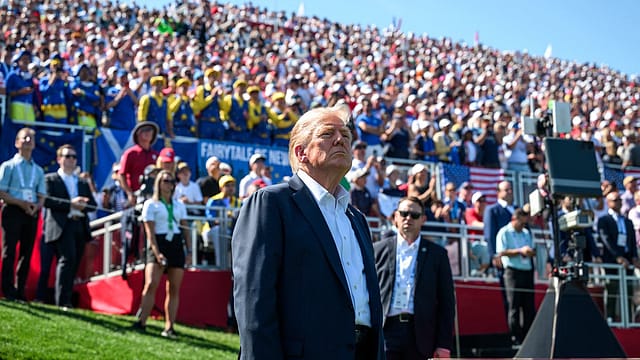
Donald Trump is campaigning almost every day. Seema Sirohi has a warning for anyone already writing his political obituary: “Don’t ever underestimate Trump.”
With the US midterms approaching, the Washington-based journalist sees a test of the president’s reputation, his legacy and his ability to persuade Americans that wars abroad are not hurting their lives. Even with polls pointing to Democratic gains, she cautions that the results could spring a surprise.
For India, the uncertainty stretches well beyond election night. Sirohi describes a partnership strained by tariffs, H-1B restrictions, anti-immigrant sentiment and the language of Trump’s officials. New Delhi needs American investment, technology and market access. Its response, she argues, is to bide its time and hope for a different president.

Look Who's Talking Regime Change
23 Oct 2026 - Vol 05 | Issue 43
That hope comes with a qualification. “I don’t think we are going back to the good old days,” she says. India and Indians, in her assessment, must prepare for an America that is less friendly and less welcoming.

Sirohi has covered Washington for more than three decades and is the author of Friends with Benefits: The India-US Story, which traces the transformation of two estranged democracies into partners. In this interview with Open Digital, she examines the strains on that relationship, China’s leverage over Trump, Netanyahu’s uncertain electoral prospects and the limits of India’s growing confidence on the world stage.
Question: The U.S. midterm elections are around the corner, and according to a CBS News poll, the Democrats are projected to win 229 seats in the US House of Representatives. How crucial is this election for President Trump, and what is at stake for him and his party?
Answer: I think a lot rides on this election for the President, because he has been campaigning hard. He is going to a different place every day to rally people, and almost all the polls show that the Republicans will lose the House and might even lose the Senate. So it is a big thing.
There is a lot of money flowing into this election. As you know, Elon Musk has put in $276 million since July. So yes, for President Trump it is very important, because his legacy and his reputation will be tested, as will his attempt to tell voters that the war is not affecting their lives.
Question: Washington has accused Canada of trying to influence the US election, having earlier pointed to Russia. With Trudeau gone and Mark Carney in office, where do US-Canada relations stand, and where are they headed?
Answer: I think US-Canada relations are in a tough spot because President Trump has unleashed a barrage of tariffs and has tried to goad Canada in so many different ways. He wants to change the name of everything. He wants them to become the 51st state. That is very insulting for any democracy. The Canadians have been quite tolerant, but I think the relationship is not in a good place.
The US and Canada were so close that there was never any difference of opinion. Now there are plenty.
Question: Since Prime Minister Narendra Modi took office in 2014 and through Trump’s return, how has the India-US relationship evolved? Has it become more transactional under Trump? And given shared concerns about China, how should India balance its strategic partnership with Washington against its own economic interests?
Answer: For India, the US is a very important partner. It is India’s largest export market and a very large source of foreign direct investment. So India does not want to pick a fight with the US unless absolutely necessary. China, as we know, is on India’s border. It is claiming all kinds of territory. So China is never going to be a partner in development for India.
For India to become a developed country, it needs Western technology and investment. That is very clear. What the Government of India is doing is biding its time and hoping that the next president will be different.
But there is no doubt that the relationship is in a very difficult place politically, even for India, because of all that has happened in the past 18 months: the tariffs and the language that some of Trump’s officials have used. The H-1B visas, the anti-immigrant feeling, and all of that. So it is not in a good place right now.
Question: How do you see China’s response to Trump’s tariffs and confrontational approach, and what leverage does Beijing have in dealing with Washington?
Answer: China is not holding back. China slapped back tariffs on the US. That is why Trump is treading softly around China. Last year, they blocked critical minerals to the United States, and so many industries were affected by that.
They are also blocking tunnel boring equipment to India. They control critical minerals; they have a monopoly. So they can tighten the screws. They are acting very confidently, in my opinion, and treating Trump like a junior partner.
Question: Between the tariffs, the Ukraine war and turmoil across the Middle East, has Trump’s approach done lasting damage to the global order? How hard would it be for his successor to undo it?
Answer: There is no question that Trump has been extremely disruptive. He has insulted allies. He has put pressure on partners. Countries that were in his corner are having second thoughts, and they are trying to do different things. So yes, the world order has been disrupted in a manner that cannot be easily fixed.
I don’t think one should assume it will be happy days again after the next presidential election. Even if a Democratic president comes, certain things have happened in American society, especially social developments such as the anti-immigrant feeling and the H-1B problem. I don’t think we are going back to the good old days. That is not going to change. So India and Indians must prepare for an America that is less friendly and less welcoming.
Question: Lula has won a fourth term in Brazil, and he is seen as someone who takes on the Trump administration. What does his win mean for India and the Global South, and does it embolden BRICS as a bloc against the West?
Answer: I don’t think it is wise to analyse world affairs in terms of taking on, beating down and fighting back, especially when you don’t have leverage. Only China can talk this language and actually mean something. Brazil may have some leverage in certain sectors. But yes, maybe Lula’s victory marks the beginning of a trend in which the right wing is being stopped by the left wing. Let’s see what happens in Israel’s election.
Question: Do you think Netanyahu is going to make a comeback or lose the election?
Answer: God, nobody knows. It is neck and neck. The polls are suggesting a dead fight in Israel. And look at the midterms. Even with all the predictions of the Democrats winning in the US, don’t ever underestimate Trump. The results could be much different from what is being projected.
Question: India now hosts major global summits as chair of various forums. After decades of covering foreign policy, do you see a major challenge emerging for New Delhi in the near future? And has India become more confident over the years?
Answer: I think India is much more confident. It has a stronger economy, it can speak on the world stage, and people listen. That wasn’t the case when I started. At that time, India was a non-aligned country, always doing the rhetoric but with no action. That has changed somewhat. But I think it still needs to do a lot more.
Question: Protests are spreading across Europe, with Italy, France and Belgium among them, and we have seen youth-led protests in South Asia as well. Governments have fallen in several countries after this uproar. How important is India’s stability to the region and to the Global South?
Answer: I think the Government of India is quite stable. Protests have their own space, and they are legitimate. The grievances are legitimate, too. The government has used somewhat of a heavy hand, but I don’t think it is in the realm of falling or anything like that. It does create some image issues abroad, though. They have to think about that. But mostly my sense is that the BJP officially doesn’t care about what foreign newspapers write and what governments say.
Question: Looking back on your years of covering foreign affairs, how has your experience as a journalist changed over time?
Answer: Access is much more difficult now than it used to be. I was just going through some old papers I found, stuff that I still have in India. There were these little tags from the Prime Minister’s trips. Now no journalist gets invited except the agencies. So it is very different now.