Netanyahu urges Likud voters to turn out as Israel election sees record-high early participation
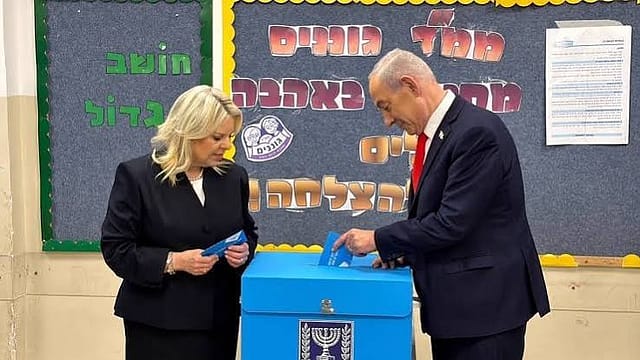
Israel’s Election Day has turned into a battle over who shows up at the ballot box. Prime Minister Benjamin Netanyahu is urging supporters to vote for his Likud party, warning that strong participation among Arab Israeli voters could reshape the country’s next government. His challenger, former military chief Gadi Eisenkot, is asking voters to help take Israel in a “new path”.
In a series of posts on X on Tuesday, October 27, Netanyahu cast the contest as a fight for the country’s future and accused political opponents of threatening the electoral process. His claims about election interference and the role of Arab Israeli voters were not independently established in the material cited here.

Look Who's Talking Regime Change
23 Oct 2026 - Vol 05 | Issue 43
Why is Netanyahu warning Likud voters about Arab turnout?
“We're at war for our home. Muslim Brotherhood supporters are raiding the polling stations and stealing the elections. Go out and vote, recover it!!" Netanyahu stated in a post. He followed that message with a warning about queues at polling stations in Arab-majority communities, urging right-wing voters to mobilise friends and relatives.
"Huge lines at polling stations in the Arab sector," Netanyahu posted. "If we don't wake up now, we'll find ourselves with a government of Mansour Abbas and Ahmed Tibi. This is the time to wake up and act! Call your family and friends now, go together to the polling stations and vote Machal."
Netanyahu also singled out Rahat, a predominantly Bedouin city in southern Israel, as he pressed his supporters to vote. "This is what's happening today in Rahat," Netanyahu added, emphasising the urgency. "You must not stay at home. Get out urgently to vote Machal. We're in a war for the home!"
In another post, he wrote: "Buses are heading to the polling stations, and huge lines are being reported in the Arab settlements. And meanwhile, the right-wing strongholds are not waking up! If we don't go out to vote now, we'll find ourselves with a government of the Arab parties. We must not stay home. Every vote counts!"
Israel election turnout rises as voters head to the polls
The urgency comes amid a strong early turnout. According to Israel’s Central Elections Committee, 44.9% of eligible voters had cast ballots by 2 pm, compared with 38.9% at the same time during the 2022 election. The Times of Israel reported that this was the highest turnout at that hour since at least 1973.
The contest is widely seen as a test of Netanyahu’s political standing following the October 7, 2023, Hamas-led attacks and the wars that followed. The election will determine the composition of the 120-member Knesset, and coalition negotiations may prove decisive because no single party is expected to secure a majority.
What is Gadi Eisenkot promising if Netanyahu loses?
Eisenkot, who leads the Yashar party, has positioned himself as a central challenger to Netanyahu. After voting with his wife, Hannah, he called for political change. “Taking Israel onto a new path. We will be worthy. I commit,” he said.
In a separate appeal to voters, Eisenkot wrote: “Eizenkot = The Way. There is ONE 'Way' to bring about the change and replace Netanyahu - Straight! It must be the largest party in Israel! On Tuesday, October 27, vote for 'The Way' at the ballot box,”
He also raised concerns about the integrity of the vote, writing, "Attention, they are harming the purity of the elections. Don't let anyone destroy the change."
Why could Arab Israeli voters influence the next government?
Arab citizens make up roughly a fifth of Israel’s population, and their turnout could affect the balance between rival political blocs. Reuters and The Times of Israel reported before election day that Arab political leaders were encouraging participation, with polling suggesting turnout could rise substantially from 2022.
Netanyahu and his wife, Sara, also cast their ballots in Jerusalem. As voting continues, the central question is not only which party wins the most votes, but which combination of parties can assemble the 61 seats needed to govern. The final outcome will depend on both turnout and the coalition negotiations that follow.
(With inputs from ANI)