Netanyahu supports Trump’s Hormuz blockade, Iran says 'ready for war as well as talks'
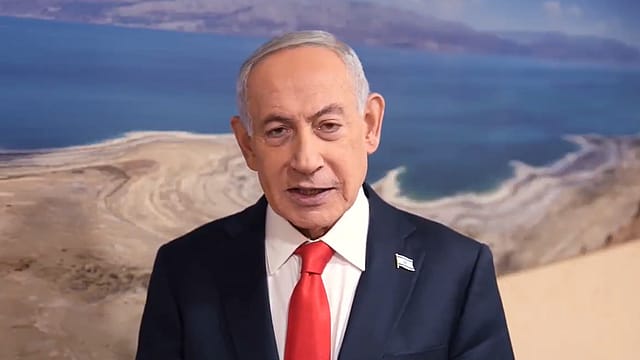
The crisis between United States and Iran has sharply escalated, with Benjamin Netanyahu confirming close coordination with Washington over a sweeping naval blockade, even as Tehran signals both willingness to negotiate and readiness for war.
The developments follow the collapse of high-stakes negotiations and a dramatic announcement by Donald Trump to block all maritime traffic linked to Iran through the critical Strait of Hormuz, a chokepoint for global oil supplies.
Why has the US imposed a naval blockade on Iran?
The blockade comes after negotiations between American and Iranian delegations ended without resolution. Speaking after the breakdown, Trump framed the move as a direct response to Tehran’s actions.
“Iran violated the rules, President Trump decided to impose a naval blockade,” Netanyahu said, backing Washington’s decision.
Trump declared the measure in sweeping terms: "Effective immediately, the United States Navy, the finest in the world, will begin the process of BLOCKADING any and all ships trying to enter or leave the Strait of Hormuz."

Zeroing In on ECI
09 Oct 2026 - Vol 05 | Issue 41
Constitutional legitimacy versus political opportunism
He further expanded the scope of enforcement, stating, "No one who pays an illegal toll will have safe passage on the high seas."
Issuing a stark warning, the US President said any hostile action would be met with overwhelming force: Iranian personnel targeting American or civilian ships would be "BLOWN TO HELL," adding that the US military is "LOCKED AND LOADED" to eliminate the remainder of Iran's military assets.
According to United States Central Command, the blockade specifically targets vessels moving to or from Iranian ports and became operational at 10 am ET on April 13.
How is Israel responding to the US move?
Israel has moved quickly to align itself with Washington. Netanyahu emphasised that coordination between the two allies remains constant and strategic.
"We, of course, support this firm position, and we are in constant coordination with the United States," he said.
The statement underscores the deepening military and diplomatic alignment between Jerusalem and Washington at a time of rising regional instability.
What is Iran’s response to the blockade and failed talks?
Iran has pushed back strongly against the US move, warning that a blockade of the Strait of Hormuz would violate international law while maintaining that it remains open to diplomacy under certain conditions.
Speaking in New Delhi, Iran’s Ambassador to India, Mohammad Fathali, said, "Our high-ranking officials and delegations said that we are ready for peace. We are ready for negotiation. But you should know that, and you should be aware that Iran is also ready for war..."
He added that future talks depend on Washington accepting Tehran’s terms: "We have formally and officially announced that if they (US) accept our conditions, it is predictable that we will have another negotiation."
Fathali also warned that the blockade would breach global norms and reiterated Iran’s control over the waterway: "This Strait is our territorial waters..."
At the same time, he sought to reassure partners, saying Iran would keep the route accessible to friendly nations, including India.
What broader tensions are shaping the crisis?
The current escalation is rooted in long-standing disputes over sanctions, nuclear issues, and regional influence. Fathali pointed to decades of economic pressure on Iran.
"You know that we have been imposed with more than four decades of different kinds of sanctions. At the first time they announced a unilateral sanction, and after that, crippling sanction, and after that, small sanction, and now announce maximum pressure sanction", he said.
He also alleged recent attacks on civilian infrastructure during the conflict: "They attacked us for 12 days, and after that, they accepted a ceasefire. And they announced that we were on the negotiation table. And after that, they attack us. They attacked our infrastructure- schools and hospitals."
Despite these pressures, the envoy said Iran has leaned into self-reliance following guidance from Supreme Leader Ali Khamenei.
"I want to thank the Indian people. They have demonstrated that they are truly reliable and compassionate in times of hardship," he added.
(With inputs from ANI)