Nepal Flood Disaster: 4,451 Rescued, 579 Dead as Race to Find 1,924 Missing in Hydropower Tunnels Intensifies
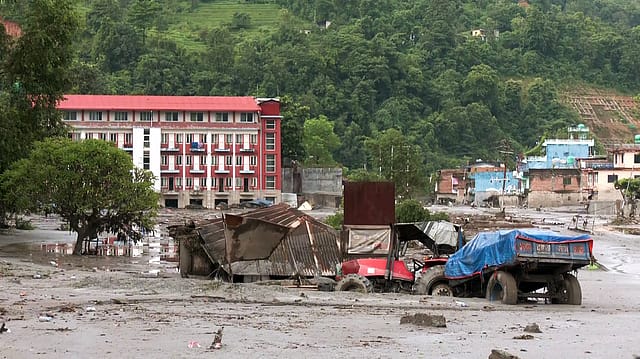
Nepal has pulled 4,451 people from flooded valleys, hydropower tunnels and shattered mountain settlements, but the scale of the rescue is struggling to keep pace with the scale of the disaster.
The official toll from the Bhote Koshi flash flood had climbed to 579 dead and 1,924 missing by Friday evening, according to Nepal’s National Disaster Risk Reduction and Management Authority. The numbers remain fluid as rescuers enter areas cut off by collapsed roads, broken bridges and communication blackouts.
Prime Minister Balen Shah said 15,431 personnel from the Nepali Army, Nepal Police and Armed Police Force had been deployed across Rasuwa and the Bhote Koshi-Trishuli corridor. Sixteen military and privately operated helicopters are supporting the operation.
The mobilisation comes with a grim complication. Nepal is no longer confronting only what the first wall of water destroyed. Debris dumped by the flood has created unstable lakes upstream, leaving rescuers and survivors exposed to another possible surge.

Zeroing In on ECI
09 Oct 2026 - Vol 05 | Issue 41
Constitutional legitimacy versus political opportunism
99 Flights, 517 Air Rescues
Shah said helicopters had completed 99 shuttle flights across Dhunche, Trishuli, Timure and Syabrubesi, rescuing 517 people by air.
Among those brought out were 191 people trapped inside hydropower tunnels. Specialist teams are concentrating on the Upper Trishuli and Rasuwagadhi hydropower projects and other sites where workers may still be stranded underground.
The Prime Minister said the deployment included 6,755 Nepali Army personnel, 4,473 members of Nepal Police and 4,203 Armed Police Force personnel.
Foreign Minister Shisir Khanal told Reuters that Nepal could manage the general search-and-rescue operation but required international assistance in highly specialised areas. These include extracting people from tunnels, restoring transport and communications, identifying bodies, conducting DNA tests and preserving remains.
Kathmandu has also requested ten 70-metre Bailey bridges from India and China. Around two dozen bridges have reportedly been destroyed, severing important routes through the mountainous disaster zone.
Nepal’s message to the world is therefore carefully calibrated: it has the people to search, but needs the technology and engineering to reach places where conventional rescue ends.
India Sends Tunnel Rescue Team
India has rescued 84 nationals, including 63 workers from the Trishuli-I hydropower project and 21 people from Tamil Nadu who have returned home, the Ministry of External Affairs said.
Another 149 Indians stranded on the Chinese side of the border crossed safely into Nepal, while around 400 remained safe in China as Indian officials worked on their evacuation.
But 320 Indian nationals were still missing or uncontactable, according to MEA spokesperson Randhir Jaiswal. Communication failures across the flood zone mean the figure does not necessarily represent confirmed missing persons.
An 11-member Indian medical and tunnel-rescue team has reached Nepal aboard the Indian Air Force’s third assistance flight. The deployment marks a shift from delivering emergency supplies to attempting technically difficult rescues inside damaged hydropower installations.
The Nepal Tourism Board separately said 117 foreign tourists had been rescued by Friday, including 85 Indians, 16 Chinese nationals, nine South Koreans, two Americans and two Italians. Shah subsequently put the number of rescued and identified foreign citizens at 129. The variation may reflect different reporting times and classifications.
Nepal’s foreign ministry has opened an emergency control room to coordinate with embassies and the families of foreign nationals.
The River Threatens to Strike Again
The original catastrophe was triggered when a glacier collapse unleashed a torrent of rock, ice, mud and water through the Himalayan river system, Reuters reported.
The debris then created a barrier lake near the Nepal-China border. When the lake began overflowing, helicopter flights were temporarily suspended and residents along the lower banks were ordered to move uphill.
Chinese state broadcaster CCTV warned that the dammed lake upstream of the Gyirong border port had begun to overflow. The danger extends beyond another flood: unstable slopes could also produce landslides and avalanches.
Nepalese authorities have asked residents along the Trishuli River up to Mugling to remain in safer areas. More than 200,000 SMS warnings have been sent to people in high-risk zones.
The warnings underline the extraordinary difficulty of the operation. Rescue teams are being asked to descend into tunnels and move through ruined valleys while watching the river above them for signs of another attack.
Roads Reopen, But the Corridor Remains Broken
Authorities have opened an alternative light-vehicle route between Rasuwa and Kathmandu, while sections of the Kathmandu-Mugling highway are carrying one-way traffic.
Telecommunication services have been restored at 145 of the 198 affected tower sites. Electricity has returned to nearly 90 per cent of Nuwakot, although restoration work continues in Dhunche.
Six hospitals have been placed on standby. Teams from Bir Hospital, the National Trauma Centre and Dhulikhel Hospital have been deployed, while emergency medical supplies have been arranged for at least 5,000 people.
Water tankers and 900 kg of bleaching powder have been sent to Nuwakot to protect drinking-water supplies. Fuel stocks, including diesel, petrol and aviation fuel, are being positioned to keep rescue vehicles and helicopters operating.
Relief Money Arrives as the Search Expands
The government has disbursed NPR 67.5 million among 15 affected local administrations. Shah said more than NPR 1.9 billion had entered the Prime Minister’s Disaster Relief Fund within 36 hours, while he and his Cabinet would donate one month’s salary.
The government is also preparing a business recovery package for enterprises damaged or erased by the flood.
But recovery remains a distant word along the Bhote Koshi-Trishuli corridor. Nearly 2,000 people are still officially missing. Hundreds of families are waiting for a phone to reconnect, a tunnel to open or a rescue team to return with an answer.
For Nepal, the first battle was against the water. The next is against broken mountains, buried tunnels and time.
With inputs from ANI