Nepal Flash Floods: 105 Indians Reported Missing, Bihar Sounds Alert Along Gandak
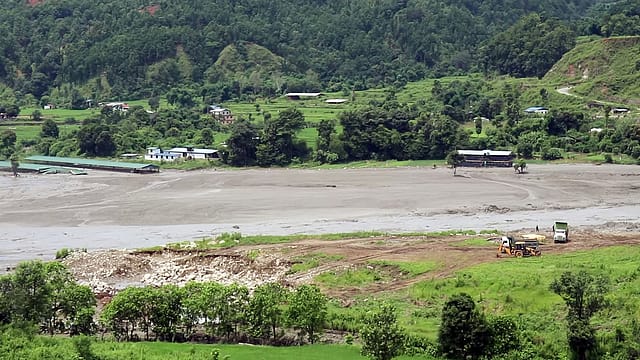
A flash flood that ripped through Nepal’s northern Rasuwa district has rapidly become a cross-border emergency, leaving at least seven people dead, cutting off nearly 400 pilgrims and travellers, and triggering a flood alert hundreds of kilometres downstream in Bihar.
Among those reported missing or unreachable are 105 Indian nationals and 37 NRIs, according to preliminary information released by the Nepal Tourism Board. The travellers were heading towards the Rasuwagadhi border checkpoint for the Kailash Mansarovar Yatra when the Bhote Koshi River surged through the Nepal-China frontier region.
Their whereabouts were still being verified. Officials have stressed that “reported missing” does not necessarily mean the travellers have been swept away or harmed. Roads, electricity and communication links have been badly damaged, making contact with groups trapped in the affected region difficult.
As Nepal deployed helicopters and security forces for rescue operations, Prime Minister Narendra Modi spoke to his Nepalese counterpart Balendra Shah, offered condolences over the loss of lives and said India was ready to provide all possible humanitarian assistance. The crisis has also placed Bihar on guard. With the floodwaters moving through Nepal’s river system and the possibility of increased discharge into the Gandak, Chief Minister Samrat Chaudhary has ordered vulnerable districts to inspect embankments, intensify night patrols and prepare rescue teams.

Zeroing In on ECI
09 Oct 2026 - Vol 05 | Issue 41
Constitutional legitimacy versus political opportunism
What happened in Nepal?
The flood struck the Bhote Koshi River in Rasuwa at around 8.30 am, sweeping through settlements, markets, roads and security installations near the border with Tibet. Drone footage from neighbouring Nuwakot showed widespread devastation, while roads leading to the worst-hit areas were washed away, leaving the disaster zone largely inaccessible by land. The precise cause has not yet been officially established. The Kathmandu Post reported that Nepal’s Flood Forecasting Division had received preliminary information suggesting that a landslide may have blocked a river in Tibet. The accumulated water may then have broken through the obstruction and rushed downstream. Until authorities complete their assessment, however, the landslide theory remains unconfirmed.
At least seven deaths had been confirmed, while 25 people had been rescued by Wednesday afternoon. Nine Armed Police Force personnel posted at Timure, close to the Nepal-China border, were also reported missing. Nepal Police, the Armed Police Force and the Nepali Army have been mobilised for the operation, with 14 helicopters reportedly deployed to search areas that can no longer be reached by road.
Where are the Indian pilgrims?
The Nepal Tourism Board said 384 travellers had been reported missing from the affected areas on the basis of preliminary records supplied by tourism and travel companies. The group included 291 foreign nationals and 93 Nepalese citizens. Among the foreign travellers were 105 Indians, while 37 NRIs were listed separately in records linked to the Himalayan Glacier area. Most were expected to cross the Rasuwagadhi checkpoint as part of their journey towards Kailash Mansarovar.
Authorities are now cross-checking passenger lists and attempting to establish contact through travel operators, guides, local administrations and security agencies. The destruction of roads and communication networks means some travellers may simply be stranded and unreachable. The Indian Embassy in Nepal said it was coordinating with Nepalese authorities to secure the early rescue and relief of affected Indian nationals.
What has India offered?
Modi conveyed India’s condolences during his conversation with Shah and said the country stood firmly with the people of Nepal. “The people of India stand in solidarity with their sisters and brothers in Nepal at this difficult time. India is ready to provide all possible humanitarian assistance to Nepal,” Modi said in a post on X. He added that Indian and Nepalese teams were coordinating closely on rescue and relief operations.
India’s immediate priorities are likely to be locating its nationals, supporting evacuation efforts and providing logistical or humanitarian assistance sought by Kathmandu. The emergency once again underscores the deeply interconnected geography of the two countries. A disaster beginning in the Tibetan Himalayan region can tear through Nepal, isolate Indian pilgrims and send water surging towards the plains of Bihar.
Why has Bihar been placed on alert?
The danger is no longer confined to Nepal’s mountains. Bihar has begun preparing for the possibility that increased water flow from Nepal’s upper catchments could raise the level of the Gandak River. After a high-level review in Patna, Chaudhary directed officials in West Champaran, East Champaran, Gopalganj, Saran, Muzaffarpur and Vaishali to remain vigilant.
These districts lie along or close to the Gandak’s course and can become vulnerable when heavy rainfall or sudden releases upstream send large volumes of water towards Bihar. Officials have been ordered to inspect dams and embankments continuously, reinforce vulnerable stretches and conduct special patrols at night. District administrations must also warn residents in sensitive areas through loudspeakers and other local communication systems. Teams from the National Disaster Response Force and State Disaster Response Force have been deployed for possible rescue and relief operations. No major flooding linked to the Nepal disaster had been reported in Bihar at the time of the review. The measures are precautionary, intended to provide districts with time to act if river levels rise sharply.
Which areas remain at risk?
Nepalese authorities have asked people living along the Trishuli River to leave exposed riverbanks and move towards safer ground. Alerts have been issued across Rasuwa, Nuwakot, Dhading, Gorkha and Chitwan as the flood travels downstream. Officials expect its intensity to weaken as it advances, but damaged infrastructure and unstable riverbanks remain serious threats.
The immediate race is now unfolding on two fronts. In Nepal, rescue teams must reach communities and travellers cut off near the border. In India, authorities must locate the missing pilgrims and prepare Bihar’s river districts before the water arrives. What began as a sudden rupture in a Himalayan river has already crossed the boundaries between a local disaster, a pilgrimage emergency and a downstream flood threat. The next few hours will determine how many of those reported missing are found safe, and whether preparedness in Bihar can prevent the tragedy from travelling farther.
(With inputs from ANI)