Making Common Cause
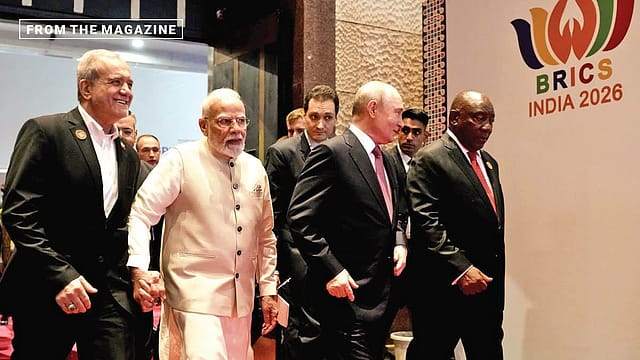
The criticism of “trade restrictive” actions was sharp even aAt a briefing a couple of days after the BRICS summit concluded, Ministry of External Affairs (MEA) spokesperson Randhir Jaiswal’s response to a situation unfolding in the US House of Representatives was pertinent. Asked about the progress of a bill that could give President Donald Trump powers to impose up to 100 per cent tariffs on countries, including India and China, which buy Russian oil and gas, the MEA spokesperson was to the point. “I want to reiterate once again that as far as energy sourcing is concerned by India… that is based on our national interest,” he said.
The brief remarks summed up India’s determination to secure energy supplies for its large and growing economy, but also provided reasons for a strong—and seemingly unlikely—convergence among the 11 member states, 10 partner countries, four regional and seven international organisations that gathered at Bharat Mandapam. Despite different geographies and interests, the leaders who attended the BRICS summit were drawn together by what the New Delhi Declaration noted was the “current state of polarisation and fragmentation in the international order.” This concern, and the need to protect core interests, found robust articulation at the discussion over a hot and humid weekend in Delhi. The commitments and pledges to pursue “multilateralism”, “faith in :WTO processes”, and an iteration of the “United Nations Charter” suddenly did not seem just routine references. The 140-paragraph declaration reflects a sense of urgency over the need to preserve essential aspects of international trade and commerce that sustain global growth.

Zeroing In on ECI
09 Oct 2026 - Vol 05 | Issue 41
Constitutional legitimacy versus political opportunism
Nothing reflected this sense of realism more than a meeting between UAE’s Khaled bin Mohamed bin Zayed Al Nahyan and Iranian President Masoud Pezeshkian on September 13 on the sidelines of the summit. The official Abu Dhabi media posted a brief video of Pezeshkian walking to a meeting venue and exchanging guarded greetings with Al Nahyan before settling down. Iran said the meeting took place at the request of the UAE, and though this might not be the first overture the Gulf nation has made, it is significant that Pezeshkian later said both sides felt the need to turn a page and move on. According to Deepika Saraswat, associate fellow at the Manohar Parrikar Institute of Defence Studies and Analysis (MP-IDSA), the UAE has adopted a dual-track approach despite close security and economic ties with the US and Israel. “With the war in the Middle East stalemated and having faced retaliation from Iran, the UAE is also likely hedging its interests. It serves Iran’s purpose as well if it discusses issues directly with the UAE,” Saraswat said.
The lack of US success in subduing Iran is certainly influencing how nations consider their options. The red-carpet welcome India laid out for Pezeshkian and his delegation that included his daughter Zahra reflected a similar pursuit of national interest. It was an opportunity to correct the impression that India was slow to react to the assassination of Ayatollah Ali Khamenei and seen to lean towards Israel. As the MEA’s response to the punitive bill in the House of Representatives indicated, securing energy supplies is a top priority and Delhi is not holding its breath waiting to see how the latest tranche of US economic sanctions against Iran will play out. The image of Prime Minister Narendra Modi’s handclasp of Pezeshkian and their animated conversation was a defining image of the BRICS summit along with other moments such as a huddle—the third in the last two years—featuring Modi, Russian President Vladimir Putin, and Chinese President Xi Jinping.
It was evident the Iranian president was given a considered prominence, being the only leader to visit Rashtrapati Bhavan and meet President Droupadi Murmu. The Iranian delegation also held an event at a five-star hotel attended by Sunni, Shia, and Hindu leaders besides representatives from leading think-tanks. The event generated a few social media moments such as a misleading video that incorrectly suggested Pezeshkian touched the feet of a Hindu leader. Yet, the presence of Srinagar Jama Masjid’s Mirwaiz Umar Farooq as well as Shia cleric Maulana Kalbe Jawad at the Iranian event was acknowledgement of a pan-Islamic sentiment in favour of the Tehran regime. At the same time, in the midst of courting Pezeshkian and the large Iranian delegation, Modi did not forget to wish Israeli Prime Minister Benjamin Netanyahu and the Israeli people on the occasion of Rosh Hashanah and posted “Shana Tova! May the new year be filled with peace, hope, good health and continued progress for all.” The Iran byplay was followed by the Delhi Declaration’s strong and detailed commitment to humanitarian relief for Gaza and support for a Palestinian state in accordance with the “1967 borders” with East Jerusalem as the capital.
At the centre of the happenings at Bharat Mandapam and India’s capacity to move BRICS deliberations towards a successful conclusion was the Modi government’s ability to retain and exercise choices without succumbing to zero-sum games. “It was a successful outcome and we were able to forge consensus—differing countries had differing positions, but we were able to bring them together. That is the convening strength of India today and how India is seen in the world at large. And beyond that, also development-focused, practical, action-oriented outcomes are there and now we will all come together to take them forward,” Jaiswal told the media.

The consensus Jaiswal referred to was evidenced in the call for “maximum restraint” in order to scale back the tensions in the Middle East and to also avoid actions that can aggravate the situation. “We encourage increasing efforts, through dialogue and diplomacy, towards a long-term understanding that will contribute to lasting peace, security and stability in the region. We stress the need to work together to maintain smooth flow of global trade, supply chains and energy, in accordance with applicable international law,” the declaration said. In a nod to the concerns of both Iran and the Arab states, the summit statement called for respect for all existing “nuclear-weapons free zones and their associated assurances against the use or threat of use of nuclear weapons, and acknowledge the paramount importance of efforts aiming at accelerating the implementation of the resolutions on establishment of a zone free of nuclear weapons and other weapons of mass destruction in the Middle East.”
The criticism of “trade restrictive” actions was sharp even as Indian diplomats ensured there was no reference to the US or the European Union (EU) as the declaration criticises “indiscriminate rising of tariffs and non-tariff barriers, or protectionism under the guise of environmental objectives, threatens to further reduce global trade, disrupt global supply chains, and introduce uncertainty into international economic and trade activities, potentially exacerbating existing economic disparities…” Also condemning the imposition of “unilateral coercive measures contrary to international law,” the declaration, for good measure, expresses “deep concern” about the situation in Cuba, noting the humanitarian impact of “unilateral blockade measures” on the Cuban people. The success in wooing Iran—perhaps aided by the regime’s tacit acknowledgement that it could do with a few friends or at least less hostility—did not come in the way of India’s dialogue with Abu Dhabi where Modi is a frequent visitor. Just as India defied expectations that the Ukraine war would prevent the adoption of a summit statement when the G20 met in Delhi in 2023, an agreement emerged after several rounds of discussion. The BRICS declaration was not, as some commentators saw it, a vaguely worded call for peace. Getting the UAE and Iran to sign on to a call for restraint was not easy and analysts missed the urgency evident in the detailed references to the need to protect trade and the relevance of the UN and the WTO, which run counter to US policy.
Modi’s bilateral interaction with Xi had been billed as a highlight, and the Chinese leader’s presence certainly added to the summit. The statements issued by the two sides point to a desire to move forward on a relationship that went through a prolonged low after the 2020 Galwan clash. In keeping with the momentum generated by the meeting between special representatives National Security Advisor Ajit Doval and Chinese Foreign Minister and State Councillor Wang Yi in August, the meeting in New Delhi noted the need to take a “strategic and long-term perspective” of the ties. “Differences should not become disputes. Prime Minister highlighted that both sides must be guided by three mutuals—mutual respect, mutual sensitivity and mutual interest,” the MEA statement said.
A couple of days later, at the MEA press conference, journalists asked about a Chinese readout that quoted Modi as having said India’s position on Taiwan and Tibet remains unchanged. They also referred to Congress suggesting that India has weakened its position on border transgressions and China’s alleged role in supporting Pakistan during Operation Sindoor. “Prime Minister referred to Indian concerns as well and underlined that both sides should show sensitivity to each other’s core concerns and be guided by the three mutuals,” said Jaiswal.
Although stated by the MEA on the day of the bilateral, it was perhaps necessary to emphasise the matter again given the political and public sensitivities over border incursions.
The regular press conference in Beijing by Chinese foreign ministry spokesperson Guo Jiakun on September 14 contained a lengthy reference to BRICS and the Modi-Xi meeting. The spokesperson said Xi’s address to the summit noted that BRICS has become the most important platform for “emerging markets and developing countries” and it needs to be on the “right side of history”. The Global South, he said, must remain committed to steering the international order in a direction that is “just and equitable and work together to build a community with a shared future for humanity.” More specifically, he proposed an inclusive AI initiative and a digital cloud platform. The remarks on the India-China bilateral were detailed too, and while Guo said China valued the assurance that no one will be allowed to engage in anti-China activities on Indian soil, he clearly stated that Modi and Xi agreed the “two sides should also address each other’s economic and trade concerns in a balanced way… and at the same time properly handle disputes and disagreements between India and China to jointly safeguard peace and tranquillity in the border area.” The Chinese spokesperson’s articulation pretty much acknowledges what the MEA had to say on border peace being the cornerstone for ties. “As the two leaders have charted a course for the future development in bilateral ties, China will work with India to implement the important common understandings reached between the two leaders… [and] make continued efforts to improve and grow our ties.” Indian sources said translating positive statements on the ground is the real test.
On September 17, the MEA issued a statement on the passage of the Sanctioning Russia and Iran Act in the US Congress, noting that India is firmly committed to ensuring energy security for its 1.4 billion people and will continue to do so through “diversified sourcing” and evolving “market dynamics”. The MEA added that the issue has been discussed at the highest levels with various US interlocutors in the context of the implications of such measures on not just the bilateral relationship but the international energy market. “The Indian side has made clear its determination to take all measures to protect its trade and economic interests.” The four-paragraph statement makes it plain that India will not be deterred from purchasing Russian crude just as it steeply increased sourcing of gas from the US in the aftermath of war breaking out in the Middle East. In the past, Trump has not imposed sanctions for India’s purchase of S-400 missile systems from Russia and the same goes for the latest bill. It is an option Trump may or may not use. India’s success in working with parties it has differences with, and who are in conflict, makes it clear that it will act in its national interest.