Kim’s Respect, America’s Hormuz & India’s Voter ID: The Great Trump Ramblings
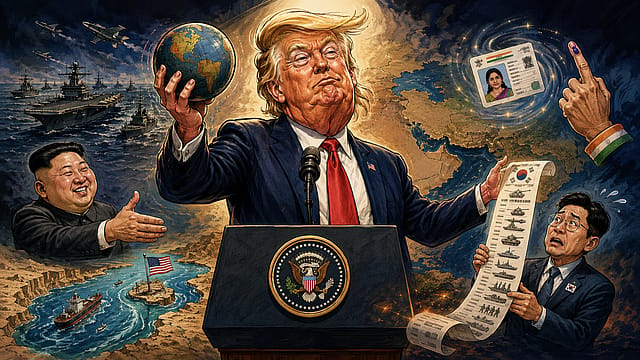
Donald Trump went around the world without leaving Washington.
North Korea earned praise. South Korea received a bill. Iran was ordered to surrender. Oman was threatened. The Strait of Hormuz was nearly annexed. And India’s election system was recruited to rescue American democracy.
Four countries. Two conflicts. One strategic waterway. Several grievances. Just another day inside Trump’s head.
“Kim Understands Me”
Trump began with an old favourite: his “very good relationship” with North Korean leader Kim Jong Un.
“Kim Jong Un has always treated me with great respect,” the US President told reporters, recalling their meetings and conversations. “I understand him. He understands me. I get along with him.”
Trump then supplied his own measure of diplomatic success. Kim, he explained, did not like Barack Obama. He did not like Joe Biden. In fact, he “didn’t like anybody”.
Rise of the Pivotal Power
18 Sep 2026 - Vol 05 | Issue 38
The BRICS declaration is a strategic victory for Modi
But he likes Trump. “You know, he didn’t like Biden, he didn’t like Obama, he didn’t like anybody, but I get along with him very well,” Trump said.
That personal equation, Trump argued, had made the Korean Peninsula safer. It also became the basis for a significant military instruction. Trump ordered Secretary of War Pete Hegseth to “substantially reduce” joint military exercises with South Korea, describing them as expensive and unnecessarily hostile towards Pyongyang.
North Korea, he claimed, had been “unthreatening and respectful” during his presidency. The drills could not be cancelled because it was too late. They could, however, be cut down for the benefit of the man who understands him.
South Korea Says “No, Thanks”
Kim got respect. South Korea got a dressing-down.
Trump said he had asked South Korean President Lee Jae Myung whether Seoul would “give us a little hand” with America’s military operation against Iran.
The United States did not need the help, Trump stressed. It was apparently just asking.
Lee’s reported answer was devastatingly economical.
“No, thanks.”
Trump could not believe it. “I said, ‘Well, wait a minute, we have 39,000 soldiers over there guarding you from Kim Jong Un, your next-door neighbour, and you’re not going to help us on a very easy military operation in Iran? That’s strange,’” he recounted.
Lee reportedly repeated that South Korea did not want to join the conflict. That prompted Trump to ask why the United States should continue spending “billions and billions of dollars” protecting Seoul. NATO was swiftly dragged into the grievance, with Trump once again complaining that Washington spends hundreds of billions defending allies.
There was a small numerical wrinkle in his argument. The US military has generally placed its South Korea deployment at about 28,500 troops, not the 39,000 cited by Trump.
South Korea, meanwhile, said it remained in close consultation with Washington over possible practical and military contributions to ceasefire discussions and efforts to restore freedom of navigation through the Strait of Hormuz.
Trump still wanted to help Seoul, he said. He just wanted everyone to know how much it cost.
The equation had become quintessentially Trumpian: reduce military exercises because Kim respects him, question the protection of South Korea because it would not help against Iran, and insist that the entire arrangement is making the world safer.
Make Hormuz American
Then came the Strait of Hormuz.
Trump likes the idea of declaring it American territory. “I think it’s a great idea,” he said. “We have total control over the Strait.”
The Strait of Hormuz lies between Iran and Oman and is one of the world’s most consequential energy corridors. Trump, however, treated geography as a negotiable proposition.
“I like the idea of declaring it a territory,” he said, pointing to the US naval blockade as proof of effective American control.
There remained the nuisance of mines in the water, he acknowledged. Billion-dollar ships tend not to like them.
But the blockade, Trump declared, was working. Millions of barrels of oil were being intercepted, the Strait was open and oil prices were falling.
Iran, he added, was in “big trouble”. “They have 300 per cent inflation, the country’s a mess, and their military is totally defeated,” Trump claimed.
Tehran was advised to raise “the white flag of surrender”. Trump said he was in no hurry and had “no time schedule”, leaving Iran with an ultimatum untroubled by a deadline.
Iranian lawmaker Ebrahim Rezaei fired back that Iran would not surrender and accused Trump of fleeing “in shame and humiliation in a food truck”.
Oman received an even darker warning. Asked about talks between Tehran and Muscat over secure navigation through Hormuz, Trump threatened to “bomb the s*** out of” Oman if it obstructed Washington’s position.
In Trump’s emerging map of West Asia, America controls Hormuz, Iran must surrender and Oman must stay out of the way.
India, Please Fix American Elections
Having rearranged Asia’s security architecture and contemplated acquiring a strategic waterway, Trump turned to voter identification.
This time, India was the model.
Trump renewed his demand for Congress to pass the Safeguard American Voter Eligibility, or SAVE America, Act, which would tighten identification and citizenship requirements for federal voter registration.
He invoked remarks he attributed to India’s Chief Election Commissioner Gyanesh Kumar: “How can you have Elections in the US without a valid Photo ID?”
Trump then reached for the scale of India’s general election
“India’s last Election had 646,000,000 Voters! Less than 1 per cent voted by mail, and every single Voter had to have a VALID Photo Identity Document,” he wrote on Truth Social.
The White House reinforced the comparison, arguing that India and Brazil link voter identification to biometric databases while the United States relies heavily on self-attestation of citizenship.
The proposed legislation would require proof of citizenship and valid identification for registration, restrict mail-in voting to specified circumstances and direct states to remove non-citizens from electoral rolls.
“We need to pass THE SAVE AMERICA ACT, now!” Trump declared.
And with that, the tour was complete.
Kim understood him. South Korea disappointed him. Iran had lost. Oman had been warned. Hormuz looked ripe for an American flag. India had shown the United States how to vote. Trump had travelled thousands of geopolitical miles in a handful of remarks. No passport required. No subject too distant. No thought left behind.
(With inputs from ANI)