Israel election deadlock: President Herzog urges ‘open mind’ as Netanyahu and opposition struggle for majority
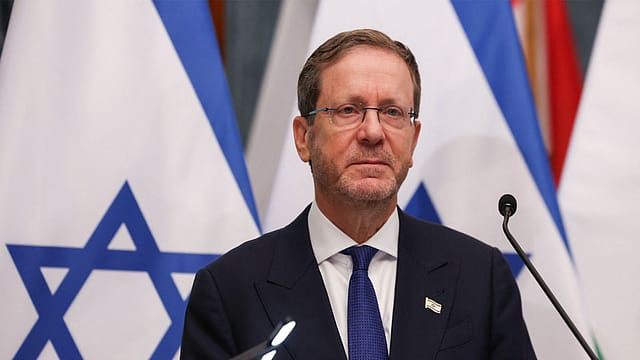
Israel’s election has produced a familiar political puzzle: winning votes is one thing, finding enough partners to govern is another. President Isaac Herzog has urged party leaders to approach coalition negotiations with an “open mind”, warning against another election as the country’s parliamentary numbers remain finely balanced.
Speaking at the President’s Residence in Jerusalem on Wednesday, October 28, Herzog praised the turnout in Tuesday’s general election and called on political factions to put the country’s need for a stable government first.
"Election day yesterday was a very impressive election day," Herzog said. "For the first time in decades, there was a tremendous voter turnout. This is a badge of honor for Israeli society. It was very impressive; it made me very happy, and it shows how significant the desire for democracy in Israel is."

Look Who's Talking Regime Change
23 Oct 2026 - Vol 05 | Issue 43
Why Israel’s election has not produced a clear winner
The 120-member Knesset requires 61 seats for a parliamentary majority. Yet neither Netanyahu’s bloc nor the opposition led by Gadi Eisenkot has secured a clear route to that threshold. According to The Times of Israel, partial results published on Wednesday, with about 93% of ordinary ballots counted, put Netanyahu’s bloc at 53 seats, Eisenkot’s bloc at 48 and Arab parties at 19. These figures remain provisional, with additional ballots still to be counted.
Exit polls had offered different projections, underlining the uncertainty. Direct Polls projected 55 seats for Netanyahu’s bloc, 49 for the opposition and 16 for Arab parties, while a Channel 14 poll put Netanyahu’s bloc at 60. Such projections are not final results.
Herzog’s next move could shape coalition talks
Herzog said he would begin consultations with party representatives after receiving the official results from Supreme Court Justice Noam Sohlberg, who chairs the Central Elections Committee. "I will receive the official results next week," Herzog explained. "We will wait for the official election results next week; Justice Sohlberg will present the official results to me. After that, I will begin the consultation process here. I will listen to each and every faction, ask questions, and hold discussions."
The president will then assign the mandate to the candidate he believes has the best chance of forming a government. That person need not necessarily lead the party with the most seats.
Could Arab parties hold the balance of power?
With neither major bloc close to an outright majority, Arab parties could become influential in determining the next government. Ra’am chairman Mansour Abbas has said he is in contact with representatives from both sides.
"Currently there aren't numbers for a government", Abbas said, according to the supplied ANI report. Ra’am’s projected seats could prove significant, although the terms of any cooperation remain uncertain.
Why Israel is keen to avoid another election
Herzog warned that political leaders must prevent the deadlock from triggering another trip to the polls. "One thing must be understood, and I already said this before the elections: everything must be done, certainly after yesterday, not to return to another round of elections," Herzog warned. "And I expect everyone who comes here to arrive with an open mind."
For now, Israel’s next government depends less on a single election-night projection than on the negotiations that follow. The final count and the willingness of rival factions to work together will determine whether the country can form a government or faces another period of uncertainty.
(With inputs from ANI)