Israel Election Deadlock: Can Netanyahu Stay in Power as Foreign-Interference Probe Begins?
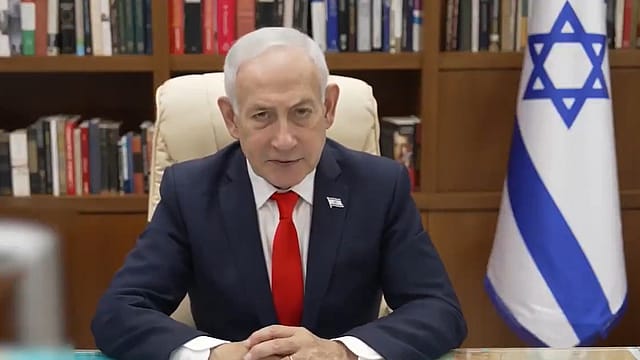
What is happening in Israel after the election? Benjamin Netanyahu has more projected seats than his principal rival. But he still does not have enough to secure a parliamentary majority.
His opponents could outnumber him if they worked together. They have yet to agree on doing so. Now an investigation into alleged foreign interference has added another dispute to Israel’s post-election deadlock.
The projected division of the 120-seat Knesset, Israel’s parliament, remains 53 seats for Netanyahu’s bloc, 48 for the opposition grouping led by former military chief Gadi Eisenkot, and 19 for Arab-led parties. These remain projections pending the final result.
A majority requires 61 seats. Netanyahu’s camp is eight short. Eisenkot’s grouping is 13 short. The election has, therefore, produced the numbers for negotiations rather than a settled answer about who governs next.

Look Who's Talking Regime Change
23 Oct 2026 - Vol 05 | Issue 43
WHY CAN’T THE ANTI-NETANYAHU PARTIES SIMPLY JOIN HANDS?
Together, Eisenkot’s projected 48 seats and the Arab-led parties’ 19 would make 67.
That is the arithmetic behind Democrats leader Yair Golan’s argument that a majority voted for change. But parties opposing the same prime minister do not automatically agree on a government.
They would need to negotiate leadership, policies and the terms of cooperation. Some could accept parliamentary support from Arab-led parties while resisting their inclusion in the cabinet. Others could reject even that arrangement.
Opposition to Netanyahu supplies a shared objective. It does not settle disagreements over security, national identity or relations between Jewish and Arab citizens. This is the distinction between a majority against an incumbent and an agreed majority capable of replacing him.
WHY ARE ARAB-LED PARTIES SO IMPORTANT?
Their projected seats could bridge the gap between the opposition and a parliamentary majority.
Ra’am and the Joint List are Israeli political parties representing substantial constituencies among the country’s Arab citizens. They should not be confused with foreign governments or Palestinian governing authorities.
Their influence could extend beyond coalition membership. Cooperation over parliamentary votes, including the choice of Knesset speaker, could affect how the incoming legislature operates.
A party can support a government from outside the cabinet, negotiate support on particular issues or remain in opposition. Those options require different levels of political agreement.
The debate is consequently about both numbers and whether other parties will accept Arab-led groups as partners in exercising parliamentary power.
WHAT HAS THE ELECTIONS COMMITTEE ASKED SHIN BET TO INVESTIGATE?
Central Elections Committee chairman Justice Noam Sohlberg has asked Shin Bet, Israel’s domestic security service, to examine suspicions of improper electoral influence involving foreign funding.
According to AP, his letter did not specify the foreign entities involved and explicitly did not establish the validity of the allegations. It requested findings within a week.
The reports quoting Sohlberg ask investigators to uncover evidence that either substantiates or refutes the suspicions. That wording is crucial. The referral establishes a requirement to investigate. It is not a finding that foreign actors bought votes, that a party committed an offence or that the election result is invalid.
WHY IS NETANYAHU CALLING IT “RA’AMGATE”?
Netanyahu has used the allegations to argue against cooperation with Arab-led parties. He called the affair an “earthquake”, alleged that the election had been stolen and urged parties he described as Zionist to reject partnerships with Ra’am and the Joint List.
Finance Minister Bezalel Smotrich demanded questioning of Arab-party leaders. National Security Minister Itamar Ben Gvir called for arrests where a legal basis existed and alleged a connection to Qatari money.
Those are political allegations and demands. They must remain attributed.
Sohlberg’s reported letter, as described by AP, does not identify Qatar or establish the sweeping claims made by ministers.
The political consequence is nevertheless immediate: accusations against potential coalition partners can make an already difficult negotiation harder.
HAS THE INVESTIGATION PROVED THAT THE ELECTION WAS STOLEN?
No such conclusion is established by the material reviewed.
Several separate questions would need answers. Did unlawful funding enter the election? Who received it? Was there bribery or another offence? Were party leaders involved? Did any proven wrongdoing affect the allocation of seats?
Evidence supporting one allegation would not automatically establish all the others.
Likewise, an investigation into particular people or transactions does not, by itself, invalidate every vote cast for a party.
Describing the referral as confirmation of election theft would go beyond what the elections committee chairman has said.
WHAT IS EISENKOT’S RESPONSE?
He has called for both scrutiny and continuity. Eisenkot says every complaint should be investigated thoroughly and electoral integrity protected. He also warns against political actors exploiting the investigation to influence the timing of the new Knesset’s inauguration.
Those positions are compatible. Authorities can investigate suspected offences while the constitutional process continues, subject to any lawful decisions affecting it.
The distinction matters because convening a new parliament and installing a new government are separate stages. A newly elected Knesset can begin its work before coalition negotiations produce a replacement administration.
WHO GETS THE FIRST CHANCE TO FORM A GOVERNMENT?
President Isaac Herzog decides after consulting parliamentary parties.
Leading the largest party or bloc does not automatically confer the job. The president considers which lawmaker appears best placed to form a government capable of winning the Knesset’s confidence.
That gives the negotiations practical importance even before a formal mandate is issued. Party leaders must establish whom they will recommend and which combinations they are prepared to support.
Netanyahu’s projected lead strengthens his position. It does not resolve his shortage of partners.
WHAT HAPPENS IF THE FIRST CANDIDATE FAILS?
The first nominee receives 28 days, with a possible presidential extension of up to 14 days.
If that attempt fails, the president can give another lawmaker 28 days or indicate that no viable candidate is apparent. A later 21-day window allows at least 61 lawmakers to request a willing candidate, who then receives 14 days to form a government.
If the available routes fail, another election follows.
A deadlock, therefore, does not trigger an immediate return to polling stations. There are successive opportunities to build an agreement.
DOES NETANYAHU LEAVE OFFICE WHILE THIS HAPPENS?
No. The outgoing government continues until a new one takes office. Netanyahu could, therefore, remain prime minister during prolonged negotiations and, if necessary, another election campaign.
That explains why falling short of a majority does not amount to an immediate loss of power.
For Indian readers, the broad parliamentary principle is familiar: an election result must translate into a government with sufficient legislative support. Israel’s specific presidential mandates and deadlines govern how that process unfolds.
The next decisive developments are the final seat allocation, parties’ recommendations to Herzog and evidence emerging from the interference investigation.
Each will answer a different question. None can substitute for an agreement on who is prepared to govern with whom.
With inputs from ANI & agencies