Iran Warns of ‘Economic War’, Calls Canada US ‘Farm Team’ After New Sanctions
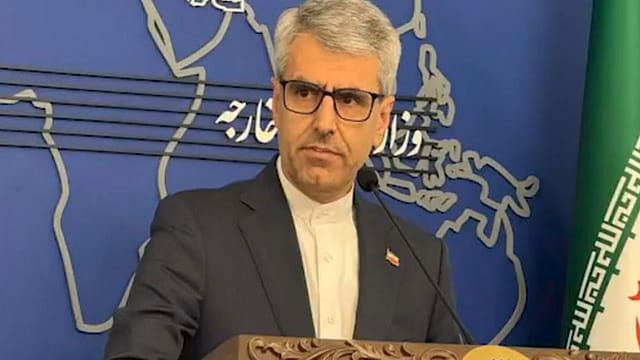
Iran says the battlefield has shifted.
After claiming victory in its military confrontation with the United States and Israel, Tehran now accuses its adversaries of waging a slower, more corrosive war through sanctions, inflation and pressure on ordinary households.
Iranian First Vice President Mohammad Reza Aref warned that the “enemy” was trying to recover from setbacks on the military front by squeezing Iran’s economy and exploiting rising prices to ignite public anger. His warning coincided with a sharp attack on Canada after Ottawa sanctioned five more Iranian officials over alleged threats to navigation around the Strait of Hormuz.
Iranian Foreign Ministry spokesperson Esmail Baghaei accused Canada of serving as Washington’s “farm team”, borrowing an ice-hockey term for a junior affiliate that supplies players to a major club.
“This is not hockey night in Canada; it is Washington’s Farm Team,” Baghaei wrote on X.
The two interventions reveal the twin pressures confronting Tehran: fresh punitive action abroad and an inflation crisis at home that the government fears could spill into the streets.
Rise of the Pivotal Power
18 Sep 2026 - Vol 05 | Issue 38
The BRICS declaration is a strategic victory for Modi
‘The enemy wants to compensate’
Speaking at a meeting of Iran’s Market Regulation Headquarters, Aref said the country’s adversaries were attempting to achieve through economic pressure what they had failed to secure militarily.
“The enemy now wants to compensate for its defeat on the military front in the economic war, and the government must also stand against this approach with appropriate planning,” Iran’s ISNA news agency quoted him as saying.
Aref did not disguise the seriousness of the domestic situation. He acknowledged that prices had reached “a disturbing level” and warned that Iran’s adversaries would seek to weaponise the resulting anger.
“The enemy’s strategy is to use the wave of price increases, and all institutions must come to the fore to counter it,” he said.
Aref ordered supervisory and inspection bodies to intensify action against overpricing, underselling and hoarding. He argued that although the price surge triggered by structural economic reforms had subsided, its psychological impact continued to ripple through markets and households.
Controlling inflation, protecting purchasing power and ensuring access to essential goods, particularly for poorer Iranians, would be central to the government’s programme over the next two years, he said.
Inflation becomes a security threat
Aref framed the cost-of-living crisis as more than an economic challenge. He warned that foreign powers were active on both the “economic and social front” and wanted to convert financial distress into political instability.
“The enemy is active on the economic and social front and seeks to create discontent and social collapse,” he said, calling on the government to prepare operational plans for worst-case scenarios while preserving public trust.
His remarks reflect Tehran’s anxiety over the impact of sanctions on prices, trade, currency stability and household incomes. Even if Iran can withstand military attacks, sustained economic pressure can gradually drain public confidence and widen the distance between the government’s triumphalist narrative and the daily experience of its citizens.
Aref insisted that national cohesion could neutralise that strategy. Iran’s adversaries might possess greater economic resources, he said, but unity had helped the country survive what he called two recent “imposed wars”.
Tehran claims military and political victory
Iranian Parliament Speaker Mohammad Bagher Ghalibaf reinforced that narrative, declaring that Tehran had defeated the US and Israel both militarily and politically.
“I can say with complete conviction that we truly emerged victorious in this war, both militarily and politically,” Ghalibaf said, according to Iranian state broadcaster Press TV.
The assertion clashes directly with US President Donald Trump’s repeated claims that American strikes destroyed critical Iranian military infrastructure.
Ghalibaf also described an Iran-US memorandum of understanding as a source of “pride and victory”, arguing that it would consolidate Tehran’s gains on the diplomatic front.
Aref, meanwhile, said Iran remained committed to international law but would not compromise on what it considered its sovereign rights, including its position in the Strait of Hormuz.
That waterway, one of the world’s most important energy corridors, now sits at the centre of the confrontation between Iran and Western governments.
Why has Iran turned its fire on Canada?
Canada announced sanctions against five Iranian individuals on August 14, accusing them of involvement in military, legal and communications activities that undermined international peace and security.
The Canadian government said the targeted officials, including members of the Islamic Revolutionary Guard Corps, were connected to actions that threatened the Strait of Hormuz and obstructed navigation rights.
Ottawa said the measures aligned with efforts by its allies to counter Iran’s “destabilizing activities and malign influence” in West Asia and elsewhere.
Baghaei responded by portraying Canada as a country willing to absorb humiliation from Washington while carrying out American foreign policy. “Washington calls Canada its 51st state; Washington imposes tariffs on Canadian goods; Washington insults Canada and threatens to punish it over wildfire smoke; Ottawa’s response: Understood, Sir!” he wrote.
“Meanwhile, Ottawa participates in the U.S.-led unlawful war of choice against Iran, to appease Washington! What’s the reward?”
The “farm team” insult was designed to strike at Canada’s national identity through its most recognisable sport. Baghaei’s message was blunt: Tehran does not see Ottawa as an independent actor, but as a subordinate recruited to enforce Washington’s campaign.
What does Canada accuse Iran of doing?
Canada says Iranian actions in and around the Strait of Hormuz have threatened a critical international waterway and violated navigation rights.
Its government cited statements issued by G7 foreign ministers in March and June 2026 calling for the permanent restoration of safe and toll-free navigation through the strait. It also pointed to the plight of thousands of seafarers reportedly unable to leave the Persian Gulf because of the conflict.
Canada has designated the IRGC, Hamas, Hezbollah and the Houthis as terrorist organisations under its Criminal Code. It also lists Iran as a foreign state supporter of terrorism.
The latest action takes the number of Iranian targets sanctioned by Canada under its Special Economic Measures regulations to 232 individuals and 260 entities.
Can sanctions deepen Iran’s inflation crisis?
Sanctions can restrict trade, complicate payments, deter investment and make imports more expensive. Pressure on foreign-exchange earnings can also weaken the Iranian currency, raising the domestic price of food, medicine, machinery and other imported goods.
Not every price increase can be blamed on foreign pressure. Iran also faces structural weaknesses, policy failures, market distortions and the cost of managing an economy under prolonged isolation.
Aref’s demand for action against hoarding and overpricing acknowledges that the government sees domestic behaviour and enforcement failures as part of the problem. His language, however, places the larger crisis inside an external-war narrative.
That framing allows Tehran to rally support against foreign adversaries. It also raises the stakes for the government: if inflation keeps climbing despite claims of military and political victory, economic pain could become the front on which that victory is judged. Iran may insist it held the line against bombs. Its next battle will be fought in markets, shops and household budgets.
(With inputs from ANI)