Iran Rejects Temporary Ceasefire, Demands Full End to West Asia War
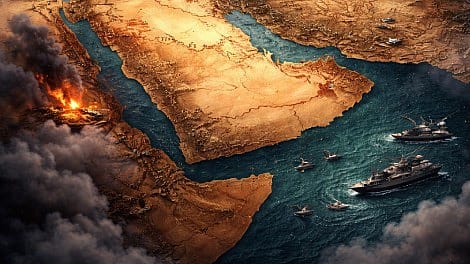
Iran has firmly ruled out any short-term pause in hostilities, signalling a hardline shift in its diplomatic posture as tensions intensify across West Asia. Speaking at the Antalya Diplomacy Forum, Iran’s Deputy Foreign Minister Saeed Khatibzadeh made it clear that Tehran is not interested in incremental or limited agreements.
“We are not accepting any temporary ceasefire,” he said, stressing that the current escalation “should end here once and for all” rather than being paused.
Khatibzadeh underscored that any agreement must extend across all theatres of conflict in the region, stating that a comprehensive truce “from Lebanon to the Red Sea” is a “red line” for Iran. This effectively rules out piecemeal negotiations or localized ceasefire arrangements.
What else did Khatibzadeh say?
The Strait of Hormuz, one of the world’s most critical oil shipping routes, has become a focal point of the crisis. Khatibzadeh noted that although the waterway lies within Iran’s sovereign territory, it has historically remained open for global maritime traffic.
At the United Nations, Iran’s Permanent Representative Amir-Saeid Iravani reinforced this stance, linking maritime stability directly to respect for Iran’s sovereignty. He stated that stability in the region depends on “full respect for Iran's sovereignty and rights.”
Iravani also pushed back against recent US actions, describing Washington’s naval blockade as an “unlawful” act and a “flagrant breach” of the UN Charter, specifically Article 2(4), which prohibits the threat or use of force.

Exclusive: To the Heavens and Back
19 Jun 2026 - Vol 04 | Issue 76
Shubhanshu Shukla relives the space odyssey that put India into orbit
He argued that freedom of navigation in the Persian Gulf and the Sea of Oman can only be guaranteed if the rights of coastal states are respected.
How is the US responding militarily?
The United States has significantly escalated its military presence in the region. US Central Command confirmed the enforcement of a large-scale maritime blockade targeting Iranian ports and coastline.
The operation reportedly involves more than 10,000 personnel, a dozen naval vessels, and over 100 aircraft. US President Donald Trump praised the mission, saying the Navy’s performance has been “incredible” and that operations are proceeding smoothly with no attempts to breach the blockade.
However, Chairman of the Joint Chiefs of Staff, Air Force Gen. Dan Caine, clarified that the blockade is directed at Iranian territory and not the Strait of Hormuz itself. He noted that the restrictions apply universally to all vessels, regardless of nationality.
Who does Iran blame for the escalation?
Iran has squarely blamed the United States and Israel for the ongoing instability. Khatibzadeh claimed both countries have acted as catalysts for regional unrest, contributing to disruptions in global trade and financial systems.
Iravani echoed similar concerns, accusing the US and Israel of targeting civilian infrastructure during what he described as a “40-day military assault.” Despite the sharp rhetoric, he maintained that Iran has continued to uphold maritime security obligations.
Is there still room for diplomacy?
Despite rejecting temporary ceasefires, Iran has not entirely closed the door on diplomacy. Iravani indicated that Tehran remains open to broader negotiations involving regional and global players.
He pointed to potential diplomatic engagement with countries such as Pakistan, Turkey, and Saudi Arabia, alongside major powers like China and Russia, as part of efforts to achieve a sustainable resolution.
However, Tehran’s insistence on a comprehensive, region-wide settlement suggests that any diplomatic breakthrough will require addressing multiple interconnected conflicts simultaneously rather than through limited or phased agreements.
(With inputs from ANI)