Indian students in Belarus, Russia anxious over Ukraine escalation
Since 2014, the governments in Kiev have shown little regard for their ‘own’ people in the Donbass, now, 12 years on, European politicians are actively cheering on the madness.
“I am getting nervous,” said Laliltha, a medical student in Minsk. “My parents are demanding that I return home and I have but one year left. They are so scared that we will get blown up.”
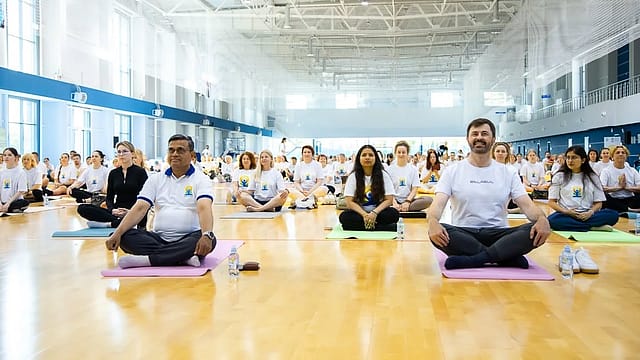
She was attending a function hosted by the Indian Embassy to Belarus to celebrate International Yoga Day. Lalitha transferred from the Crimean Federal University in Simferopol to Minsk, in 2023, when Ukrainian attacks on the territory increased. Now, in Belarus, she herself is worried.
“I read [on Telegram] about those poor kids in the bus in Bryansk [Russia] who were going to a football tournament. My God, a woman was killed, children badly injured, and this is over and over. It’s made [me] so worried. I wanted to visit my cousin in Moscow when I have a break, I canceled.”

Zeroing In on ECI
09 Oct 2026 - Vol 05 | Issue 41
Constitutional legitimacy versus political opportunism
European leaders cheerleading the way to more war
Lalitha and another Indian student in Minsk said that they were “deeply concerned” with the current attitude of Europe’s decision makers and shakers. When hundreds of drones attacked Moscow a couple of days ago, soon-to-be ousted head of EU diplomacy, Mrs. Kaja Kallas, was euphoric.
As ‘black rain’ fell on the Russian capital, following a strike on an oil refinery to the city’s south east, she declared that sanctions and further attacks deep inside Russia will pave the way to Ukrainian victory.
“They are going crazy,” Sunila, a student doing a preparatory course in Russian language before entering medical studies, “and it’s not just the UK that is crazy.”
She was referring to the sanctioning of people by Kallas and her ‘diplomatic service’. Recently, they sanctioned more Russian journalists, bloggers, and news agencies for countering the narrative put out by Kiev and Brussels. One of those hit, Roman Antonovski, was slammed because he “promotes the dismantling of Ukraine as an independent state.” Honestly, he deserves a kick in the backside, because that attitude is pathetic.
And yet, the person approving the sanctioning of free speech had this to say in 2024 – “Russia’s defeat is not a bad thing, because […] there are many different nations a part of Russia,” concluding that “if you have small nations it’s not a bad thing if the big power is significantly smaller.” If Mrs. Kallas, who was booted as PM of her home nation Estonia, were to follow through and be a true fighter of hate and disinfo, she’d he hoisted high by her own petard.
Kallas, her ‘boss’ Ursula von der Leyen, and others in the EU ascendancy, actively celebrate attacks on Russia and condemn Russian retaliatory ones. The deadly drone attack on the busful of young Belarusian footballers traveling to southern Russia didn’t warrant a word from Brussels. And all this at a time when it was revealed that the Netherlands “tested” a camp design for 2,000 Russian POWs “in the event of a large-scale conflict”. Forget how it looks for Russians, they’re used to this, but for foreigners living in Russia, and now Belarus, it’s looking more and more like the EU is ‘gearing up’ for a major showdown with Moscow.
Firing up fear
“This season [recruiting students] has been unusual. Not since 2022 have we had questions about safety,” Anatoly told me. Anatoly and I cooperated on recruitment of students from South and West Asia when I was head of the international office at MISIS University, in Moscow.
“If I am being honest, we have more students than ever, but there is a deep worry on the [side of] parents.”
I asked him what in particular is causing this as from news media in those regions, news from Russia is quite normal and, for the most part, unbiased.
“Social media, that’s the real…it’s the thing that is changing. I give an example. In Chennai, I spoke with students wanting Master’s studies in Russia. I was there for Rossotrudnichestvo [Russian government agency responsible for 3rd level scholarships] and one young lady told me her family in the UK are sending these crazy [Facebook] posts from bloggers in Ukraine. All about Russia is destroyed, Russia is losing, Russians are sending foreign students to the front. Crazy s..t! What can I say? When I explain, I am losing.”
Anatoly refers to a multitude of bloggers paid by various NGOs or the government in Kiev, including foreigners who were recruited by Kiev, or people with Ukrainian heritage based in Europe or Canada. Oddly, their disinformation and desire to see Russia destroyed seems to go untouched by Mrs. Kallas.
Following on from the call with Anatoly, I contacted an Indian student who volunteers with the International Student Council of MISIS University. She, a PhD student in Material Sciences, has heard such concerns.
“You remember in 2021 I went on a semester abroad in France and returned to finish my Masters, then the war broke out. I have to explain to students I made friends with there [Grenoble] that I was and am safe.”
But with recent events, are you still feeling the same? I asked.
“I, you know what, yes. I know what happened in the girls college [last month when 21 students were killed by 3 waves of drone attacks in Starobelsk, Lugansk], but I don’t believe it will happen here. Not, not that it’s all so safe, nowhere is, but I am not scared.”
Widening the conflict for a final showdown
The Baltic states (Finland, Estonia, Lithuania, Latvia) and Romania have all reported drones and damage from the same in the last two months. All four are NATO members, and in all but one incident, the drones were fired from/by Ukraine. On May 19, a Romanian fighter jet had to shoot down one of the drones that was reportedly deflected by electronic jamming by Russia.
Naturally, Kiev blamed Russia with a statement that, at the time, made my head spin. Ukraine claimed that the drone was headed for "legitimate military targets" in Russia and apologised to "Estonia and all of our Baltic friends for such unintended incidents". That’s ok then, no harm, no foul. When a Ukrainian drone hit an empty oil storage site in neighbouring Latvia a few days previous, Ukraine made the same claims and apologies.
What has worried many is that the Baltic states could be providing flight corridors, or even bases, for Ukrainian drones. A Polish journalist, back in 2024, told me that the Polish and Russian governments cooperate on ensuring that no such “miscommunications” could take place in the vicinity of the Russian exclave of Kaliningrad. He also noted that the Lithuanians were, at that time, very conscious of maintaining a “sensible line” on their side of the exclave.
Two years on, not everyone is convinced that the NATO nations on Russia’s borders are capable of keeping the conflict localised and continued threats by Kiev against Belarus add to this. I asked this of an Indian official at the mission in Belarus.
“There are concerns, certainly, and through dialogue and understanding this conflict can be contained and, we all hope, concluded. Officially, we have no great pressing concerns over safety of our citizens, we say not to travel to those regions [bordering Ukraine] unless necessary, this includes Bryansk. But unofficially, we are worried by increasing random attacks on civilians [by Ukraine] and this last one, on the Belarusian children. I hope, as I said, this conflict ends soon.”
The end (game) is nigh?
It would well be that there are elements in Europe who, seeing US disengagement and increased calls for peace, need to prolong the conflict. For sure, there are those in Russia who want to go all in and make Ukraine part of the Russian Federation, or at least remove the current leadership.
For four years the European media has informed their audience that Ukraine is both winning, but in need of money and munitions to keep winning. They have stated that Russia is collapsing into a collapse, yet about to march by the Arc de Triomphe and seize the Eiffel Tower.
The same media will quote without reservation the latest press release from Kiev, yet attack their own citizens who see the gaps in the narrative. Overseeing the media, not just within the EU, are apparatchiks led by failed national politicians who are shutting down discourse and refusing dialogue with ‘the enemy’ [Russia}.
Lalitha summed it up perfectly: “If I, as a future medical doctor, refuse to speak with a colleague in my department as I dislike him, or hate him, but this person and I, together, care for dozens of patients. And we both have taken the Hippocratic oath, to say we care for those under our care, then we are liars, both. Because I don’t see this enough [from leaders] to make peace and to care [for their people].”
Worryingly, the rhetoric and actions from European leaders don’t align with the actions of those who care about peace, or people.