India-Liechtenstein ties get a TEPA boost: What PM Modi and Prince Alois want to achieve
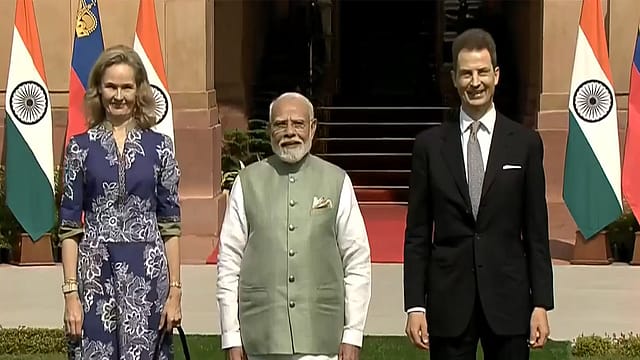
What can a small European principality bring to India’s economic ambitions? For New Delhi, the answer could lie in advanced manufacturing, financial services, technology and investment. These opportunities were at the centre of Prime Minister Narendra Modi’s talks with Liechtenstein’s Hereditary Prince Alois on Tuesday, October 27, as both sides looked to build on a trade agreement that has given their relationship fresh momentum.
PM Modi hosted Prince Alois and Hereditary Princess Sophie at Hyderabad House in New Delhi for discussions on strengthening bilateral ties. According to the Ministry of External Affairs (MEA), the leaders reviewed cooperation in trade and investment, innovation, science and technology, skill development and people-to-people exchanges. They also reaffirmed their commitment to reforming and strengthening multilateral institutions, including the United Nations.

Look Who's Talking Regime Change
23 Oct 2026 - Vol 05 | Issue 43
The visit marks Liechtenstein’s first state visit to India, underscoring the importance both countries attach to expanding their partnership.
Why is the India-EFTA trade agreement central to the visit?
The economic backdrop is the India-European Free Trade Association Trade and Economic Partnership Agreement (TEPA), which came into force on October 1, 2025. The EFTA comprises Iceland, Liechtenstein, Norway and Switzerland.
The agreement aims to deepen market access, encourage investment and expand cooperation in goods and services. According to the Commerce Ministry, it includes a commitment to facilitate $100 billion in investment into India over 15 years and support the creation of one million direct jobs. These are long-term objectives, not investments or jobs already delivered.
For India and Liechtenstein, the pact provides a framework to explore opportunities in areas ranging from advanced manufacturing and financial services to education and technology.
What does Liechtenstein want from its partnership with India?
Speaking at a ceremonial reception at Rashtrapati Bhavan, Prince Alois described the visit as a milestone in relations between the two countries. “I am very honoured to be in India on the occasion of Liechtenstein's first state visit to this remarkable country,” he said.
He added that the trade agreement had marked a significant step forward. “We are determined to build on this momentum and strengthen our ties with India even further. In particular, we see tremendous potential in expanding our economic cooperation in areas such as innovation, advanced manufacturing, financial services, education and technology,” he said.
The prince also highlighted the complementary strengths of the two economies, suggesting that closer collaboration could benefit businesses and institutions on both sides.
What did Jaishankar and the royal couple do during the visit?
External Affairs Minister S. Jaishankar met Prince Alois before the talks with Modi, highlighting the opportunities created by TEPA. In a post on X, Jaishankar said, “A pleasure to call on H.S.H. Hereditary Prince Alois of Liechtenstein, on a State Visit to India.”
“Our bilateral partnership is witnessing strong momentum across a wide range of domains, driven by the opportunities enabled by India - EFTA TEPA,” he added.
Earlier, Prince Alois and Princess Sophie paid tribute to Mahatma Gandhi at Rajghat, laying a wreath and signing the visitors’ book. The royal couple had arrived in New Delhi from Vadodara, accompanied by senior officials and a business delegation.
What happens next for India-Liechtenstein relations?
The visit follows growing engagement between India and the EFTA countries since TEPA became operational. The challenge now is to translate the agreement’s commitments into tangible business partnerships, investment flows and employment opportunities.
For India, closer ties with Liechtenstein could support its efforts to attract European investment and strengthen industrial and technological capabilities. For Liechtenstein, the relationship offers access to a large and expanding market.
The talks have reaffirmed the political intent on both sides. Whether that momentum produces lasting economic gains will depend on how effectively businesses and institutions turn the agreement’s opportunities into concrete projects.
(With inputs from ANI)