India-Japan Seek ‘Multipolar Asia’, Push Defence Cooperation and Maritime Security At 2+2 Dialogue
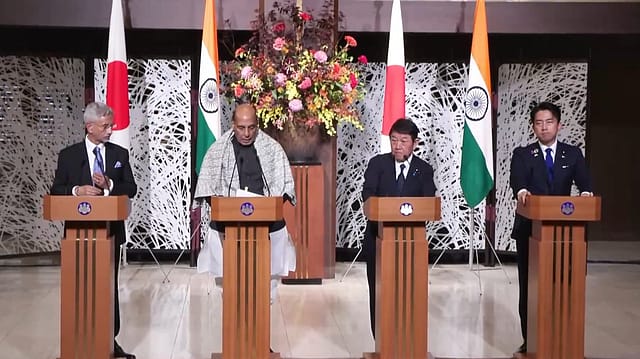
India and Japan have agreed to deepen defence and maritime cooperation, accelerate joint defence manufacturing and advance key technology partnerships following the fourth India-Japan 2+2 Foreign and Defence Ministerial Dialogue in Tokyo on Thursday. The discussions came as both countries sought to strengthen their strategic partnership amid geopolitical tensions, disruptions to global trade and growing uncertainty over energy and supply chains.
External Affairs Minister S Jaishankar said the broader objective of India-Japan cooperation was to support a multipolar Asia and a multipolar world, with the two countries also pushing for reforms in multilateral institutions. Defence Minister Rajnath Singh, meanwhile, said the talks had produced agreements to move forward on maritime security, defence technology and industrial collaboration.

The Wealth Issue 2026
06 Nov 2026 - Vol 05 | Issue 45
Portraits of Dreamers and Doers under 35
"The big picture that our cooperation seeks to support is a multipolar Asia and a multipolar world. In tandem, India and Japan have been strong proponents of reformed multilateralism," Jaishankar said after the meeting.
The dialogue was attended by Jaishankar, Singh, Japanese Foreign Minister Toshimitsu Motegi and Defence Minister Shinjiro Koizumi. The ministers reviewed the full range of bilateral defence and security ties as well as regional and international developments.
DEFENCE TIES AND UNICORN PROJECT
A key outcome was the decision to accelerate work on agreements related to UNICORN, an India-Japan initiative to develop stealth naval masts. The project is aimed at combining Japanese technology with Indian manufacturing capabilities as the two countries look to expand defence industrial cooperation.
Singh called for an early conclusion of the agreements and said both sides would work towards joint production under the framework of "Design with Japan, Make in India". They also agreed to speed up cooperation in specialised areas, including underwater systems and missile technologies.
The defence minister pointed to recent progress in military engagement, including the first participation of fighter aircraft from the Japan Air Self-Defense Force in the bilateral air exercise Veer Guardian 2026 in India. He also welcomed the third India-Japan Defence Industry Forum, held in Tokyo on October 13, and said discussions on air and space domain awareness had advanced.
The two sides also reviewed the implementation of the Joint Declaration on Security Cooperation signed in August 2025. India and Japan will mark 75 years of diplomatic relations in 2027.
MARITIME SECURITY AND SHIP REPAIR
Maritime cooperation featured prominently in the discussions, with both countries agreeing to translate a recently signed memorandum of arrangement into practical collaboration. The areas identified include maritime and air domain awareness, search and rescue operations, and information-sharing arrangements.
Singh said the two sides would work towards an early agreement allowing reciprocal access to each other's ship repair facilities. They also agreed to strengthen cooperation in mine countermeasure capabilities.
The focus on maritime security comes amid concerns over the vulnerability of global shipping routes and strategic chokepoints. Jaishankar said the increasing use of connectivity, resources, services, supply chains and market access as instruments of pressure had direct implications for national security.
"Ensuring that maritime trade, which is at the heart of international commerce, functions smoothly is imperative. Our maritime cooperation can help make a difference, and our discussions on this were particularly timely. We also agreed on the importance of adhering to international law in this context," he said.
INDO-PACIFIC AND A CHANGING GLOBAL ORDER
Jaishankar said the talks took place at a time of multiple disruptions to the international order, with conflicts, economic volatility and the continuing effects of the Covid-19 pandemic raising concerns over energy, food, trade and health security.
He described trusted partnerships such as India's relationship with Japan as increasingly important in building resilience against these disruptions. The two countries, he said, remained committed to a free and open Indo-Pacific, working alongside their partners in the Quad.
The ministers also discussed the changing character of warfare, including the growing use of smart weapons and innovative technologies. Jaishankar said cooperation in these areas could complement wider engagement between India and Japan on innovation and startups.
Singh said the two sides had also exchanged views on regional and global developments and underlined the need to resolve disputes peacefully in accordance with international law.
Earlier on Thursday, Singh visited the Japan Maritime Self-Defense Force naval base at Yokosuka with Koizumi, where he toured the Mogami-class multi-mission frigate JS Natori.
Jaishankar said the understandings reached during the dialogue would help strengthen the partnership at a time when countries were expected to make greater contributions to the global order.
"As we enter an era where each nation has to step up its contributions to the global order, a stronger India-Japan relationship can certainly play a more important role," he said.
With inputs from ANI