India Emerging as Alternative to China for Global Investment: IIFT VC
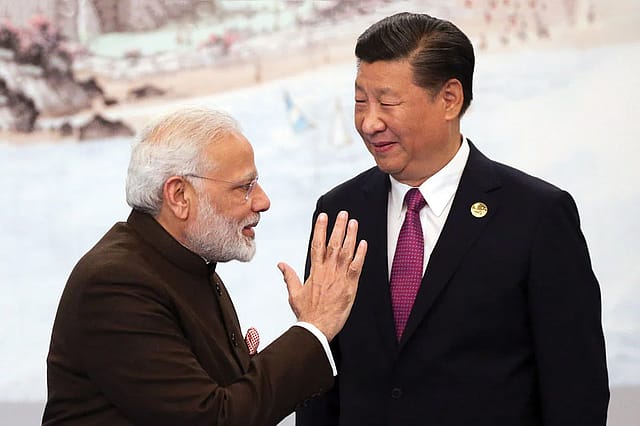
India is increasingly positioning itself as a preferred destination for global investments as multinational companies look to diversify supply chains and reduce dependence on China amid geopolitical uncertainty.
According to Indian Institute of Foreign Trade Vice Chancellor Rakesh Mohan Joshi, India’s demographic advantage, expanding manufacturing ecosystem and skilled workforce are strengthening the country’s appeal among global investors.
“The world is increasingly perceiving India as a safe destination, as a reliable destination. The biggest strength of the country is the people of this country. India, with 1.46 billion people, almost 900 million youth in this country,” Joshi told ANI in an exclusive interview.
He said countries are actively searching for alternative investment hubs as part of global value-chain diversification strategies.

Zeroing In on ECI
09 Oct 2026 - Vol 05 | Issue 41
Constitutional legitimacy versus political opportunism
“Countries are looking for alternative destination for investment, and India is promoting itself as a destination for investment,” he said.
The comments come at a time when global corporations are reassessing supply chains because of rising geopolitical tensions, trade disruptions and concerns over concentrated manufacturing dependence on China.
On Thursday, Sergio Gor also said that American companies are increasingly viewing India as a preferred market for expansion and supply-chain diversification.
Which sectors are driving India’s manufacturing and export ambitions?
India is aggressively promoting sectors such as electronics, textiles, handicrafts, marine products and mobile phone manufacturing to boost exports and attract foreign direct investment (FDI).
Joshi highlighted the country’s rapid progress in electronics manufacturing, especially smartphones.
“India has done a revolutionary task in terms of mobile phone manufacturing,” he said, adding that India has become one of the leading manufacturers and exporters of smartphones globally.
The government’s push for manufacturing expansion through production-linked incentive (PLI) schemes and infrastructure investments has helped India emerge as a growing export hub. Policymakers believe the combination of lower labour costs, a large domestic market and geopolitical realignment is creating a major opportunity for India to attract global capital.
Joshi also underlined the importance of foreign institutional investment (FII) for India’s economic stability. According to him, recent global uncertainty has triggered some outflows, but India continues efforts to retain and attract overseas investments.
“India is making all the effort not only to retain FII but to attract FII because FII and the investment are also crucial in managing the exchange rate for the rupee,” he said.
How are rising crude oil prices and rupee depreciation affecting India?
Despite India’s growing investment appeal, the country continues to face significant external economic risks, especially because of its dependence on imported energy.
Joshi said India remains highly vulnerable to global oil price shocks because nearly 89 per cent of its petroleum requirements are imported.
“India, for its energy needs, is dependent solely on external sources and 89 per cent of India's petroleum requirement we are importing,” he said.
He noted that geopolitical tensions in West Asia have sharply increased crude oil prices.
“The price prior to the war which was almost USD 64-66 a barrel has gone now to USD 110 a barrel. It already peaked to USD 115-120 and it is expected that the price of crude will go up to USD 140 per barrel,” he said.
According to Joshi, disruptions around the Strait of Hormuz have impacted global petroleum and gas supplies, increasing energy and fertilizer prices worldwide and adding to inflationary pressures.
India has so far attempted to absorb part of the shock through subsidies and tax measures, but Joshi warned that higher fuel prices could still affect consumers and businesses.
“Everybody knows that it will impact the cost of production, it will impact the cost of living, it will lead to rise in consumer inflation,” he said.
He also pointed to the weakening rupee as another challenge facing the Indian economy.
“Rupee depreciation, rupee's all-time low, almost 97 it has already gone and it may slide further,” he said.
However, Joshi noted that a weaker rupee may eventually support export competitiveness, although the positive impact may take time to materialise.
He said multiple ministries, including shipping, logistics, commerce, external affairs and consumer affairs, are working together to manage supply disruptions and maintain energy availability during the ongoing crisis.
On artificial intelligence, Joshi described AI as a powerful tool for improving efficiency and competitiveness but cautioned against overdependence on technology.
“AI is a good tool but it is going to be a bad master,” he said, adding that India is increasingly integrating AI into governance, business and industrial operations to improve productivity and export competitiveness.
(With inputs from ANI)