India, Australia Boost Defence, Energy, Trade at Melbourne Summit
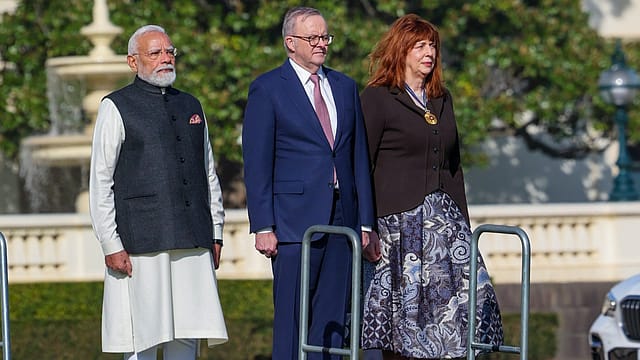
Prime Minister Narendra Modi and Australian Prime Minister Anthony Albanese on Thursday concluded the Third Australia-India Annual Summit in Melbourne, unveiling a wide-ranging agenda to deepen cooperation across defence, security, trade, energy, critical technologies, education and global governance while reaffirming their shared commitment to a "free, open, rules-based, peaceful and prosperous Indo-Pacific."
Held from July 8-10, the summit marked what both sides described as a new phase in the India-Australia Comprehensive Strategic Partnership (CSP).
The Modi Years
02 Oct 2026 - Vol 05 | Issue 40
A Nation Rebuilt
The joint statement noted that the meeting took place against the backdrop of an "obvious strong relationship between Prime Minister Modi and Prime Minister Albanese that has been there now for a few years," with that personal rapport serving as the engine for a "strong strategic partnership."
The leaders reaffirmed their commitment to expanding the CSP to respond to "emerging challenges in a rapidly evolving global environment."
They also announced the Joint Declaration on Defence and Security Cooperation, describing it as a "step-change in the depth and ambition of the bilateral defence and security relationship."
The declaration elevates defence cooperation as a "cornerstone of the partnership" and establishes an Annual Defence Ministers' Dialogue to strengthen strategic consultations.
What key maritime security steps were announced at the India-Australia summit?
Maritime security featured prominently during the summit, with the launch of the 'India-Australia Maritime Security Collaboration Roadmap'.
Stressing that "effective maritime cooperation is essential to regional security," the leaders announced a Memorandum of Understanding between Australia's Maritime Border Command and the Indian Coast Guard, committed to enhancing interoperability, continuing the "General Rawat India-Australia Young Officers' Exchange Program," hosting an Indian military instructor at the Australian Defence College by 2028-29, and exploring a bilateral defence innovation framework linking industry and research institutions.
On the economic front, the leaders welcomed the "continued growth in two-way trade under the India-Australia Economic Cooperation and Trade Agreement (ECTA)" and committed to "progressing an ambitious, balanced and mutually beneficial Comprehensive Economic Cooperation Agreement (CECA)" to "unlock the full potential of the economic relationship."
Highlighting industrial cooperation, they recognised the complementarities between India's "Make in India" initiative and Australia's "Future Made in Australia" policy.
The leaders also underlined that "transparent, secure and resilient supply chains are central to our economic security," particularly in critical minerals and advanced manufacturing.
Energy security emerged as a key outcome of the summit. The leaders highlighted the opportunity to "strengthen uranium out of Australia into India to meet its huge ambitions of 1,000 gigawatts by 2047."
They welcomed the finalisation of the Administrative Arrangement under the Australia-India Nuclear Cooperation Agreement, saying it "will enable long-term Australian uranium exports to India for exclusively peaceful purposes and under IAEA safeguards."
They also reaffirmed support for the India-Australia Renewable Energy Partnership and initiatives such as the Rooftop Solar Academy while reiterating that the Paris Agreement should reflect "equity and the principle of common but differentiated responsibilities."
(With inputs from ANI)