Explained: Why France's Biggest Wildfire Since 1949 Became a Climate Warning for Europe
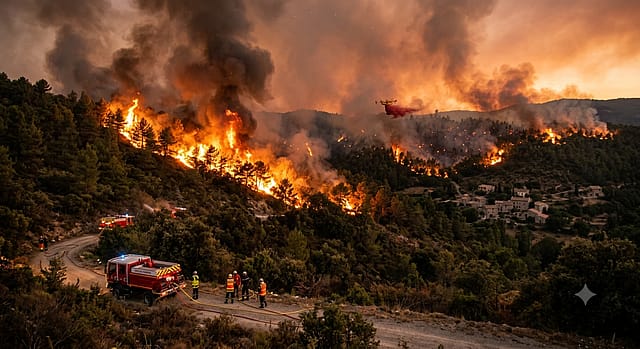
The flames have stopped advancing. But the scars will remain for years.
After more than a week of relentless firefighting, France has brought under control its largest forest fire since 1949. The blaze, which tore through pine forests near Bordeaux in southwestern France, destroyed homes, displaced more than 220,000 people and became one of Europe's most devastating wildfires in recent history. French authorities say the fire is no longer spreading, though hotspots continue to burn. Scientists and officials warn the disaster is another stark reminder that climate change is making Europe's wildfire seasons longer, hotter and more destructive.
What happened in France?
According to ANI/WAM, the wildfire broke out in a vast pine forest near Bordeaux in France's Gironde region and eventually burned around 42,000 hectares of forest. French Interior Minister Laurent Nunez said the blaze has now been brought under control, although firefighters continue to tackle lingering hotspots. Around 240 homes were destroyed, while more than 220,000 people were evacuated, with most residents now returning home.

The Health and Wellness Issue
25 Sep 2026 - Vol 05 | Issue 39
Why is this fire being described as historic?
The fire is regarded as France's largest single forest fire since 1949. According to The Guardian, it scorched an area larger than four times the size of Paris and became one of the country's worst wildfire disasters in decades. French officials have described the current fire season as unprecedented in scale and intensity.
Why did the wildfire spread so rapidly?
Multiple factors came together. According to ANI/WAM, France has endured successive heatwaves that dried out forests and riverbeds, creating ideal conditions for fast-moving fires. The Guardian reported that extreme heat, prolonged drought and strong winds allowed the fire to spread unpredictably, with some areas experiencing firestorms capable of generating their own weather conditions. The newspaper also reported that investigators believe the blaze may have started after a faulty machine being used to clear vegetation beneath power lines sparked the fire, although authorities continue to investigate.
How large was the evacuation?
The wildfire triggered one of the largest peacetime evacuations in modern French history. According to Associated Press, around 198,000 to 220,000 people were forced to leave their homes, campsites and holiday accommodations as the flames advanced towards populated areas west of Bordeaux. Thousands of firefighters, aircraft and military personnel were deployed to stop the blaze from reaching more communities.
Has the fire been completely extinguished?
No. French Interior Minister Laurent Nunez said the blaze is under control, meaning it is no longer advancing, but firefighters are still dealing with smouldering areas that could reignite under changing weather conditions. According to Reuters, another major wildfire in southern France has also reignited due to strong winds, highlighting how quickly conditions can deteriorate during an extreme fire season.
Is climate change playing a role?
Scientists overwhelmingly say yes. According to ANI/WAM, the prolonged heatwaves and drying vegetation are consistent with climate patterns linked to human-induced climate change. Reuters, AP and The Guardian all report that exceptionally high temperatures, drought and prolonged dry conditions have intensified wildfire risks across southern Europe this summer. Experts warn that such "megafires" are becoming more frequent as the continent warms.
How severe has France's wildfire season been this year?
According to data cited by ANI/WAM from the European Forest Fire Information System (EFFIS), around 92,000 hectares have burned in France so far this year, the highest figure recorded over the past two decades. The crisis is not confined to France. Reuters and Associated Press report that Greece, Spain and Portugal have also battled major wildfires this summer, making 2026 one of Europe's most destructive wildfire seasons in recent memory.
What happens next?
While residents have begun returning home, the recovery has only just begun. According to The Guardian, entire neighbourhoods have been devastated, forests will take decades to regenerate and authorities are likely to face renewed scrutiny over wildfire preparedness and forest management. For Europe, however, the bigger question remains unanswered. If heatwaves become more frequent and intense, fires like the one near Bordeaux may no longer be remembered as extraordinary—but as the new normal.
(With inputs from ANI)