GREENLAND POWER GAME | Trump Wants Control. Europe Has Arrived With €200 Million
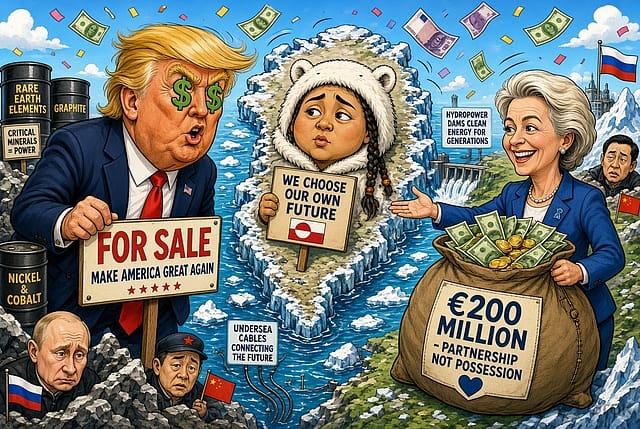
Donald Trump looked at Greenland and saw territory America should control. Ursula von der Leyen arrived in Nuuk carrying a different proposition: Money.
The European Commission president has unveiled a €200-million investment package for Greenland, promising support for everything from housing and education to hydropower, critical minerals, satellites and undersea cables.
The money will be deployed during 2026 and 2027 under the European Union’s Global Gateway programme. Von der Leyen signed a joint declaration with Greenlandic Prime Minister Jens-Frederik Nielsen and Danish Prime Minister Mette Frederiksen, describing the Arctic territory as a strategic ally and trusted friend.
The vocabulary was diplomatic. The message was unmistakably geopolitical.

Losing Memory
16 Oct 2026 - Vol 05 | Issue 42
The making of a medical and social emergency
Europe is responding to Trump’s campaign for American control of Greenland with an alternative model of influence: partnership without possession.
The €200 million cannot purchase an island. It can help ensure that Europe is present when Greenland decides who builds its mines, powers its towns, carries its data and supports its journey towards greater economic independence.
The most consequential contest in the Arctic may be fought without a shot being fired. It will be fought through cables, capital, minerals and choices.
What has the EU promised Greenland?
The package spreads European investment across Greenland’s economic and strategic vulnerabilities. It will support education, fisheries, housing, tourism and smaller businesses. It also targets hydropower, sustainable extraction of critical raw materials, satellite links and submarine internet cables.
Each investment has an immediate civilian purpose.
Better housing can ease severe shortages in Greenland’s settlements. Education can help develop the skilled workforce required by an economy attempting to diversify beyond fishing. Tourism and small businesses can create employment outside the public sector.
But the infrastructure carries another layer of value.
Satellite and cable networks can connect remote communities while strengthening secure communications across the Arctic. Hydropower can reduce dependence on imported fuel and eventually support mining or data centres. European capital for raw materials can help bring Greenland’s mineral deposits into supply chains outside China’s control.
The European Commission calls this development cooperation. It is also strategic positioning.
Why is Greenland so important?
Greenland has fewer residents than many Indian towns but occupies an area larger than Western Europe.
Its location explains much of the attention. The island sits between North America and Europe, overlooking parts of the North Atlantic and Arctic approaches to the United States. As temperatures rise and sea ice retreats, northern shipping routes and resources are becoming more accessible, even if their commercial potential remains constrained by extreme weather, limited infrastructure and environmental risks.
Greenland is also positioned along the shortest paths that aircraft and missiles could travel between Russia and North America.
The United States understood that geography long before Trump began talking about ownership.
It operates the Pituffik Space Base, formerly called Thule Air Base, on Greenland’s northwestern coast. The base supports missile warning, space surveillance, satellite operations and Arctic defence. It is the northernmost installation operated by the US Department of Defense.
A 1951 defence agreement between Washington and Copenhagen gives the United States extensive rights to operate and potentially expand military facilities in Greenland, subject to the relevant agreements and consultation.
America already possesses enormous strategic access. What it does not possess is sovereignty.
Why does Trump want American control?
Trump has repeatedly argued that the United States needs Greenland for national and international security, pointing to Russian military strength and Chinese interest in the Arctic.
His interest began during his first presidential term, when he floated the possibility of purchasing the island. The proposal was rejected by Denmark and Greenland.
After returning to the White House, he revived the demand with greater force. At different moments, Trump declined to rule out economic or military pressure, threatened tariffs against European countries supporting Denmark and insisted that American control was essential.
He subsequently withdrew the immediate threats of force and tariffs, but the ambition did not disappear. At a NATO summit in July 2026, Trump again said Greenland should be controlled by the United States rather than Denmark, Reuters reported.
The claim has created an extraordinary fault line within NATO.
The United States and Denmark are founding members of the alliance. Washington argues that the island is essential to collective defence. Copenhagen responds that an ally cannot protect NATO by questioning another member’s territorial integrity.
Greenland’s answer has been even more direct. It is open to American cooperation. It is not available for acquisition.
How is Europe answering Trump?
Von der Leyen did not need to mention annexation while standing in Nuuk. She said Greenland could count on the European Union. She promised that Europe would become more present and engaged in Greenland and the wider Arctic. She also emphasised freedom, territorial integrity and the right of Greenlanders to shape their future.
That was Europe’s counteroffer. Trump has framed Greenland as strategic territory that America requires. The EU is framing it as a partner whose consent must be earned.
The distinction matters in a place carrying a long history of decisions made by distant capitals. Europe is also giving its political support a financial foundation. Expressions of solidarity can fade with the news cycle. A cable, mine, power project or education programme creates a relationship lasting years.
The €200-million package comes on top of €225 million already allocated to Greenland under the EU’s 2021-2027 budget. Approximately 90 per cent of that earlier allocation was directed towards education and the remainder towards green growth, according to the European Commission.
For the 2028-2034 budget cycle, the Commission has proposed raising support for Greenland to approximately €530 million, subject to negotiations. The direction is clear. Europe is moving from assistance towards strategic engagement.
Is Greenland part of the European Union?
No. Greenland joined the European Economic Community through Denmark in 1973. After achieving home rule, it voted to leave, primarily amid disagreements over fishing rights. Its departure became effective in 1985.
Greenland remains an autonomous territory within the Kingdom of Denmark and is associated with the EU as an Overseas Country and Territory. Its residents are generally Danish citizens, which gives them European citizenship, but EU law does not apply there in the same way it does within the bloc.
That creates an unusual relationship.
Greenland can receive European funding and cooperate closely with Brussels without being governed as part of the EU. It can also maintain distinct relationships with Denmark, the United States and other partners.
Von der Leyen’s visit does not signal Greenland’s return to the bloc. It signals the EU’s determination to ensure that political distance does not become strategic distance.
Why are critical minerals central to the courtship?
Greenland possesses deposits of rare earth elements, graphite, zinc and other minerals used in electric vehicles, wind turbines, electronics, energy infrastructure and weapons systems.
Europe wants them because China dominates the mining or processing of several critical materials on which European industries depend.
The EU and Greenland entered a strategic partnership on sustainable raw materials in 2023. In 2025, Brussels selected a graphite project in Greenland among 13 strategic mineral projects outside the union, Reuters reported.
The promise of Greenland’s geology, however, is easier to describe than commercialise.
Much of the island lacks roads, ports, electricity and a large local workforce. Projects face punishing weather, enormous construction costs and lengthy supply lines. Environmental concerns are especially serious in a fragile Arctic ecosystem.
Mining also intersects with Greenland’s political identity. A project may provide revenue required for greater independence. It may simultaneously expose communities to environmental damage while allowing foreign companies to extract much of the value.
That makes the identity of the investor—and the conditions attached—nearly as important as the mineral itself. Europe wants Greenland’s resources. Greenland wants resource partnerships that strengthen its own economy. Those interests can align, but they are not automatically identical.
Where do Russia and China enter the story?
Russia possesses the Arctic’s largest military footprint. It has reopened or expanded northern bases, invested in icebreakers and treated its Arctic coastline as a central economic and security asset.
The opening of additional navigable waters could make the Northern Sea Route more commercially important and increase military activity across the region.
China has no Arctic coastline but describes itself as a “near-Arctic state”. It has pursued research access, shipping opportunities and investments in minerals and infrastructure, frequently through cooperation with Russia.
Western governments worry that Chinese companies could acquire influence over mines, airports, ports, telecommunications or other strategic assets in Greenland. Some proposed Chinese-linked investments have already attracted security objections from Denmark or the United States.
The EU’s investment programme is therefore partly defensive. If European capital does not finance Greenland’s expensive development needs, another investor may eventually make a more attractive offer. Brussels wants to prevent a strategic vacuum before it appears.
Why doesn’t the US simply expand its existing military presence?
It can seek greater access under existing arrangements. The United States and Denmark signed their Greenland defence agreement in 1951. It established a framework allowing American forces to use designated areas for NATO defence. The arrangement was updated in 2004 to provide Greenland’s government with a more direct role.
Pituffik’s position gives the United States an extraordinary advantage for detecting missile launches, monitoring space and projecting military capabilities across the Arctic.
The base’s mission includes supporting space superiority, scientific research and allied operations, according to the US Space Force.
This is why several European officials have struggled to understand the necessity of Trump’s ownership demand.
If Washington’s objective is more radar, personnel, runways or surveillance, those requirements can be negotiated through agreements with Denmark and Greenland.
Ownership answers a different political impulse. It provides permanent sovereign control over the territory, resources and strategic decisions of an island whose people have repeatedly said they do not wish to become American. Trump’s argument is built around what the United States believes it needs. Europe’s response is built around what Greenland agrees to permit.
What does Greenland want?
Greenland wants security without subordination, investment without extraction and eventually, for many of its citizens, independence without impoverishment.
Those ambitions are difficult to reconcile.
Denmark provides an annual block grant exceeding $600 million. The transfer accounts for roughly half of the Greenlandic government’s revenue and about one-fifth of its economy.
Fishing dominates exports, leaving the island vulnerable to environmental changes and fluctuations in international demand. Tourism is growing, but geographical isolation and limited accommodation constrain its expansion. Mining promises transformative revenue but has repeatedly struggled to move from exploration to large-scale production.
Denmark’s financial support underpins Greenland’s public services. It also illustrates why formal independence cannot be separated from economic viability.
European investment can help Greenland diversify its economy, strengthen administrative capacity and reduce its dependence on a single sector or benefactor. American investment could also contribute, provided Nuuk participates in setting the terms. Greenland does not necessarily need to choose one partner. It needs enough bargaining power to prevent its partners from choosing for it.
Could the EU package help Greenland become independent?
Indirectly, yes. Immediately, no.
The €200 million is significant for a population of fewer than 57,000. It is modest compared with the cost of Arctic ports, mines, power systems, housing and digital infrastructure.
It also cannot replace Denmark’s annual financial contribution. What it can do is expand the economic foundations from which Greenland makes future decisions. Better education can increase local participation in specialist industries. Renewable energy can reduce imported-fuel dependence. Connectivity can make businesses and public services more viable. Mining and tourism can produce new export revenue.
Economic diversification would give any future independence debate greater credibility. That presents Denmark and the EU with a delicate question. They say they support Greenlandic self-determination. Successful European investment could eventually make separation from Denmark more financially achievable.
But attempting to make support conditional on continued allegiance would contradict the very principle Europe is using to distinguish itself from Trump. The partnership works only if Greenland is free to use it to become more independent—even from Europe.
Is Europe’s approach free from colonial baggage?
Far from it. Greenland’s modern relationship with Denmark carries the history of colonisation, cultural assimilation and policy decisions imposed on Inuit communities. Grievances include the removal of children, coercive birth-control practices and the marginalisation of Greenlandic language and traditions.
European institutions cannot enter this landscape pretending that only Washington possesses an imperial imagination.
Von der Leyen repeatedly used the language of partnership and Greenlandic choice. The credibility of that promise will depend on how projects are designed.
Who owns the mine? Who receives the jobs? Who controls the data travelling through new cables? Who bears the environmental risk? How much of the value remains in Greenland? If European companies acquire strategic minerals while local communities inherit disruption, the package will resemble extraction with improved public relations.
Greenland has heard powerful outsiders describe what its land can provide for centuries. It now wants to determine what development provides for Greenlanders.
Why were European troops arriving at the same time?
Von der Leyen’s visit coincided with expanding European military activity in the Arctic.
Denmark has increased defence spending and deployed conscripts to Greenland for Arctic training. European allies have participated in exercises intended to demonstrate that Denmark and NATO can protect the region. Eleven NATO countries reportedly joined the latest Arctic Shield drills, without American participation.
The soldiers and the €200 million perform different functions.
One demonstrates that Greenland’s sovereignty can be defended.
The other attempts to make that sovereignty economically sustainable.
Europe is trying to answer Trump’s underlying security argument while rejecting his proposed solution. It wants to show that Denmark is not neglecting Arctic defence, Greenland is not vulnerable and NATO does not require American ownership of allied territory to function.
But European activity also risks being interpreted as another group of outsiders using Greenland to send messages to one another. Military reassurance must, therefore, remain subordinate to Greenlandic consent.
Can €200 million really change the Arctic balance?
It will not balance American military power, replace Danish funding or transform Greenland into a mining giant within two years.
Its strategic value comes from direction rather than scale.
The package tells Washington that Europe will not leave Denmark to face American pressure alone. It tells Russia and China that Brussels intends to contest influence in the Arctic. It tells investors that Europe may help absorb some of the infrastructure risk associated with Greenlandic projects.
Most importantly, it tells Greenland that rejecting American control need not mean accepting economic isolation.
That promise must still survive implementation.
Large infrastructure projects can take years to approve. Mines may fail to attract private capital. Cables and hydropower require substantial additional investment. A programme spread across many sectors can lose force if it becomes a collection of announcements without completed assets.
Europe’s advantage is that it is offering Greenland a relationship built around consent. Its weakness is that Europe often moves more slowly than the geopolitical moment demands.
Who will ultimately win Greenland?
The question itself carries the problem. Greenland is discussed as though it were an unclaimed prize sitting between competing powers. Its ice, minerals, airspace and location are examined more frequently than the political will of its inhabitants.
Trump wants greater American control. Denmark wants to preserve the unity of the kingdom while repairing a damaged historical relationship.
Europe wants Greenland anchored within a friendly political and economic system. Russia and China want Western dominance of the Arctic constrained. Greenland wants development, dignity and the power to make decisions that cannot be reversed by a distant capital.
The €200-million package succeeds only if it strengthens that final objective. Europe cannot defeat Trump’s ownership claim merely by offering a larger cheque. It must demonstrate that strategic partnerships can be built without converting geography into possession and that critical minerals can be developed without turning their owners into bystanders.
Trump looked at Greenland and saw an asset America could not afford to lose. Europe looked at the same island and recognised a partner it could no longer afford to neglect.
Greenland must now turn the attention of powerful nations into something it has sought for generations: The power to choose itself.
With inputs from ANI & agencies