The Remains of a Legacy
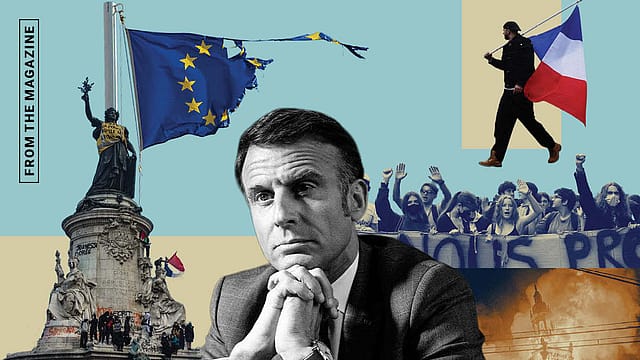
Legacies don’t die over one weekend. Emmanuel Macron’s has been dying for years. This month was merely its funeral. In 2017 he had arrived like a conjurer. Thirty-nine years old, free of party, equally fluent in policy and literature, Macron promised a rejuvenated Fifth Republic that need not choose between two spent camps, still less surrender to the extremes that feasted on them. He kept Marine Le Pen out of the Élysée twice. Few democratic leaders have been handed so much hope, and squandered it so publicly. Now a town hall lies gutted in Limoges, Marianne’s bust has been hurled from its plinth in Marseille, and the president is left on television speaking of “anger and shame”.
His first term was not a mirage. The promised reforms in a country synonymous with bureaucratic red tape and volatile streets were indeed attempted. Labour rules were loosened, the railways confronted, corporate taxes trimmed, joblessness driven down to levels France had not seen in years. Even the Gilets Jaunes (Yellow Vests), who nearly broke him in 2018, proved he could bend without breaking. Macron then looked like the reformer a secular and sclerotic state had been praying for. But reform is a debt repaid in instalments and the bill was due in the second term.
Re-elected in 2022, Macron lost his parliamentary majority within weeks. The pension overhaul, the one change the arithmetic of an ageing country demanded, was forced through without a proper vote and with the streets in revolt. In that moment, the president of youthful charm had become middle-aged and branded highhanded. The gains were, of course, lost. But that too paled before his 2024 gamble. Humiliated by the Rassemblement National (National Rally) in the European elections, Macron dissolved the National Assembly and ended up with three irreconcilable blocs, none able to govern. Prime ministers came and went. The deficit stayed above 5 per cent of GDP; debt drifted past the point where markets stop being polite. The man who promised to keep the extremes from power had built the very stage on which only the extremes retain organisation, money and conviction.
Being term-limited, the departing president could only have looked back. He had made France European leadership material again notwithstanding the size of the—now kaputt—German economy. And abroad, the erosion is subtler but just as telling. For nearly a decade Macron was Europe’s loudest voice. At the Sorbonne in 2024 he had warned that Europe was mortal, and then behaved as though he meant it. He was among the first leaders to entertain European troops in Ukraine; he pushed partners towards rearmament; he made French nuclear deterrence a continental conversation; and he sent forces towards Greenland when Donald Trump threatened to grab it. After Trump’s return, Macron was the one man in the room who could flatter and resist in the same breath. At Davos he said Europe preferred “respect to bullies”. It was a fine line, but not enough to hold the stage.
Because at Davos the standing ovation went to someone else. Mark Carney, opening in French, no less, declared that the world was “in the midst of a rupture, not a transition”, and that middle powers must act together, since those missing from the table end up on the menu. Almost overnight the Canadian became the face of resistance to Trump, a part Macron had spent years rehearsing. Carney had what Macron no longer possessed: a clear mandate and a calmer home front (now revalidated with the Alberta referendum). Power abroad is the shadow cast by order at home. A president whose cities burn cannot command a room with his splendid diction. And France, once the continent’s pivot, is now a fiscal patient, watched by Brussels and the bond markets with the wary courtesy reserved for senior relatives who borrow.
Macron’s nemesis turned out to be the quarrel between old and young. France is organised around its pensioners. The retirement bill swallows an ever larger share of the budget while schools decay, and critics argue classrooms are quietly paying for pensions. The lycéens who barricaded their leaking buildings in September were making a modest request of a state that had stopped listening to its young. Many of them are of immigrant background, wholly or partly, and they don’t share the reflexes of earlier generations of protest. As Walter Russell Mead argues in the Wall Street Journal, they are likelier to torch the town hall than to petition it. Limoges lent it terrible force.
Then the protest was stolen. More than half-a-million marched on October 17, most of them peacefully, among them exasperated parents and teachers. By evening black-clad militants and criminals owned the streets. The far-left, which had spent weeks stoking contempt for the police, was slow and grudging in its condemnation. The sincere marchers lost their message; the cameras focused on the fire—which also gutted a presidential legacy. A democratic grievance was delegitimised in a single night.
The one person who gained most is the one Macron twice defeated. Le Pen leads the polls with an election barely six months away and when she went on air before the tricolour, she sounded like an incumbent in waiting. She mocked a Macronist administration “out of steam” and a left that excuses violence. Disorder is the oldest asset in her family’s portfolio. It lets her offer what the president cannot: order, and an audience ready to hear it. An Ifop-Fiducial poll in August had her winning every runoff tested, and beating the far-left’s Jean-Luc Mélenchon—and alleged instigator-in-chief of the mayhem—by roughly two to one. Her numbers have only improved since.
So, what survives of Macron? A few reforms, a handsome Olympic summer in Paris, a brief season when France believed in itself. What has died is the critical promise. He said the extremes could be held at bay. He leaves a country where they are the only choices: one burning, the other patiently waiting. The centre failed to hold and not for want of ideas. It failed for want of citizens willing to be governed by it. Macron set out to perpetuate the middle. It only reminded him of his impermanence. Europe and the world are not waiting for him.