From Kargil to Operation Sindoor: Evolution of India–Israel Military Cooperation
Behind some of India's most decisive military moments lies a little-discussed partnership. India-Israel weapons imports span six decades, covering everything from ammunition airlifted during Kargil to Kamikaze drones that struck across the border in 2025.
Here is a brief history of how it all began and where it stands today.
When Did India And Israel Begin Their Defense Relationship?
Israel supplied India with critical ammunition during the 1962 Sino-Indian War, the 1971 Bangladesh Liberation War, and provided decisive arms support during the 1999 Kargil conflict. Full diplomatic relations were established in 1992, and by the 2000s, Israel had become one of India's top three defence suppliers.
How Significant Is Israel India’s Arms Supplier?
India-Israel defence deals have grown enormously: India is Israel's largest defence customer, accounting for 34% of Israel's total arms exports between 2020 and 2024, according to SIPRI. Total arms sales during this period amounted to approximately $20.5 billion.
The partnership spans missiles, drones, radars, and electronic warfare systems across all three armed forces.
What Are The Barak And Spyder Missile Systems India Operates?
The Barak-8 is a surface-to-air missile co-developed by Israel's IAI and India's DRDO that intercepts aerial threats at ranges up to 70 km. India also operates the Spyder quick-reaction air defence system, which uses Python-5 and Derby missiles paired with the EL/M-2084 radar, capable of tracking hundreds of targets simultaneously.

The Abandoned Kejriwal
01 May 2026 - Vol 04 | Issue 69
Brain drain from AAP leaves Arvind Kejriwal politically isolated
What Are Harop And Harpy Kamikaze Drones, And How Do They Work?
These are loitering munitions. The Harpy is an autonomous anti-radar drone that hunts and destroys enemy radar systems, while the Harop is a surveillance-strike hybrid capable of loitering for up to nine hours before striking.
Harop and Harpy Kamikaze drones earn their name because the drone itself becomes the weapon, crashing into a target and detonating its 23-kg warhead on impact.
Has India Used These Israeli Drones In Actual Combat?
Yes. During Operation Sindoor in May 2025, India reportedly deployed Harpy and Harop drones to neutralise air defence infrastructure across the border. While India did not officially confirm the deployment, defence reports indicate these drones were pivotal in striking high-value radar installations.
What Is The Phalcon Awacs And Why Does India Value It?
Acquired in a $1.1 billion deal in 2004, the Phalcon is an airborne radar system mounted on Russian Il-76 aircraft, giving the IAF the ability to detect incoming fighters, drones, and cruise missiles from up to 500 km away.
It was the IAF's first airborne early warning capability and remains its most strategically significant surveillance asset. India is currently in discussions to acquire two additional Phalcon aircraft.
What Is The Spice Bomb, And What Role Does It Play?
SPICE kits are precision guidance packages that convert standard unguided bombs into satellite-guided smart weapons. The SPICE-2000 was reportedly used in the 2019 Balakot airstrikes, and India is now procuring the SPICE-1000 variant, which allows pilots to release munitions from up to 100 km away, keeping aircraft safely out of enemy air defence range.
What Came Out Of PM Modi’s Landmark 2026 Visit To Israel?
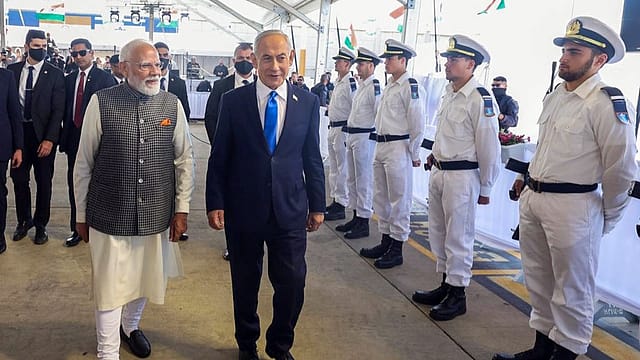
In February 2026, Modi visited Israel for talks with Netanyahu, with both nations committing to shift from a buyer-seller dynamic toward co-development.
Deals worth $8 to $10 billion were discussed, as part of deepening India-Israel defence deals, including the Iron Beam laser weapon and potential integration into India's Mission Sudarshan Chakra air defence programme.
(With inputs from yMedia)