EXPLAINED | Why India Is Rolling Out the Red Carpet for Liechtenstein’s Prince Alois
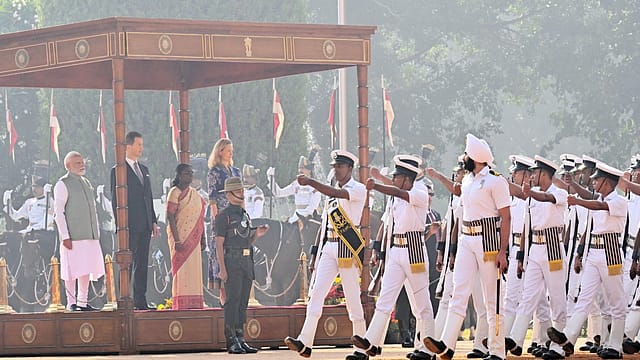
A country with around 41,000 residents has brought a prince and a business delegation to India. Delhi’s welcome includes a ceremonial reception at Rashtrapati Bhavan and talks with Prime Minister Narendra Modi.
Hereditary Prince Alois of Liechtenstein is on the third day of a four-day state visit to India, which concludes on Wednesday, October 28. His country sits between Switzerland and Austria, covers roughly 160 square kilometres and has a population smaller than many Indian neighbourhoods. Its economic reach extends considerably further.
Behind the royal itinerary is a practical question: can a European trade agreement bring more investment, technology and skilled jobs to India?
Liechtenstein belongs to the four-country European Free Trade Association, or EFTA. Its pact with India includes an objective of mobilising $100 billion in investment over 15 years. That figure belongs to the entire bloc. It is also a target whose delivery depends on investors making business decisions.

Look Who's Talking Regime Change
23 Oct 2026 - Vol 05 | Issue 43
Here is what India hopes to gain.
WHERE EXACTLY IS LIECHTENSTEIN?
It is a tiny country in the Alps, squeezed between Switzerland and Austria. It covers about 160 square kilometres, roughly a ninth of the size of Delhi, and has around 41,000 people. Its capital is Vaduz.
Do not let the size fool you. Liechtenstein is one of the richest countries in the world per person, and its economy rests on high-end manufacturing and financial services. It is a hereditary monarchy, with a prince as head of state and an elected parliament.
It also belongs to the European Free Trade Association (EFTA), a four-nation bloc with Iceland, Norway and Switzerland. EFTA is not the European Union. Its members trade freely with each other and sign their own deals with other countries, and that is the bloc India signed a trade pact with.
WHO IS PRINCE ALOIS, AND DOES HE RUN THE COUNTRY?
Strictly speaking, he is the Hereditary Prince, the heir to the throne. The reigning prince, Hans-Adam II, handed over the day-to-day running of the state to his son in 2004. That makes Alois the Acting Head of State, which is why India has treated this as a state visit. He is travelling with his wife, Hereditary Princess Sophie, a high-level official delegation and a group of business leaders.
He knows India well. He visited in 2010 and 2018, and again in February this year for the AI Impact Summit in Delhi.

WHAT BRINGS PRINCE ALOIS TO INDIA?
A trade agreement that can turn into real business. The visit runs from October 25 to 28, with stops in Mumbai and Vadodara before Delhi. Foreign Minister S Jaishankar, Finance Minister Nirmala Sitharaman and Skills Minister Jayant Chaudhary are set to meet him.
The Ministry of External Affairs said the visit would give “renewed impetus” to relations, and it is easy to see why. India and Liechtenstein established ties in 1993, and apart from the trade pact there has been little to show for them.
WHAT DID HE AND PM MODI TALK ABOUT?
According to the Ministry of External Affairs, the two leaders reviewed the whole range of ties. They discussed trade and investment, innovation, science and technology, skill development and people-to-people links. They welcomed the “positive momentum” created by the trade pact and promised to strengthen the partnership.
Speaking earlier, the prince put it in his own words. He said he was “determined to build on this momentum” and saw “tremendous potential” in innovation, advanced manufacturing, financial services, education and technology. The two countries, he said, have “complementary strengths.” Jaishankar said the partnership has “strong momentum,” driven by the opportunities the trade pact opens.
The official readouts did not list any new agreements. That is common in a first state visit, which is mostly about setting direction.
WHAT IS TEPA?
It is the India-EFTA Trade and Economic Partnership Agreement, or TEPA. India signed it on March 10, 2024, after nearly 16 years of talks, and it came into force on October 1, 2025. It was India’s first trade deal with a group of developed European countries.
Its biggest feature is not about tariffs. It is a promise on investment. The four EFTA countries said they would aim to bring $100 billion of investment into India over 15 years, $50 billion in the first ten and another $50 billion in the next five. They also aim to help create one million direct jobs. No Indian trade deal had made a pledge like that before.
On tariffs, EFTA opened its market for 92.2 per cent of its product categories, covering 99.6 per cent of India’s exports. India opened 82.7 per cent of its categories, covering 95.3 per cent of EFTA’s exports, while keeping sensitive sectors such as dairy, soya and coal out of the deal.
WHAT CAN SUCH A SMALL COUNTRY OFFER INDIA?
India does not measure this relationship in today’s trade. When the pact was finalised, India’s imports from Liechtenstein were around $110 million a year, a fraction of the figure for Switzerland, which dominates India’s trade with the bloc. And one product skews the picture. Gold makes up more than 80 per cent of what EFTA sells to India.
What India is after is what Liechtenstein’s companies might do tomorrow. The country is home to makers of precision tools, dental products and industrial equipment, the kind of firms that could set up factories or research centres in India. That matches what Delhi says it wants: technology, investment and skills, not just goods. A warm welcome is also a way of telling the prince’s business delegation that India is serious about making their investments easy.
WHERE DOES SKILL DEVELOPMENT FIT IN?
It may be something where the two countries fit best. Liechtenstein, like its neighbours Switzerland and Austria, is known for vocational training that blends classroom work with time inside companies. India has been trying to build something similar. It is no accident that Jayant Chaudhary, the minister for skill development and entrepreneurship, received the prince at the airport and attended the Rajghat ceremony.
WHY DOES THIS MATTER FOR INDIA’S BIGGER PLANS?
India is trying to open up Europe, market by market. It has the EFTA pact in force, a deal with the UK, and a free trade agreement with the European Union in the works. Commerce Minister Piyush Goyal said in The Hague this week that, taken together, these agreements have “effectively opened the entire European market to Indian industry.”
A state visit from one EFTA member helps to keep the pact alive. Trade deals can sit on paper for years. Visits like this one put pressure on companies and officials to act. It also shows other countries that India takes smaller partners seriously.
WHAT ARE THE CATCHES?
There are three.
First, Liechtenstein alone will not move India’s economy. The $100 billion is a shared target for all four countries, and most of the weight sits with Switzerland and Norway.
Second, the pledge is something the bloc says it will aim for, not a guarantee, because the money will come from private companies making their own decisions.
Third, an agreement does not do the work of setting up a factory. India still has to make it easy to do business, with clear rules and fast approvals.
WHAT SHOULD WE WATCH AFTER THE PRINCE LEAVES?
Whether Liechtenstein’s business delegation comes home with real plans, such as new plants, joint ventures or training partnerships. And whether the investment figures under the pact start to show up in the data. The prince’s visit ends on Wednesday. The answer to whether the red carpet was worth it will come over the next few years.