EXPLAINED | What Is ‘Maxxing’, Dictionary.com’s Word of the Year?
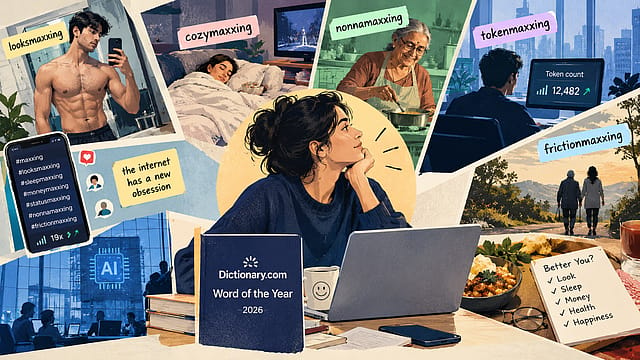
Why does even relaxing need to be maxxed?
Put on a film, pull up a blanket and settle into the sofa. You could call it a quiet evening. The internet has a more ambitious description: cozymaxxing.
The joke works because the ending is familiar. Attach “maxxing” to an activity and it sounds as though you are pursuing its most complete, effective or exaggerated version.
Dictionary.com has selected maxxing as its 2026 Word of the Year. Its October 26 announcement recognises an expression that can describe a serious personal goal or give watching television the vocabulary of a performance review.
WHAT DOES MAXXING ACTUALLY MEAN?
It means maximising something or trying to optimise a particular aspect of life. The word attached to it identifies the pursuit: looksmaxxing concerns appearance; sleepmaxxing concerns sleep.

Look Who's Talking Regime Change
23 Oct 2026 - Vol 05 | Issue 43
The tone can be earnest, playful or mocking. Someone discussing a carefully planned routine may mean it seriously. Someone describing an afternoon under a duvet may be enjoying the absurdity.
Its adaptability helps explain the appeal. Once you recognise the pattern, you can usually decode a new variation without consulting a dictionary.
DID SOMEONE INVENT IT IN 2026?
The vocabulary is older. Its roots include maximum, maximise and the gaming strategy known as min-maxing, where players make trade-offs to build a more effective character.
Online communities subsequently applied the language of optimisation to people. Dictionary.com documents looksmaxxing by 2015, with moneymaxxing and statusmaxxing circulating by 2021.
Those dates establish that the expressions existed by then. They do not necessarily identify who first invented them.
Word of the Year recognition marks prominence during a particular period. It need not celebrate a word’s birthday.
WHY DOES LOOKSMAXXING CARRY MORE BAGGAGE?
It developed in online incel communities, where men discussed physical attractiveness and romantic rejection. Some of those spaces also circulated misogynistic ideas. The vocabulary later spread to a wider social-media audience.
The associated activities vary enormously. Grooming and fitness can sit beneath the same label as extreme interventions and unsupported claims about changing facial appearance.
That makes context essential. A person joking about a haircut and a forum assigning social worth through facial measurements may use the same expression for very different behaviour.
HOW DID MAXXING GET INTO THE OFFICE?
Through expressions such as tokenmaxxing.
AI systems divide text and other material into units called tokens. Consumption can be counted, which makes it an appealing measure for companies eager to demonstrate AI adoption.
Tokenmaxxing describes efforts to maximise that use. Workplace versions have included tracking consumption and comparing employees or teams through leaderboards.
The obvious question is what all that activity achieves. A higher token count may accompany useful work, but the count alone cannot establish the quality of the result.
CAN MAXXING ALSO MEAN SLOWING DOWN?
Nonnamaxxing takes inspiration from an Italian grandmother, or nonna. Think home cooking, walking and time with family and friends. Familiar routines acquire the presentation of an internet wellness strategy.
Friction-maxxing takes another route. It asks whether we should become more willing to tolerate inconvenience instead of automatically eliminating it through technology.
An awkward conversation, a household task or a moment of boredom can all be treated as problems requiring a digital solution. Friction-maxxing invites people to consider what they might lose by removing every difficulty.
The ending is flexible enough to accommodate both relentless improvement and a deliberate change of pace.
HOW BIG WAS THE WORD’S RISE?
Dictionary.com says digital-media use of maxxing in August 2026 was nearly 19 times its 2025 monthly average.
That comparison measures the expression’s visibility in media. It does not count how many people follow a particular routine or establish whether those routines work.
A word can become prominent because people adopt it, joke about it or argue over it.
WHAT IS THE INDIA CONNECTION?
Indian reporting was examining looksmaxxing well before this announcement.
An August 2024 report featured 18-year-old college student Ayush Bijlwan, who described checking his reflection around 40 times a day. It offered an early Indian example of the pressure that could accompany appearance optimisation.
An April 2026 exploration of maxxing also examined how beauty, fitness and self-improvement could turn into expectations of constant personal upgrading.
Nonnamaxxing offers a lighter point of recognition. Home cooking, walking and family time may sound familiar to a dadi or nani. An internet label can give established household habits a fashionable new identity.
WHAT OTHER WORDS HAVE BEEN MAKING NOISE IN 2026?
There is plenty beyond maxxing itself.
Friction-maxxing means accepting more everyday inconvenience. Tokenmaxxing describes maximising AI consumption, sometimes as a workplace performance signal. Chinamaxxing refers to an online embrace of habits associated with Chinese life, sometimes playfully or superficially. Nonnamaxxing borrows an Italian grandmother’s routines.
Work has supplied microshifting, or organising tasks into shorter blocks around other responsibilities. Tech’s anxieties have produced SaaSpocalypse, a label for fears that AI could disrupt software-as-a-service businesses.
Then there is unc, derived from uncle. Depending on context, it can affectionately or mockingly cast someone as older or out of touch. It also made Dictionary.com’s shortlist.
These are distinctive terms that attracted attention this year. Several were already in circulation.
DOES WORD OF THE YEAR MEAN EVERYONE USES IT?
It reflects a particular publisher’s editorial selection. Other dictionaries make their own choices.
Dictionary.com’s shortlist also included affordability, data center and odyssey, alongside unc.
Maxxing stands out because its ambition can be sincere or comical. It can describe a carefully pursued goal or make an ordinary evening at home sound like an achievement.
Before decoding someone’s latest maxxing project, ask what they are actually doing. Sometimes the inflated description is the joke.