EXPLAINED | Spain Train Crash: How Did a Moving Train Hit One That Had Already Stopped?
What happened on the Madrid-Seville line?
The Iryo train had stopped. Behind it, a Renfe train was allowed to move again.
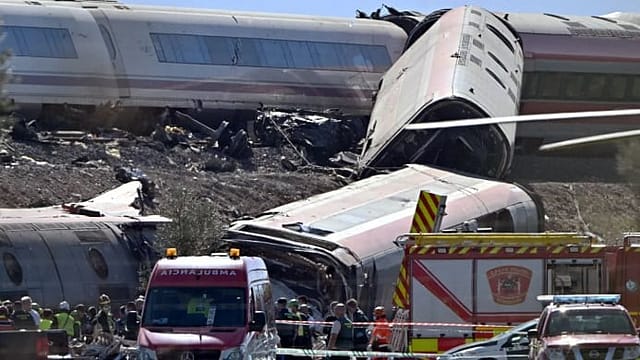
The resulting collision killed at least 68 people near Urda in Toledo province on October 28. Carriages derailed, wreckage fell down an embankment and emergency teams searched the damaged trains for victims.
The services were carrying 544 passengers between them: 147 on the privately operated Iryo train and 397 on the state-owned Renfe service, according to the regional authorities.
Renfe confirmed that its 8 am departure from Madrid’s Puerta de Atocha station, bound for Seville, was involved. Services between Madrid, Ciudad Real and Andalusia were interrupted.

Look Who's Talking Regime Change
23 Oct 2026 - Vol 05 | Issue 43
The latest corroborated reports available on October 29 still put the death toll at at least 68. Injury counts differ across updates, so they should remain provisional.
WHY HAD THE FIRST TRAIN STOPPED?
Spain’s Transport Minister Óscar Puente said a computer communications failure triggered automatic stops.
According to his preliminary account, central control then authorised the Renfe train to proceed without a speed restriction, although the Iryo train remained stationary ahead.
Puente described the instruction as “inexplicable”. ABC News reported his explanation that the control centre takes over when the system fails. That account identifies the immediate question. A technical problem had brought trains to a halt. Investigators must establish how the subsequent operating instructions permitted a collision.
The minister’s statement is an initial explanation. It does not replace the findings of the technical and judicial investigations.
SHOULDN’T AUTOMATIC PROTECTION PREVENT THIS?
Automatic protection is intended to keep a dangerous movement from becoming a crash. But a railway also needs procedures for operating when equipment becomes unavailable.
Those procedures govern who can authorise movement, what information must be checked and how cautiously a train may proceed.
In this case, investigators need to reconstruct the status of the signalling and protection equipment, the location information available to controllers, the instructions issued and the response aboard the Renfe train.
They must also establish its actual speed. A train’s description as “high-speed” does not establish its speed at impact. The central issue is how the system protected a stopped train while another was being authorised to approach it.
IS “HUMAN ERROR” A COMPLETE EXPLANATION?
It identifies a possible action without explaining the conditions behind it.
Investigators will need to examine communications, operating rules, training and the information displayed to staff. They must establish whether the instruction breached a clear procedure, whether safeguards were unavailable and whether another check should have prevented the movement.
Responsibility may ultimately attach to particular decisions. Understanding why those decisions occurred is essential to preventing another collision.
A final account must explain the entire sequence, including the technical failure and the procedures used afterwards.
DIDN’T SPAIN SUFFER ANOTHER DISASTER IN JANUARY?
Yes. On January 18, a high-speed train derailed near Adamuz in Córdoba province and collided with an oncoming service. Forty-six people died.
That crash also involved Iryo and Renfe services on the Madrid–Andalusia corridor. The two disasters have therefore killed at least 114 people combined.
The circumstances differ. Adamuz involved a derailment and an approaching train on another track. The October collision involved a moving train striking a stationary service ahead.
Shared operators and a shared corridor do not establish a shared cause. Each investigation must determine what failed.
WHAT OTHER FATAL TRAIN CRASHES HAS EUROPE SEEN IN 2026?
Spain also suffered a fatal commuter-train crash at Gelida, near Barcelona, on January 20. A retaining wall fell onto the track during heavy rain, and the train driver died. The incident highlights the danger posed by structures and terrain beside a railway.
In northern France on April 7, a TGV struck a truck carrying military equipment at a level crossing in Bully-les-Mines. The train driver was killed. A high-speed train can operate over conventional track, where road crossings introduce a different hazard.
On April 16, a passenger train and a lorry collided at a crossing in Dunajská Streda, Slovakia. The lorry driver died and 21 people were injured.
A train struck a school minibus at Buggenhout, Belgium, on May 26, killing four people, including two children. The deaths occurred in a road vehicle involved in a railway collision.
Britain suffered a fatal passenger-train collision near Bedford on June 19. The Corby–London service struck a stationary Nottingham–London train at Elstow. The approaching train’s driver died, the transport secretary told Parliament.
On June 20, two freight trains collided on a bridge in Munich, killing one person. Carriages fell onto the street below, according to Reuters’ account of police statements.
At Hoghton in Lancashire on June 25, a passenger train struck a car at a level crossing, killing the motorist. Britain’s Rail Accident Investigation Branch opened an investigation.
On September 9, a passenger train collided with a concrete mixer truck at Sokolniki Suche in Poland and derailed. Updated specialist reporting confirms one passenger death; an early report of a second death was not officially confirmed.
WHAT ABOUT THE UNITED STATES?
The US record requires the same distinction between train occupants, road users and railway workers.
Near Victor, Iowa, on June 3, a train struck a truck at a crossing and derailed. One person in the truck died. In Jacksonville, Florida, a motorist was killed in an Amtrak crossing collision on July 22.
Fatal railway incidents also include workers struck during operations. The National Transportation Safety Board is investigating the death of an Amtrak maintenance worker at Lancaster, Pennsylvania, on February 23, and a Norfolk Southern conductor near Whiting, Indiana, on July 9.
These are serious safety events, but they are different from a mass-casualty passenger-train collision.
The February 22 collision between a reversing freight train and a stationary Amtrak service near Memphis caused minor injuries to four people, according to the NTSB. It should not appear in a list of deadly crashes.
DO TRAM CRASHES BELONG IN THE COMPARISON?
They belong in a separately identified category.
A Sarajevo tram derailment killed one person on February 12, while a Milan tram derailment killed two on February 27. Urban trams interact with streets and pedestrians under operating conditions different from intercity railways.
Similarly, serious crashes without fatalities must not be added to a death chronology. Denmark’s April head-on train collision injured 18 people; the reporting reviewed did not establish deaths.
DO THESE CRASHES PROVE RAIL TRAVEL IS BECOMING MORE DANGEROUS?
A sequence of disasters warrants scrutiny, but cannot establish a trend on its own.
A meaningful comparison requires consistent categories and measures of exposure, such as passenger journeys or train-kilometres.
Eurostat recorded 750 accidental railway deaths across the EU in 2024. Most were unauthorised people on railway property. Those figures cannot be treated as a count of passengers killed in crashes.
For Indian readers, that distinction matters when comparing railway systems with different networks and traffic patterns. Passenger collisions, level-crossing deaths and worker fatalities each require their own analysis.
WHAT MUST SPAIN ANSWER NOW?
Investigators must establish what failed, who authorised movement, what speed and stopping instructions applied, and why the stationary train remained exposed.
Spain has declared three days of mourning, from October 29 to 31.
The stopped Iryo service had become an obstacle the railway needed to protect. Explaining how another train reached it is the essential task now.
Lead-picture caption: Rescue crews search damaged carriages near Urda after the October 28 collision. Investigators are examining the authorisation to restart a Renfe service while an Iryo train remained stopped ahead.