EXPLAINED | He Lost Brazil’s Election. Why Is Flavio Bolsonaro Claiming Victory From Miami?
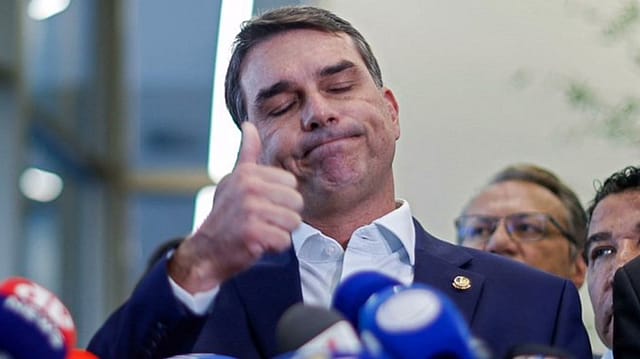
What did Bolsonaro say after reaching America?
The first letter called him “the elected president”. The replacement called him the rightful “leader”.
Both came after Flavio Bolsonaro had lost Brazil’s presidential election and arrived in Miami.
Reuters reported that the senator deleted the initial version of his statement on X and published another accusing President Luiz Inácio Lula da Silva and the Supreme Court of stealing the election. He supplied no evidence establishing electoral fraud.
The change of wording left his political message intact: he would challenge Lula’s legitimacy and lead opposition from abroad.
His departure has also created a separate legal dispute. Brazilian authorities say he left despite restrictions imposed in a criminal investigation. Bolsonaro denies wrongdoing and says he travelled to protect himself and his family.

Look Who's Talking Regime Change
23 Oct 2026 - Vol 05 | Issue 43
WHO ACTUALLY WON THE ELECTION?
Brazil’s Superior Electoral Court, known as the TSE, announced Lula’s re-election following the October 25 runoff.
Its figures give Lula 64,256,232 votes, or 51.79% of valid votes, against Bolsonaro’s 59,826,041, or 48.21%. The difference is 4,430,191 votes.
Bolsonaro had finished ahead in the first round. That gave his campaign momentum, but the runoff was a separate contest between the remaining candidates.
AFP describes a campaign in which Lula recovered while Bolsonaro’s supporters anticipated victory. Bolsonaro nevertheless secured almost 60 million votes, leaving him with a substantial constituency after defeat.
His declaration from America has not changed the result announced by Brazil’s electoral authority.
WHO IS FLAVIO BOLSONARO?
The 45-year-old senator is the eldest son of former president Jair Bolsonaro and an heir to his father’s political movement.
He entered Rio de Janeiro’s state legislature at 21 and became a senator at 37. During the presidential campaign, he sought to broaden the family’s appeal while repeatedly invoking its political identity.
That surname carries an established support base and a history of confrontation with Brazil’s courts.
His father also travelled to Florida after losing to Lula in 2022. Jair subsequently returned to Brazil and was convicted of plotting a coup following that defeat. The parallels make Flavio’s departure particularly charged, although the allegations and proceedings involving each man must be considered separately.
WHAT IS HIS ARGUMENT AGAINST THE RESULT?
A central complaint concerns a court decision extending voting by two hours.
Lula’s campaign had raised transport problems affecting voters. Bolsonaro’s campaign also sought an extension, citing heavy rain in southern and southeastern regions, according to Agência Brasil.
The TSE’s president acknowledged operational difficulties. The extension was communicated after the normal closing time, when thousands of voting machines had already been closed and could not reopen. Processing of results was temporarily interrupted while officials adapted procedures.
Those difficulties deserve scrutiny. They do not themselves establish that votes were fabricated or that Bolsonaro won.
Reuters cited an analysis estimating fewer than 35,000 votes were cast during the additional period, against a winning margin exceeding four million. That comparison concerns the alleged effect of extended hours; it is not a ruling on every possible electoral complaint.
IS HIS OWN CAMPAIGN BACKING THE FRAUD CLAIM?
A significant qualification has come from within his camp.
Campaign coordinator Rogério Marinho said neither he nor Bolsonaro’s Liberal Party could assert that fraud occurred because they lacked evidence, according to Folha de S.Paulo.
That distinction matters. A candidate may object to a procedure or pursue a legal challenge. Establishing that an election was stolen requires evidence capable of supporting that conclusion.
The burden does not disappear because the allegation comes from a candidate with millions of supporters.
WHY WAS HE ORDERED TO SURRENDER HIS PASSPORTS?
The travel restrictions relate to a criminal investigation.
Brazil’s Federal Police said it sought precautionary measures on October 25 after identifying a risk that Bolsonaro would leave. These included passport seizure, a prohibition on departure and restrictions on contact with other people under investigation.
Agência Brasil reports that the relevant proceedings concern suspected money laundering and currency offences. Bolsonaro denies irregularities. The court decision itself is under seal, limiting independent examination of its full reasoning.
An investigation is not a conviction. The restrictions nevertheless created obligations whose alleged breach is now being examined separately.
HOW DID HE GET TO MIAMI?
The reported route passed through Argentina and Ecuador before reaching Florida.
AFP reports that Bolsonaro arrived with his wife and two daughters after a secretive departure from Brazil.
Brazil’s Federal Police said his Brazilian ordinary and diplomatic passports had been cancelled and an immigration alert entered. It also said he failed to surrender any passports of other nationalities within the stipulated deadline.
Crucially, police reported no official record of his departure through Brazilian immigration checkpoints.
The circumstances of the journey therefore remain part of the inquiry.
DOES THAT MAKE HIM A FUGITIVE?
Brazilian police explicitly cautioned against that conclusion.
Their October 28 statement said restrictions involving travel documents do not, by themselves, establish fugitive status or authorise arrest, permanent surveillance or additional precautionary measures.
This explains an apparent contradiction in the headlines. Reporting may describe someone as having fled because of the circumstances of departure, while the authorities apply a narrower legal classification.
Police are investigating alleged non-compliance with judicial orders. Their statement should govern how his current status is described.
HAS TRUMP RECOGNISED HIM AS PRESIDENT?
The material available does not establish such recognition.
According to the supplied ANI report, Donald Trump said he “won’t get involved” when asked about Bolsonaro’s claim, while again describing the election as “very strange”.
Admission to the United States is a different decision from recognising someone as another country’s president.
Bolsonaro’s presence also places Washington in a sensitive position: an allied politician is contesting the result in a major regional country while staying on American territory.
WHY SHOULD INDIAN READERS FOLLOW THIS?
India has already responded to the announced result.
Prime Minister Narendra Modi congratulated Lula on October 26 and expressed his intention to deepen the India–Brazil Strategic Partnership and cooperation on Global South priorities.
The episode also illustrates how several disputes can become entangled: an election challenge, a criminal inquiry and a politician’s relationship with a foreign government.
Each requires its own evidence. A travel restriction does not prove an electoral claim false; alleging persecution does not prove an election stolen.
WHAT HAPPENS NEXT?
The immediate questions concern any formal electoral challenge, the investigation into Bolsonaro’s departure and his ability to maintain political leadership from abroad.
His vote share gives him a substantial audience. Distance may change how effectively he can organise it.
For now, Lula remains the winner announced by the electoral authority. Bolsonaro’s task is to turn allegations into a substantiated legal case if he wants that result overturned. A declaration issued from Miami cannot do that work.