EXPLAINED | From Arnab to Murasu: Who Gives Cyclones Their Names?
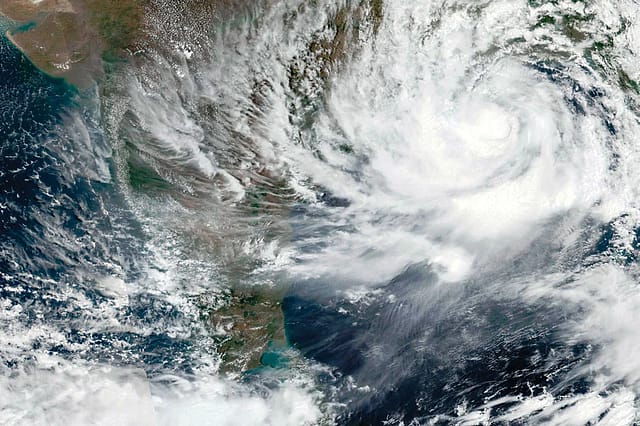
A new Bay of Bengal storm has acquired a name: Murasu. The India Meteorological Department’s November 1 bulletin says it became a cyclonic storm. It follows Arnab, which made landfall in Andhra Pradesh on October 28.
Bangladesh supplied Arnab; India supplied Murasu. Neither name was invented for these storms. Both were on a list approved in 2020.
Who actually decides a cyclone’s name?
There are three stages: proposing names, approving the list and assigning a name to a storm.
Participating countries submit suggestions through regional arrangements involving their weather services. The responsible regional committee agrees on a list under the World Meteorological Organization’s framework. When a storm qualifies, the designated weather centre assigns the next name according to that region’s rules.

The Era of Forever Wars
30 Oct 2026 - Vol 05 | Issue 44
Coping with an explosive Middle East
For the Bay of Bengal and Arabian Sea, that centre is IMD in New Delhi. Its responsibility covers storms across this region, including those heading towards another country.
Why did Murasu follow Arnab?
The North Indian Ocean list contains 169 names, with 13 supplied by each of 13 countries. The countries are arranged alphabetically. Forecasters work down one column, then move to the next.
In the relevant column, Bangladesh’s Arnab is followed by India’s Murasu, then Iran’s Akvan. The storm’s destination does not decide whose suggested name it receives. The same queue serves the Arabian Sea and Bay of Bengal.
Murasu means “drum” in Tamil. Its position on the list cannot tell us how powerful the storm will become.
Can you suggest a name yourself?
Public suggestions can feed into the process. An IMD committee considered suggestions from people in India when selecting the country’s contributions to the 2020 list.
Acceptance has conditions. North Indian Ocean names must be short, easy to pronounce and no longer than eight letters. They must avoid offence and remain neutral towards politics, political figures, religious beliefs, cultures and gender. The regional panel can reject a proposal or review an approved name following a reasonable objection.
A suggestion, therefore, needs scrutiny and approval before it reaches a storm.
When does a storm earn its name?
For systems forming in this region, IMD assigns a name when maximum sustained surface winds reach at least 34 knots, approximately 62 kmph. That is cyclonic-storm strength.
A depression can be tracked before it qualifies. Once named, a storm keeps its name as it strengthens. A more powerful Murasu would still be Murasu.
Did forecasters really approve “Dim-sum”?
Yes. On June 8, 2026, the Hong Kong Observatory announced nine replacement names endorsed by the regional Typhoon Committee. Hong Kong’s Dim-sum replaced Man-yi on the western North Pacific and South China Sea list.
That is a concrete example of the approval stage. A proposed name becomes part of the official list before a future storm receives it. The announcement established Dim-sum’s place in that list; it did not announce an active storm called Dim-sum.
The list reflects the participating countries’ languages and cultures. The North Indian Ocean’s particular selection rules are not universal.
What other surprising names are on the lists?
There is enough food for a small menu. Macao’s Bebinca means Macanese milk pudding. Malaysia’s Nangka means jackfruit. Hong Kong’s Yun-yeung refers both to a duck species and to a drink mixing tea and coffee.
Japan’s Koinu is listed as “Canis Minor; puppy”, connecting the name to a constellation. Cambodia supplied Damrey, meaning elephant. The Republic of Korea supplied Gaemi, meaning ant. Micronesia’s Tirou is a formal, respectful greeting in Chuukese culture.
China’s Wukong refers to the Monkey King. The Hong Kong Observatory explains the character’s journey accompanying the monk Xuanzang to India for Buddhist scriptures. Vietnam’s Son-Tinh refers to a mountain god in Vietnamese mythology.
These are approved names with documented meanings. A friendly animal, a sweet dish or a mythical hero offers no clue to the danger of the storm receiving its name.
Do America and Australia use the same system?
They also use agreed lists, but the arrangements differ.
Atlantic lists alternate male and female names and normally repeat every six years. Men’s names were introduced in 1979. Australia uses an alphabetical sequence alternating male and female names, taking the next available name.
The western North Pacific list includes words contributed by countries and territories, used sequentially across years. It does not restart at the top every January. North Indian Ocean names, meanwhile, are used only once.
Why do some names get banned from returning?
A name associated with exceptional death or destruction can be retired where lists normally repeat. Katrina is a retired Atlantic name; Australia’s Tracy was retired after the devastating 1974 cyclone.
Language can also be a problem. In its June 2026 announcement, the Hong Kong Observatory said Jebi had been retired because of an inappropriate meaning in other languages. It did not identify the language or meaning. Narae replaced it.
North Indian Ocean names already follow a non-repetition rule, regardless of whether a storm becomes a historic disaster.
Can one storm have two names?
Yes. The Philippines assigns domestic names alongside international ones. Typhoon Rai was locally called Odette in 2021. Both names identified the same system.
A storm can also keep its name while changing its regional description. Dora crossed the International Date Line in 2023 and became a typhoon after travelling through the eastern and central Pacific as a hurricane.
What makes a cyclone dangerous beyond its name?
A tropical cyclone is an organised, rotating storm over warm ocean waters. Rising moist air forms clouds and releases heat as water vapour condenses, helping fuel the system. Suitable atmospheric conditions are also needed. Hurricane and typhoon are regional terms for strong tropical cyclones.
Its dangers include destructive winds, heavy rain and storm surge: an abnormal rise in sea level driven mainly by winds pushing water towards the coast. Flooding can extend inland. A wind category alone cannot describe every threat.
Names help people recognise which system a warning concerns, particularly when several storms are active. Local forecasts explain the danger.
What happens next?
IMD’s November 1 afternoon forecast placed Murasu’s expected crossing of the south Andhra Pradesh coast between late November 2 and early November 3. That timing remains subject to revision.
Iran’s Akvan comes next in the regional naming queue. Its position tells us the next name, without predicting when or where another storm will form. For people in affected districts, the immediate priority is the latest weather warning and evacuation advice.