Europe Protests: Meloni Warns Against Setting Cities Ablaze, Macron Vows Prosecutions
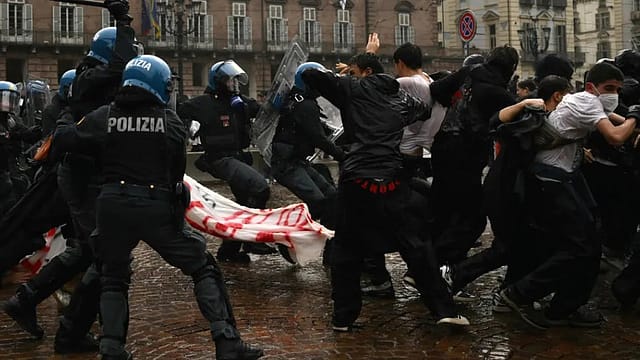
Protests against the rising cost of living turned violent in several European countries on Saturday. Clashes broke out between demonstrators and police in France, Italy and Belgium, and the leaders of all three governments responded with sharp warnings against violence.
FRANCE: WEEKS OF STUDENT ANGER BECOME A NATIONAL PROTEST
The unrest in France began weeks ago with student protests over what young people call “deplorable” school conditions, alleged education budget cuts and excessive police force. It has since grown into a larger protest over fuel prices and falling purchasing power.
Interior Minister Laurent Nuñez told France 24 that about 550,000 people took part across the country, including 110,000 in Paris, and that police have arrested around 400.
According to France 24, the protests turned severely violent in places. A protester lost a hand, several fires were set, and dozens of shops were ransacked. Police used water cannons and tear gas on masked groups throwing missiles and launching fireworks, and several vehicles were set ablaze in the capital.

Zeroing In on ECI
09 Oct 2026 - Vol 05 | Issue 41
Constitutional legitimacy versus political opportunism
The worst of the violence was carried out by masked youths on the fringes of rallies that were otherwise peaceful and drew diverse crowds, including families.
President Emmanuel Macron said there was “no room for violence in our Republic.” Those who attacked prefectures and businesses, or looted town halls, he said, “will be prosecuted and punished.” He expressed the nation’s support for the police and vowed unity against the “sowers of chaos.”
Prime Minister Sébastien Lecornu blamed “ultraleft groups” for orchestrating violence in several cities, saying delinquents had joined in to pillage and destroy. Six months before the presidential election, he rejected any attempt to use the unrest as a “warm-up,” saying no one would impose a political agenda through violence.
He also backed the “pay-the-damagers” bill, which would make those responsible bear the cost of the destruction. Nuñez, meanwhile, joined the Paris crisis unit and brought together the district mayors to coordinate the response, calling on residents to stay calm.
French media report that former “Yellow Vest” figures are set to join the protests in support of high-school students. That movement began in 2018 over fuel prices and inequality, and its clashes with police injured more than 2,500 protesters and 1,800 officers.
ITALY: ‘DEMONSTRATING IS A RIGHT. SETTING OUR CITIES ABLAZE IS NOT’
In Italy, rallies organised by the “Italy in the Square” committee against inflation, low wages, underfunded healthcare and poor conditions in public schools turned violent, according to Rai News. More than 5,000 people took part in Milan alone.
The worst trouble came in Milan’s Piazza Duomo, which Rai News described as “urban warfare.” Agitators smashed shop windows, set a construction site on fire and fired pyrotechnics at police on Via Broletto.
Riot police charged repeatedly after protesters tried to break through security cordons. About 12 people were hospitalised and around 50 were detained. In Bologna, a breakaway group of hooded youths targeted the central railway station, throwing stones, bottles and smoke bombs at police. Water cannons and tear gas were used, and at least seven people were detained.
Prime Minister Giorgia Meloni said she respected the thousands who protested peacefully, including those in the CGIL-called mobilisation that left-wing leaders joined. She said stones were thrown at police in Milan, officers were injured and the procession had to be halted, that people were stopped in Turin carrying cobblestones and window-breaking hammers, and that Bologna’s station was closed as a precaution.
She called those responsible “thugs” who exploit demonstrations to hold entire cities hostage.
“Demonstrating is a right. Setting our cities ablaze is not,” she said. She also urged the opposition not to be ambiguous, saying it must condemn the violence unequivocally and appeal for peaceful protests. “Any hesitation becomes justification,” she said.
BELGIUM: WATER CANNONS IN BRUSSELS AND LIÈGE
In Belgium, clashes broke out between protesters and police in Brussels and Liège, Euronews reported. Police used water cannons while protesters threw objects, including water bottles, at officers.
Interior Minister Bernard Quintin said what was unfolding was no longer protest but “pure and simple violence, organised and repeated to destabilise our society.” Federal police are supporting local forces, he said, and “all necessary means” will be used to restore order against the “rioters.”
With inputs from ANI