Christ Statue in Southern Lebanon Vandalised? Here’s What A Viral Photo Shows
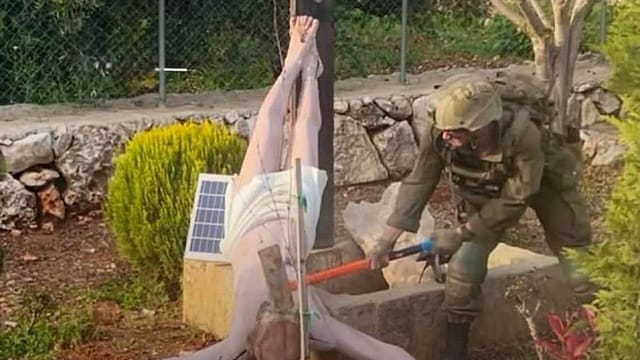
A photograph showing an Israeli soldier damaging a statue of Jesus Christ in southern Lebanon has ignited widespread outrage, prompting the Israeli military to launch an official investigation.
The image, which spread rapidly across social media, appears to show a soldier striking the head of a crucified Christ statue with a hammer or axe in the predominantly Christian village of Debel.
What exactly does the viral image show?
According to reports, the photograph captures the figure of Christ dislodged from the cross and leaning awkwardly, appearing upside down. The act of damage—allegedly carried out by a soldier—has amplified the shock, given the religious significance of the symbol.
The image was first shared by Palestinian reporter Younis Tirawi, who also posted an earlier photo of the statue alongside the biblical quote: “Father, forgive them; for they know not what they do (Luke 23:34).”
Why has the image triggered such strong reactions?
The reaction has been swift and emotional, particularly because the incident involves a sacred Christian symbol in a region already marked by conflict.
"We certainly condemn this shameful act because it offends our religious feelings and is an attack on our sacred beliefs," Maroun Nassif, the deputy head of the Debel municipality, told CNN.

Open Minds 2026
26 Jun 2026 - Vol 05 | Issue 26
The power of ideas and arguments in 50 portraits
Social media users echoed similar sentiments. “You don't have to be Christian to see what this represents: disrespect, dehumanisation, and impunity,” one user wrote, while another said, “This guy literally had to go out of his way to do this. Disgusting.”
How did the Israeli military respond initially?
The Israeli military initially approached the image with caution, questioning its authenticity.
Responding to the viral post, IDF spokesperson Lieutenant Colonel Nadav Shoshani said, “If this is indeed a real, recent picture, these actions do not align with the IDF's values and the behaviour expected of IDF soldiers,” adding that the matter would be investigated thoroughly.
What has the IDF confirmed since then?
In a subsequent update, the Israel Defense Forces confirmed that the photograph is authentic and does depict one of its soldiers damaging a Christian symbol in southern Lebanon.
The military said it views the incident with “great severity,” adding that the soldier’s conduct is “wholly inconsistent with the values expected of its troops.”
"Appropriate measures will be taken against those involved in accordance with the findings," the IDF said.
What actions are being taken now?
The investigation has been handed to the IDF’s Northern Command and is being processed through the chain of command.
The military also stated that it is working to assist the local community in restoring the damaged statue to its original place, signalling an attempt to address both accountability and community relations.
Why is this incident significant in the broader conflict?
Debel is one of several towns in southern Lebanon currently under Israeli military presence, located near Bint Jbeil—an area at the centre of ongoing operations targeting Hezbollah infrastructure.
While the IDF has reiterated that its operations are aimed at militant targets and not civilian or religious sites, this incident risks undermining that claim and intensifying tensions, particularly among local Christian communities.
(With inputs from ANI)