Beaten by Gen Z, Deuba Returns to a Nepal That Has Moved On
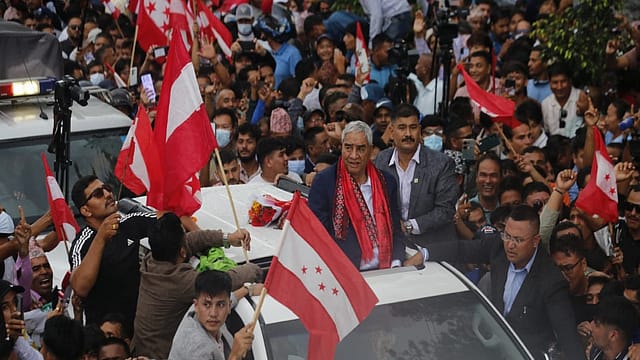
Last September, they came for his house. This August, they came to the airport to welcome him home. Between those two images lies perhaps the most dramatic year in Sher Bahadur Deuba’s long political life.
On September 9, 2025, Nepal’s Gen-Z protests reached the home of the five-time prime minister. A mob stormed his residence. Deuba and his wife, former minister Arzu Rana Deuba, were beaten and suffered serious injuries.
On Thursday, almost a year later and after nearly six months abroad for medical treatment, the 80-year-old politician returned to Kathmandu. This time, there were musical bands. Cultural performances. Thousands of Nepali Congress workers waiting for him. And Deuba returned with a message that would have been difficult to imagine amid the violence of last September. The younger generation, he said, must be given greater opportunities to lead.
The Identity Project
11 Sep 2026 - Vol 05 | Issue 37
Amit Shah leads the mission for a national demographic correction
A homecoming carrying the scars of September
Deuba had left Nepal for Singapore on February 25 with his wife for medical treatment following the injuries they suffered during the protests. The couple were subsequently seen in Hong Kong, though they have not publicly disclosed details of their treatment.
He returned alone on Thursday. Senior Nepali Congress leader Bimalendra Nidhi recalled the violence while waiting for Deuba at Tribhuvan International Airport. “He was brutally beaten and his wife and he were injured, with injuries to their heads,” Nidhi told ANI.
The man returning, however, chose reconciliation over recrimination. In a statement after landing, Deuba said he had come back “not to gain power but to strengthen national unity.” He spoke about healing wounds created by political divisions and hostility. He called for reconciliation instead of retaliation. And then he addressed the political force that has transformed Nepal over the past year: its young.
What does Deuba say about Gen Z now? There is an intriguing complexity to his message.
Deuba said the Nepali Congress had accepted the demand for change voiced by the younger generation and argued that young people should be given greater opportunities in leadership.
But he also pushed back against the idea that generational change requires repudiating everything that came before it. “Change does not mean that the past was bad or that the sacrifices, struggles and contributions of our generation were wrong,” he said.
It is, in many ways, the argument of an old political order trying to negotiate with the new one. Make room for the young, Deuba is saying. Just don't erase the old.
But what exactly is Deuba returning to?
Certainly not the Nepal he left behind. His own party is embroiled in a bitter leadership struggle. Gagan Thapa ousted Deuba through a special general convention, and in April the Supreme Court recognised the Thapa faction as the official Nepali Congress.
That battle isn't over. Earlier this month, the Supreme Court allowed a review petition, reopening the question of who controls the party. A three-judge bench will now reconsider the dispute.
Deuba's return also coincides almost perfectly with a national gathering of the Nepali Congress's non-establishment faction from August 14 to 16. He is expected to address it on Friday.
So the man who says he has not returned for power has landed straight back in the middle of a fight over who gets to wield it.
And politics isn't his only problem. A money-laundering investigation initiated last November continues to hang over Deuba and his family. Authorities froze movable and immovable assets registered in the names of Deuba, his wife, their son Jaybir Singh Deuba and some relatives. The government of Prime Minister Balendra Shah had also sought arrest warrants against the couple and requested an Interpol Red Notice. Interpol declined the request, while Nepal's Supreme Court annulled the arrest warrant in May.
Deuba's allies describe the allegations as politically motivated. Nidhi called them “revengeful acts” and “false and fake charges”, saying they would be resolved through due process.
So, why has Deuba returned now? That may be the most interesting question. At 80, Deuba has already been prime minister five times. His political career spans decades of upheaval in Nepal. Yet he insists this return is different. “My life is an open book,” he said after arriving home, promising to continue working for the country, democracy and the Constitution for as long as he lives. He described himself not as a politician returning in search of another office, but as a lifelong citizen hoping to use his experience to help the country navigate change.
Nepal will now discover whether its younger generation wants that experience. Because Deuba's return carries an extraordinary political irony. The Gen-Z uprising nearly drove him out of public life. Now, months later, he has returned promising to help put Gen Z closer to the centre of it.
(With inputs from ANI)