Anne Carson Wins 2026 Nobel Prize in Literature
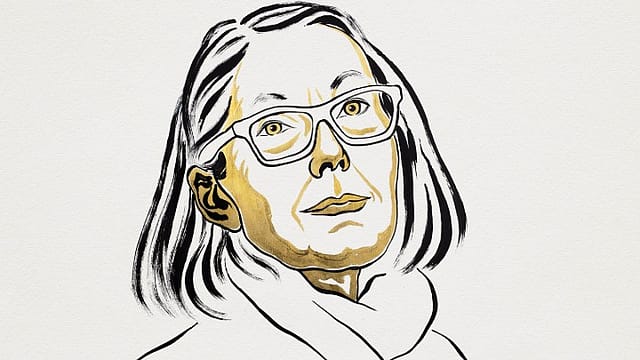
Canadian poet and essayist Anne Carson won the Nobel Prize in Literature on Thursday. The Swedish Academy cited her "bold and inventive oeuvre", which in playful dialogue with the classical tradition has created new forms for contemporary literature.
Ingrid Carlberg, the Academy's Permanent Secretary, said Carson was in Iceland "listening to the wind" when the Academy reached her with the news. The prize carries 12 million Swedish kronor, about $1.2 million.
THE SCHOLAR-POET
Carson was born in Toronto in 1950. She published her doctoral thesis in Classics in 1981, titled Odi et Amo Ergo Sum. Since then she has moved between writing poetry, translating and teaching at universities.
Nearly everything she has written sits where a philologist's obsession with words meets a poet's hunger for new meaning. She has said that the etymology of a word is where her work begins.

The Modi Years
02 Oct 2026 - Vol 05 | Issue 40
A Nation Rebuilt
Her translations from Classical Greek are treated as works in their own right, among them If Not, Winter (2002), her rendering of Sappho's fragments. She has also translated tragedies, including Sophocles' Electra (2001) and Antigone (2015) and Euripides' Bakkhai (2015).
Her long essay Eros the Bittersweet (1986) set out the ideas that her later work builds on. Taking a compound adjective from Sappho that makes desire both sweet and painful, she argues that the gap between lover and beloved is what gives Eros its force and sets a poem moving.
Carson writes by pitting voices against each other. She calls this a "stereoscopic vision", the ability to hold two perspectives at once. In Economy of the Unlost (1999) she places the sixth-century BC poet Simonides of Keos beside Paul Celan.
In Men in the Off Hours (2000), the historian Thucydides is set alongside Virginia Woolf. These unexpected pairings have helped her move away from lyric poetry tied to the narrating self. The results are playful, ironic works that cross between classical and modern poetry and between genres and art forms.
THE BREAKTHROUGH DECADE
The 1990s brought some of her most celebrated work. "The Glass Essay," from Glass, Irony, and God (1995), shows what the long poem can do when genre lines blur. It is a verse narrative about grief and unrequited love.
A woman abandoned by her husband travels to see her lonely mother on the moors, carrying the works of her favourite writer, Emily Brontë. Brontë's moorland and inner life are woven through the text, and the poem becomes at once a reading of Brontë and an essay on abandonment.
Then came Autobiography of Red: A Novel in Verse (1998), often called her greatest work. Carson began with fragments by the sixth-century BC poet Stesichoros about Geryon, the winged red monster whom Heracles kills in one of his labours, stealing his cattle.
She recasts Geryon as a tender young hero devoted to his mother, in what becomes a modern coming-of-age story. Geryon, who has suffered sexual abuse by his brother, falls for the smug and boorish Heracles. The book asks what happens when you love someone who will ultimately destroy you.
WIT AND LOSS
Carson has described boredom as her arch-enemy and meets it with sharp humour. The Beauty of the Husband: A Fictional Essay in 29 Tangos (2001) tells of a bitter, sardonic quarrel with a deceitful husband. Each of its twenty-nine episodes opens with lines by the Romantic poet John Keats, whose lofty words on beauty and truth clash with the exhausting domestic drama.
Nox (2010) is among her most unforgettable books. She wrote it in memory of her brother Michael, who vanished from the family's life before dying in Denmark in 2000.
It is built as an object as much as a text: a boxed epitaph holding a fold-out accordion of pictures, letters and writings. A third voice enters through the Roman poet Catullus and his elegy for his own brother, who also died abroad. Carson's translation of that poem is part of the book.
Her recent work continues to test what writing can be. Float (2016) is made up of twenty-two chapbooks on different subjects that can be read in any order. Wrong Norma (2024) gathers varied texts with a strongly performative streak.
She has also collaborated with visual artists, choreographers, and opera and theatre directors. Her freedom with literary rules is a large part of why her work has mattered so much to the international art and literature scene since the 1990s.
Swedish experts had listed Carson among the favourites, with Australian novelist Gerald Murnane and Chinese writer Can Xue.
Two Canadians had won the prize before her: Alice Munro in 2013 and Saul Bellow in 1976. Last year the prize went to Hungary's László Krasznahorkai. The laureates receive their medals in Stockholm on 10 December.