All Channels to Pak are Currently Closed, No Updates Expected
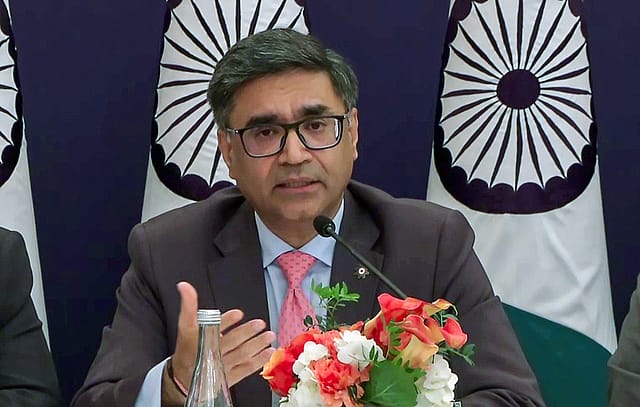
Within a week of reports of so-called “Track 2” talks between India and Pakistan on the sidelines of an event in Colombo, Foreign Secretary Vikram Misri not only categorically denied they were blessed by the government but said such “talk shops” are dime a dozen and need not be taken seriously. As a result, the question whether India was exploring an “opening” with Pakistan was did not arise.
Speaking to reporters in Victoria, Seychelles—where Prime Minister Narendra Modi was on a visit to participate in the events marking the 50th anniversary of the country’s independence—Misri said, “There is nothing new, nothing special about these events. As far as we are concerned, these are private events organised by private parties.” He went on to add that, “I cannot speak for the government of Pakistan, but as far as the Government of India is concerned, there is no official participation, no official support or involvement in these visits.”

The Health and Wellness Issue
25 Sep 2026 - Vol 05 | Issue 39
Misri effectively dissed reports that last week, on the sidelines of an event in Colombo, participants from India, including former Chief of Army Staff M M Naravane, met with their Pakistani “interlocutors” who included Sherry Rehman--a senator and a former minister—a serving diplomat Sajjad Haidar Khan and Isfandyar Ali Khan Pataudi, a retired general who once served in the Inter-Services Intelligence (ISI). Another Indian “participant,” Bharatiya Janata Party’s Ram Madhav, dismissed the “track 2” story as unwarranted spin.
Within no time of the reports of the alleged meeting, there was speculation in India that an “opening” to Pakistan was being sought a year after the two countries engaged in a conflict in the aftermath of 26 civilians being killed at the hands of Pakistani terrorists in Pahalgam on 22nd April.
In May this year, Dattatreya Hosabale, a senior Rashtriya Swayamsevak Sangh (RSS) leader told a news agency that, “The government of the day has to protect the country’s security and dignity. At the same time, doors for engagement should remain open.” This was construed as a “green light” of sorts by certain sections of civil society in India for engagement with Pakistan. It was speculated that such an “opening” could be prelude to a re-starting of official engagements between the two countries.
This suggestion—while it was sweet music to a class of retired diplomats and officials who argue for engagement with Pakistan at any cost—was taken with considerable scepticism by people at large. The idea that India can negotiate with Pakistan at gun point, or at the tip of a nuclear missile, is past its sell-by date. Later, it was conveyed to Hosabale that India-Pakistan ties do not lend themselves to easy analysis and a long track record of nurturing terrorism has turned the neighbour into a rogue state.
The official Indian policy is now guided by the dictum “blood and water cannot flow together.” Speaking in Parliament in July last year, Minister for External Affairs Jaishankar elaborated on India holding the Indus Water Treaty (IWT) in abeyance. He stated that, “Putting the Indus Water Treaty in abeyance was an important step by India. The Indus Water Treaty will be held in abeyance until Pakistan irrevocably gives up its support of terrorism. Blood and water will not flow together. India has faced cross-border terrorism since 1947. Operation Sindoor gave the message that India will not accept nuclear blackmail. It was Pakistan that begged India for a ceasefire.”
India has also expedited a number of irrigation and water projects that were closed to it under the IWT since then. Pakistan’s position since 2019, when it recalled its High Commissioner from New Delhi, has been the restoration of statehood to the Union Territory of Jammu and Kashmir (J&K) before re-engaging with India. India has, always, stated that J&K is an issue internal to India and the question of any involvement of Pakistan in the matter does not arise.
Since then, India has seen two short conflicts with Pakistan, one in the wake of a Pakistan-sponsored suicide bomber killing 40 CRPF troopers in Pulwama in J&K and in the wake of Pahalgam last year. In the face of Pakistani recalcitrance and its rather long list of “preconditions” for talks, the question of any room for diplomacy does not arise.
In the event, Misri’s statement where he also said that, “Anybody from India who is participating in these events, whether it is retired diplomats, retired military officials, members of civil society, when they participate in such events, they speak for themselves and they represent their own point of view. They do not in any way, they cannot in any way, represent the view of the Government of India. We really take no cognizance of these events,” makes the Indian position abundantly clear.