A Decade On, From Obama’s Abstention to Trump’s Aggression on Cuba
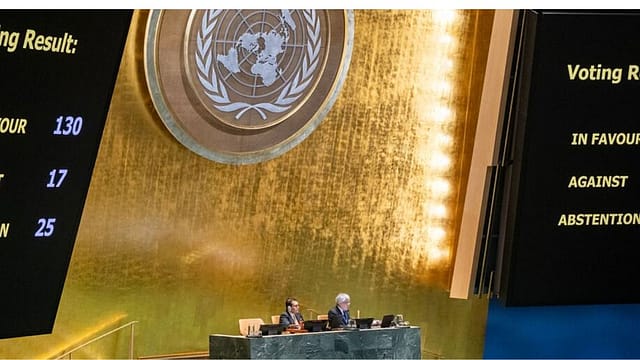
With the Donald Trump-led US pursuing an aggressive campaign against neighbour Cuba inside the United Nations over a vote calling for an end to the American embargo on the island nation, it is tough to imagine that exactly 10 years ago, with Barack Obama at the helm, the US itself had abstained from voting in the resolution to end the economic, commercial and financial embargo imposed by the US against Cuba.
In October 2016, 191 of UN General Assembly’s 193 members voted in favour of a resolution on Cuba and the US. The US and its all-weather ally, Israel, also abstained, marking a radical shift in the relations between the world’s biggest economy, which is also the world’s biggest military power, and tiny Cuba 90 miles south of Miami, Florida.

Look Who's Talking Regime Change
23 Oct 2026 - Vol 05 | Issue 43
Obama left and in came Trump, and things got even worse as he got re-elected last year and had Marco Rubio, a Cuban American who had never visited the island but has been fiercely critical of the government there, as Secretary of State.
This year, a resolution demanding the lifting of sanctions against Cuba passed by 130 votes in favour to 17 against with 25 abstentions. Last year it was adopted by 165 votes to seven with 12 abstentions. When the assembly first voted on a similar resolution in 1992, 59 countries backed the resolution, three opposed it and 71 abstained. According to UN reports, support for Cuba peaked at 191 votes in 2015 and 2017 during what is often called the “Cuban thaw” under Obama (June 2015-June 2017), who was the first US president in 88 years to visit Cuba. In 2016, the United States abstained for the first time. Obama, back then in March 2016, visited Cuban leader Raul Castro, even met Cuban dissidents and attended a baseball game. A year later, in June, the newly elected President Trump reversed various Cuba measures undertaken by Obama.
Dr C Jose Ramon Cabanas Rodrigues, former Cuban Ambassador to the United States who had worked closely on the Cuba-US talks during Obama’s presidency, tells Open about the vote that took place at the UN General Assembly on October 28: “Considering the amount of resources they invested in this campaign against Cuba and the pressure they put on countries to withdraw their support to the resolution, the Americans suffered a paramount defeat.” In 2015, Dr Cabanas Rodrigues became the first Cuban ambassador to the US in 54 years, a post that had lain vacant for more than half a century. Previously, he was the chief of the Cuban Interests Section in Washington D.C. He continued as ambassador until 21 December 2020, during the time of the US-Cuban thaw and the worsening of it during Trump’s first term. When he was ambassador to the US, the two countries saw a massive shift in relations.
He told Open, “They (the Americans) should be ashamed of the arguments they used against Cuba, the way they blackmailed foreign diplomats and of bringing terrorists to the floor to accompany their delegation.”
Since 1992, except for 2020 during Covid, a period when the vote was postponed, the General Assembly has held debates to lift the unilateral sanctions imposed on Cuba by the United States, followed by a vote. Cuba has received overwhelming support except over the past few years, with more countries—other than Israel, for instance Ukraine—and right-wing dispensations in the US, Europe and elsewhere throwing their weight behind the US, either by voting against the resolution or by abstaining.
The scenes at the Assembly this time were ugly, with US Ambassador to the UN Mike Waltz and Cuban Foreign Minister Bruno Rodriguez Parrilla engaging in heated exchanges after the former made an aggressive speech, which Havana says was based on fictitious newspaper reports. Parrilla posted on X after the vote, saying that the “US government is once again isolated in its attempt to continue strangling the Cuban people and subjecting them to an act of collective punishment and genocide.”
The US has been able to sway more countries to its side lately. Those who voted against the resolution and favoured the US include, besides the US, Israel, Argentina, Paraguay, Hungary, North Macedonia, Ukraine and others. Among the others, those who voted in favour of Cuba last year and switched sides this year include Colombia, Slovenia, Trinidad and Tobago, and United Arab Emirates (UAE). Those that abstained last year but voted in favour of the US include Bosnia and Herzegovina, Costa Rica, Czechia, Ecuador, Lithuania and Morocco.