A Cut Beneath the Sea Could Disconnect Millions: War Threat Looms Over Global Internet
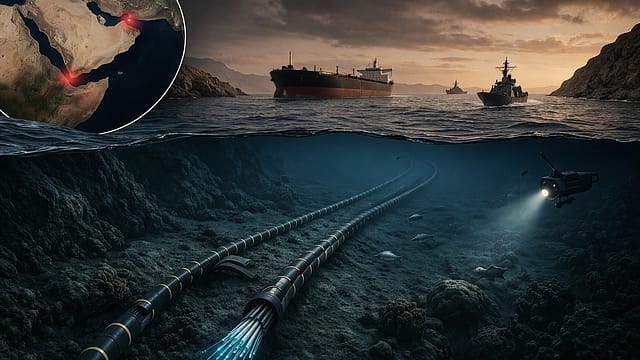
The escalating US-Israeli war against Iran is casting a shadow beyond the battlefield, with a new and largely invisible threat emerging beneath the sea in the form of vulnerable undersea internet cables.
As the war in West Asia continues to rage, fears and concerns regarding internet disruptions have increased due to possible cuts in the Red Sea cables.
Concerns are mounting over the safety of critical undersea fibre-optic cables running through the Strait of Hormuz and the Red Sea, the hidden network behind the majority of the world's internet.

Look Who's Talking Regime Change
23 Oct 2026 - Vol 05 | Issue 43
While Iran has not officially threatened the cutting of the submarine communications cables, several accounts of X have warned of the possibility as tensions rise between the US, Israel and Iran.
In this modern information age, undersea cables have become a strong foundation for digital connectivity.
Could Red Sea Undersea Cable Cuts Trigger Another Global Internet Disruption?
The last time the world saw a cut in the Red Sea cables was in September 2025, which was allegedly caused by a commercial ship which dragged its anchor and severed several of the undersea fibre optic cables.
Due to this incident, several countries saw disruptions in internet connectivity, especially in West and South Asia.
According to the International Telecommunication Union, about 99 per cent of the international internet traffic goes through submarine cables.
The Yamani rebel group has, on several occasions, threatened to cut the fibre-optic cables in the Red Sea. Due to this, the potential of a future attack from the Houthis on the Red Sea cables cannot be ruled out.
Any disruption to these cables could be a massive concern for India, as about 60 per cent of the country's internet traffic is handled on the crucial link that passes through the Gulf, travelling from Mumbai to Europe.
The rest goes through Chennai, travelling east via Singapore and the Pacific.
Given India's growing reliance on cloud services, digital payments, and AI devices, any damage to cables in the Red Sea could hamper connectivity and lead to major economic consequences for the nation.
This leaves the majority of India's internet network exposed to geopolitical tensions.
The cables in the Red Sea are responsible for a large number of services such as financial transactions, cloud services, video calls, emails and even workloads for artificial intelligence networks.