India’s Chip Tiger is Ready to Jump. Can It Build the Products?
A chip cannot fly a drone on its own.
It needs a circuit board, sensors, software and a power supply. Someone must make those parts work together, test the machine and give a customer a reason to buy it.
That journey from silicon to something useful sits at the heart of an opportunity Lars Reger sees opening up in India.
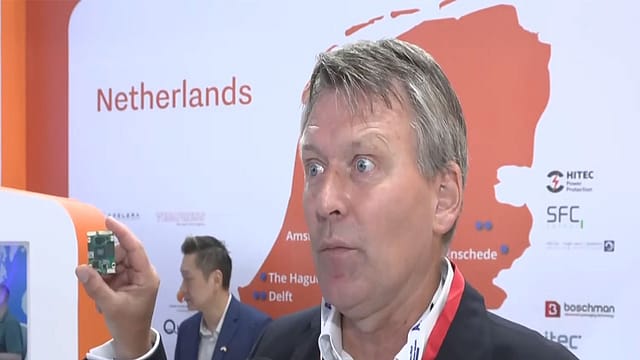
Speaking to ANI on the sidelines of SEMICON India 2026 in New Delhi on September 17, NXP Semiconductors’ executive vice president and chief technology officer described the Indian market as “a tiger that is ready to jump”.
The image is catchy. His explanation gives it substance: India’s established engineering strengths are meeting a growing domestic appetite for complete electronic systems. The question is how many Indian businesses can turn that combination into products of their own.

The Modi Years
02 Oct 2026 - Vol 05 | Issue 40
A Nation Rebuilt
Why NXP sees a turning point in India’s electronics market
“Everyone knows India as a big R&D country,” Reger said, pointing to decades of hardware and software development. “What now comes is that there is an uptake of the Indian market for all of these electronic systems.”
For a chip supplier, that creates an additional opportunity: customers in India designing devices around its technology.
NXP’s investment plans provide some context. In September 2024, then chief executive Kurt Sievers said the company intended to invest more than $1 billion in India as it doubled its R&D efforts over the following years. Reuters reported at the time that NXP had four semiconductor design centres in the country, employing about 3,000 people. That was a commitment announced two years ago, with a multiyear horizon.
Reger’s latest remarks extend the discussion to the businesses that could use such engineering capabilities. He said conversations with Prime Minister Narendra Modi and ministers had focused on building a full Indian electronics industry, including the systems surrounding semiconductors.
His examples were specific: modules for drone control and car-to-car communication.
From semiconductor designs to products customers can buy
Reger’s emphasis on reference designs explains where the practical work begins.
A reference design gives engineers a starting point for building an application around a chip. The commercial product still requires development for its intended use, testing and a route to manufacture.
“We have all this silicon but we need to train our customers and to help them to apply that quickly,” he told ANI.
Consider the drone-control module he cited. A prospective customer needs it to perform reliably as part of a complete aircraft. The manufacturer must integrate it with the rest of the machine and support the finished product.
That is the significance of “productisation”, the process Reger highlighted: taking available technology through the engineering and commercial steps needed to make it useful to a paying customer.
It also helps explain why his discussion ranged across students, startups and established customers. Each enters that journey with different resources. A student may need hands-on experience; a young business may need technical guidance and access to potential buyers.
What Ather’s chip partnership tells us
An earlier Indian example makes the connection tangible.
In May 2025, Ather Energy and Infineon Technologies announced a memorandum of understanding covering semiconductor technologies for light electric vehicles, charging infrastructure and safety. Their stated aim was to combine Infineon’s semiconductor capabilities with Ather’s vehicle-development expertise.
For a scooter buyer, the eventual value of that work would appear in the vehicle’s performance, efficiency and reliability. The semiconductor becomes part of a product whose usefulness the customer can judge.
The announcement established a collaboration agenda; it did not, by itself, demonstrate delivery of every intended benefit. But it illustrates the relationship Reger is describing: a product company working with a semiconductor supplier to solve a larger engineering problem.
A comparable approach has emerged overseas. In December 2024, South Korean startup bitsensing entered a partnership with NXP to combine the chipmaker’s radar chips with its own radar hardware and software for automotive systems, Reuters reported.
The business opportunity in that arrangement lies in what the product developer builds around the silicon. For Indian founders, it offers a useful model to examine.
Why training matters to India’s semiconductor ambitions
Reger placed education and practical assistance near the centre of his argument. Suppliers, he said, must help engineers apply the technology already available to them.
NXP’s existing programmes show how that approach can work. Its NXP Cup India asks engineering students to build mobile-robotics prototypes, using technologies such as sensors, computer vision and obstacle avoidance, with challenges in simulated and real environments.
Its broader startup programme targets areas including automotive, industrial applications, robotics and healthcare. The selection process considers technology, market potential, business models and teams before defining a collaboration.
These programmes offer routes into product development. Their larger economic value depends on what participants subsequently build and whether customers adopt it.
The real test: can Indian electronics businesses scale?
The implication of Reger’s argument is that India’s semiconductor ambitions need a growing base of capable product companies.
Those businesses must make repeated decisions about performance, cost, component availability and customer needs. They need to move from a working demonstration to dependable production, then persuade buyers to place repeat orders.
For India, the potential reward includes engineering work, product intellectual property, manufacturing activity and lasting customer relationships. How much value domestic companies capture will depend on the capabilities they develop and the roles they own.
Reger’s optimism rests on an opportunity: established technical talent meeting expanding local demand. Turning that into a broad electronics industry will require many companies to complete the difficult journey he described.
The tiger has caught everyone’s attention. Its next leap will be measured in products that leave the development bench and find paying customers.
With inputs from ANI & agencies