India, France share "same objective" on AI innovation, not "totally dependent" on US, Chinese models: French President Macron
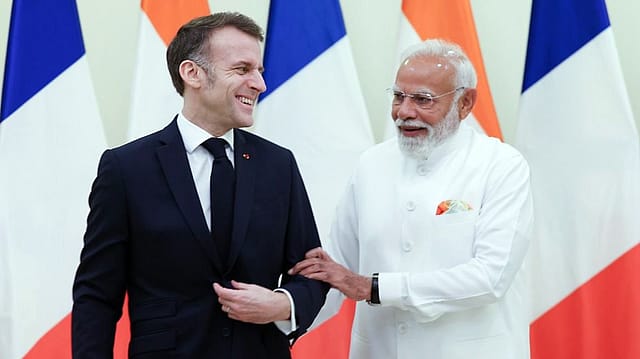
French President Emmanuel Macron on Wednesday said India and France share the "same objective" on artificial intelligence (AI) innovation and do not want to be "totally dependent" on US and Chinese models, emphasising the need for a balanced and sovereign approach to emerging technologies.
Speaking at an event at the All India Institute of Medical Sciences (AIIMS), Macron highlighted the importance of strategic autonomy in the rapidly evolving AI landscape.
“I think it is important that this innovation becomes a very important part of our countries. I believe we share the same objective in India and France, and in Europe -- that we do not want to be totally dependent on US and Chinese models. We believe we need our own balanced model, and we want to be part of the solution. We want our players to be part of the solution as well," he said.
Underscoring the significance of the ongoing India AI Impact Summit, taking place in Delhi, Macron described it as "extremely important" for shaping discussions around responsible innovation.
"The summit organised by India is extremely important regarding all these issues. After the Action Summit one year ago, we continued the conversation to ensure that our countries benefit from innovation and to make sure that this innovation serves our common good and humanity," he added.

Youth Issue 2026
24 Apr 2026 - Vol 04 | Issue 68
50 Portraits of Icons and Achievers
What are the three key pillars Macron underscored?
Macron also stressed that strengthening AI ecosystems requires investment in three key pillars -- computing capacity, talent and capital.
"We are making sure that we have data centres and computing capacities and that we train talent in our countries. It is clearly about three elements: computing capacity, talent, and capital," he said, adding that affordable and low-carbon computing capacities are also essential.
Acknowledging the global AI race, Macron noted that while India and France may be trailing the United States and China, they remain active contenders.
"We are in the race. We might be lagging behind the US and China, but we are in the race," he said.
He further emphasised that widespread adoption of AI, guided by ethical principles, is critical to unlocking its full potential.
"Adoption is critical because, with the right ethical approach, AI will be adopted and will allow us to discover new diseases, transform our energy model, and become much more productive. This is one of the only ways to fully understand the consequences of AI through statistics and to avoid a well-known paradox where AI is seen as a wonderful innovation without delivering real impact," Macron said.
Macron, JP Nadda inaugurate Indo-French Campus on AI in Global Health
President Macron and Union Minister for Health & Family Welfare, Jagat Prakash Nadda, inaugurated the Indo-French Campus on AI in Global Health at All India Institute of Medical Sciences.
This initiative marks a significant step in strengthening India-France collaboration in artificial intelligence for global health. The campus aims to advance research, innovation, and capacity building in AI-driven healthcare solutions, fostering academic excellence and international partnerships.
"It's very important for us to welcome more Indian students and to have more French students coming here. We speak about 10,000 per year, more or less, depending on the season. We decided with Prime Minister Modi to have 30,000 by 2030. It's largely feasible. On the French side, we have to simplify, and we will simplify, our sourcing and as well as the visa facility. To have a visa which meets the expectations of the students and is appropriate, for instance, if you have a PhD, I don't know how many years it took for you, three years, so many. So if I give you a visa for one year, I'm little bit crazy," he said.
"So on the French side, we will clearly streamline this approach in order to have something which meets the expectations and is much more practical for the students and the schools....We will establish better connections in order to have a better sourcing. In India, 10-15 years ago, it was not the number one source of students. Let's be honest. So I want our universities and high schools to do much more, but we will do as well much more in terms of administrative facilities," he added.
India is hosting AI Impact Summit 2026 from February 16 to 20. It is anchored in three foundational pillars, or 'Sutras': People, Planet and Progress.
The Prime Minister inaugurated the India AI Impact Expo 2026 at Bharat Mandapam in New Delhi on Monday.
The Summit, the first global AI gathering to be hosted in the Global South, has witnessed unprecedented participation, with over 20 Heads of State, 60 Ministers, and 500 global AI leaders.
Bringing together policymakers, technology companies, innovators, academia, and industry leaders, the Summit seeks to translate global AI deliberations into actionable development outcomes under the IndiaAI Mission and the Digital India initiative.
PM Modi will deliver the inaugural address on February 19, setting the tone for enhanced global cooperation and advancing India's vision for inclusive, trusted, and development-oriented artificial intelligence.
(With inputs from ANI)