How NISAR’s Radar Vision Is Transforming Earth Observation
Clouds can hide cities. Rivers can vanish under haze. Forests can blur into green noise. But not for NISAR.
A newly released image from the NASA–ISRO Synthetic Aperture Radar mission has done what optical satellites couldn’t—pierced thick cloud cover to reveal the Mississippi River Delta in striking detail. From New Orleans and Baton Rouge to wetlands, farms, bridges and forests, the radar image maps the Earth as it truly is, not as the weather allows it to be seen.
Captured in late autumn, the image showcases NISAR’s defining strength: the ability to “see” through clouds using radar instead of light. While optical imagery taken the same day was largely washed out by cloud cover, NISAR’s radar sliced through the obstruction, laying bare the land below.
At the heart of this capability is the satellite’s L-band synthetic aperture radar, developed by NASA’s Jet Propulsion Laboratory. Using microwaves with a wavelength of about 24 centimetres, the radar can pass through clouds, vegetation, and even parts of forest canopies—making it invaluable for tracking ecosystems, crops, wetlands and infrastructure.

Survival Instinct
22 May 2026 - Vol 04 | Issue 72
India navigates global economic turmoil with austerity and smart diplomacy
The Mississippi Delta image reads like a colour-coded map of human and natural activity. Urban pockets of New Orleans glow green, while other neighbourhoods turn magenta depending on building orientation and street grids. Healthy forests west of the Mississippi River appear bright green; thinning tree cover in the Maurepas Swamp shows up in yellow and magenta. Agricultural fields reveal whether land is fallow or actively cultivated.
Even iconic infrastructure is visible. The Lake Pontchartrain Causeway—nearly 39 kilometres long and the world’s longest continuous bridge over water—stands out clearly, a reminder of the resolution NISAR brings to Earth observation.
This image is more than a visual milestone. It arrives just weeks before NASA releases thousands of NISAR data files for global researchers, with early sample datasets already available to help scientists prepare. These data products are expected to transform disaster response, climate monitoring, agriculture planning, and infrastructure surveillance worldwide.
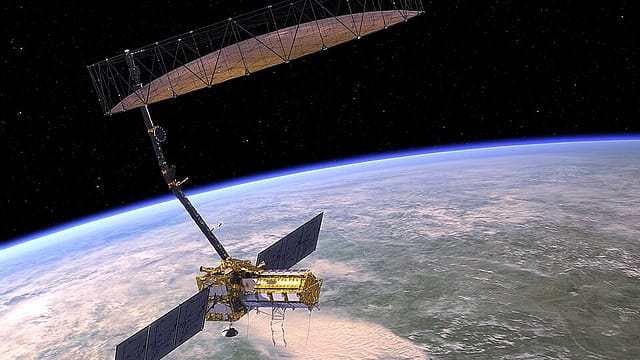
Launched on July 30 from India’s Satish Dhawan Space Centre, NISAR is the first satellite to carry two radar instruments operating at different wavelengths—NASA’s L-band and ISRO’s S-band. Together, they will scan Earth’s land and ice surfaces every 12 days using a massive 12-metre-wide radar reflector, the largest ever flown by NASA.
In an era of climate volatility and extreme weather, NISAR doesn’t just watch the planet. It reads it—clearly, consistently, and without being blinded by clouds.
(With inputs from ANI)