Gaganyaan Clears Module Separation Tests Ahead of First Uncrewed Mission
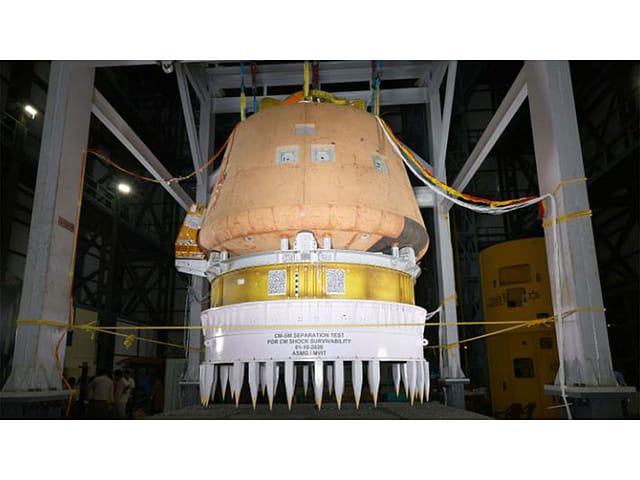
The Indian Space Research Organisation (ISRO) has successfully completed a series of tests of Gaganyaan’s Crew Module–Service Module separation system, clearing a key technical milestone ahead of the programme’s first uncrewed mission.
The tests, conducted at the Vikram Sarabhai Space Centre in Thiruvananthapuram, validated the separation system’s design and demonstrated the ability of several critical Crew Module subsystems to withstand the shock generated during separation, ISRO said.
The first uncrewed Gaganyaan mission, G1, is targeted for launch in 2026.
A CRUCIAL BREAK BEFORE RE-ENTRY
Gaganyaan’s Orbital Module consists of the Crew Module and the Service Module. The two are integrated before launch and operate as a single unit until the end of the mission’s on-orbit phase.
Electrical and fluid connections between them run through a set of umbilical links. Before the Crew Module re-enters Earth’s atmosphere, it must detach from the Service Module through a precisely timed sequence involving pyrotechnic devices and jettisoning systems.

Zeroing In on ECI
09 Oct 2026 - Vol 05 | Issue 41
Constitutional legitimacy versus political opportunism
The tests simulated this separation, including the severing of multiple umbilical connections. An extensively instrumented setup recreated the integrated module assembly, allowing engineers to assess the process.
CRITICAL SYSTEMS WITHSTAND SEPARATION SHOCK
Beyond the separation mechanism itself, the tests assessed the robustness of systems essential to the Crew Module’s operation and return.
These included avionics, inertial navigation systems and the Thermal Protection System in the aft and conical heat shields.
The tests also demonstrated the shock-survivability of the Crew Module Deployable Umbilical Shield and pyrotechnic devices associated with the Crew Module Uprighting System and the Thermal and Humidity Control System.
ISRO said the successful tests provided confidence in the separation system’s functioning for the upcoming G1 mission.
With inputs from ANI