From Engineering to Edge of the Universe: Meet Rohan Naidu, the Astronomer Behind ‘Black Hole Star’ Discovery
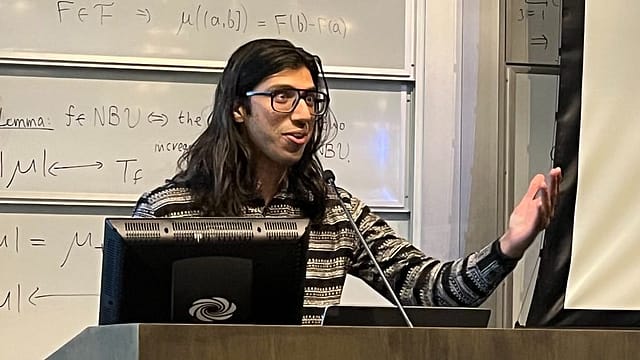
Imagine being 18, enrolled in engineering school and expected to follow a fairly predictable path. Then imagine walking away from it. That is what Rohan Naidu did.
He left engineering at 18, bought his first-ever plane ticket and joined the founding class of Yale-NUS College in Singapore. Even Naidu's own MIT biography describes the decision as a “Bollywood-esque plot twist.”
Today, the Hyderabad-born astronomer studies some of the earliest galaxies and black holes in the universe. And his latest work has taken him to a particularly strange corner of the cosmos — a mysterious object called MoM-BH-1*, which may represent what astronomers are calling a “black hole star.”
So, who exactly is Rohan Naidu?
From engineering to the stars: Naidu grew up in Hyderabad and initially enrolled in engineering. But engineering wasn't where his curiosity stayed.

Zeroing In on ECI
09 Oct 2026 - Vol 05 | Issue 41
Constitutional legitimacy versus political opportunism
At Yale-NUS, he discovered astronomy while working on blazars — extraordinarily bright objects powered by matter falling into supermassive black holes — with astronomer Charles Bailyn. He also spent time as an exchange student working with researchers associated with Yale's Pieter van Dokkum group. The switch became permanent.
Naidu went on to Harvard, where he completed his PhD in Astronomy in 2022 under Charlie Conroy. His doctoral research focused on “Galactic Archaeology” — using the stars and structures in the Milky Way to reconstruct the history of ancient galaxies that were absorbed into our own.
Then came the early universe.
Why does Naidu study the beginning of everything?
Naidu's research now focuses on some of the first galaxies that formed after the Big Bang. That means looking incredibly far away is, in a sense, looking incredibly far back in time.
His MIT profile says his work examines when the first galaxies emerged, how they affected the hydrogen between galaxies and how they produced the elements that eventually helped seed the universe. He has also been among the early users of the James Webb Space Telescope, studying galaxies at extreme distances.
The JWST has opened a remarkable window into that period. And through it, astronomers have found something they did not quite know what to make of.
Then came the mysterious red dot
Enter MoM-BH-1*.
It was identified in JWST observations as an extraordinarily red and unusual object at a redshift of about 7.76, meaning we are seeing it from a time when the universe was less than 700 million years old. Naidu and his collaborators reported the object in a 2025 research preprint. It stood out immediately.
The object showed an unusually strong Balmer break, broad hydrogen emission and absorption features that are difficult to explain with an ordinary population of stars. It was also the reddest source in the roughly 250-square-arcminute field in which it was identified. And that is where the story gets strange.
Is it a star? A black hole? Something in between?
Naidu and his collaborators proposed that MoM-BH*-1 could be a “black hole star” — essentially a massive black hole surrounded by an extremely dense cocoon of gas. The black hole would power the object through accretion, while the surrounding gas would absorb and reprocess its radiation, making the whole thing appear remarkably star-like.
Think of it as a black hole hidden inside a gigantic glowing atmosphere. The researchers' modelling suggests this could explain the object's unusual spectrum and may offer a way of understanding the mysterious “little red dots” that JWST has repeatedly found in the early universe.
But there is an important caveat. “Black hole star” is a scientific model or proposed interpretation, not a settled new category of astronomical object. Other researchers continue to explore competing explanations for these strange early-universe sources. The existence and nature of the phenomenon are still active areas of research.
Why does this matter?
Because there is a cosmic problem hiding underneath the discovery. Astronomers have found evidence for surprisingly massive black holes very early in the universe. But how did they grow so quickly?
The universe simply may not have had much time to build billion-solar-mass black holes through the ordinary pathways we understand today.
That is where objects like MoM-BH*-1 become interesting.
Naidu's research suggests that a dense, gas-enshrouded black hole could represent an early stage in the growth of the enormous black holes that eventually sit at the centres of galaxies. The idea could also help explain why JWST keeps finding those puzzling little red dots.
A mystery that looked like a strange collection of red specks may actually be giving astronomers clues about how some of the universe's biggest black holes began.
Naidu is not finished
The “black hole star” is only one chapter in Naidu's broader work. Before this research, he was involved in studies of some of the earliest galaxies observed by JWST, including work on the high-redshift galaxy GLASS-z13. Yale-NUS notes that Naidu was among the astronomers involved in its discovery in 2022.
His academic path has also taken him through the NASA Hubble Fellowship and the MIT Pappalardo Fellowship in Physics. MIT currently lists him as a Pappalardo Fellow for 2025–2027, with astrophysics as his research area. He has since moved on from his MIT fellowship period to the University of Hawaiʻi's Institute for Astronomy, where his work continues to focus on the early universe.
And then there is the less cosmic side of Rohan Naidu. MIT's biography describes him as a quiz and trivia enthusiast, published poet and Test cricket fan. Which makes the story rather wonderfully human. A boy from Hyderabad left engineering at 18. He bought a plane ticket. He went looking for something he couldn't yet name. Years later, he is helping astronomers look billions of years into the past — at objects so strange that scientists are still debating exactly what they are.
The universe, it turns out, has plenty of mysteries left. And Rohan Naidu is looking straight at them.
(With inputs from yMedia and agencies)