World Athletics U20 Championships: Basant Meghwal, Shahnavaz Khan Make History as India Win Two More Medals
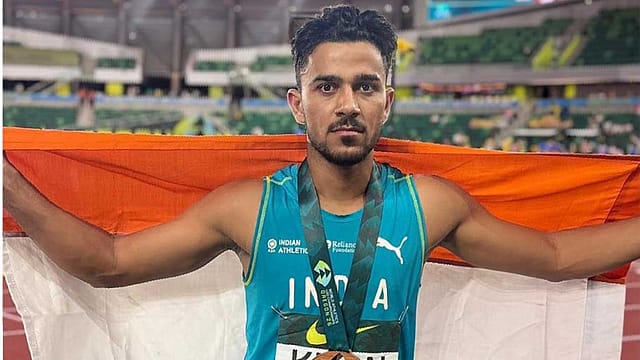
India's next generation isn't waiting for permission. Two teenagers. Two medals. Two pieces of history.
Basant Kumar Meghwal cleared a personal-best-equalling 2.21m to win silver in the men's high jump, becoming the first Indian ever to win a high jump medal at the World Athletics U20 Championships.
Then came Shahnavaz Khan. The Indian U20 Asian champion leapt 7.84m for bronze in the men's long jump, becoming the first Indian man to win a long jump medal at the junior world championships.
Together, they have pushed India's medal tally in Eugene to three, after Ashish Yadav's silver in the javelin on Friday. And there is a bigger number hiding behind that tally. Three medals matches India's best-ever haul at the World Athletics U20 Championships, equalling the three-medal performances from the 2021 and 2022 editions.

Zeroing In on ECI
09 Oct 2026 - Vol 05 | Issue 41
Constitutional legitimacy versus political opportunism
The 19-year-old Meghwal arrived in Eugene with momentum. He had already cleared 2.21m at the Junior Federation Cup in Bengaluru in April before winning gold at the Asian U20 Championships in Hong Kong with a 2.20m clearance in May. In Eugene, he needed two attempts at 2.12m but cleared 2.17m first time. He then matched his 2.21m personal best on his second attempt.
Three athletes cleared 2.21m. None could get over 2.24m. Gold went to Algeria's Younes Ayachi, who cleared 2.21m on his first attempt. Britain's Otis Poole took bronze after needing three attempts. Meghwal's second-attempt clearance earned him silver on countback. "I was a bit nervous" attempting 2.24m, Meghwal told Olympics.com, adding that he expected to do better at senior level. For Indian high jump, that future suddenly looks rather interesting. Then Shahnavaz took flight
Shahnavaz Khan's bronze was another first. The Indian opened his long-jump final with 7.67m, improved to 7.72m and then produced the leap that put him on the podium: 7.84m. He came into Eugene with a much bigger personal best, 8.30m, set at the Indian Championships in June. Italy's Daniele Leonardo Inzoli won gold with 7.97m, while Australia's Mason McGroder took silver with 7.96m.
Shahnavaz's medal also extends a small but significant Indian tradition in the event. Shaili Singh had won silver in the women's long jump at the 2021 championships.
Now the men's event has its own Indian medallist. Three medals. And a familiar name in the background. India has won only two gold medals in the entire history of the World U20 Championships. One belongs to Neeraj Chopra, who won the javelin title in 2016 with his then-world U20 record of 86.48m. The other belongs to Hima Das, who won the women's 400m in 2018.
In both those editions, India's gold was also its only medal. This time, India has three podium finishes without a gold. But perhaps the more interesting story is what those medals represent. A javelin thrower. A high jumper. A long jumper. Three different disciplines. Three teenagers. Three reasons to believe India's athletics story is becoming broader than the one superstar who changed it forever.
(With inputs from ANI)