Why Asia Cup Rising Stars Was A Failure For Indian Players
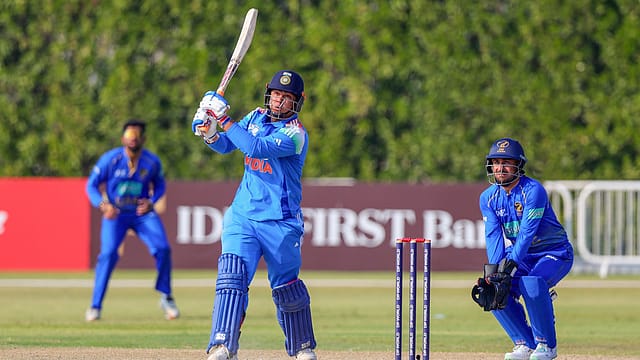
To the India A team players, the Asia Cup Rising Stars tournament in Qatar, from which the team has now crashed out after losing to Sri Lanka A in the semi-final, was in one sense not only about the tournament. Several of the players are already familiar names. Many are legitimate IPL stars, and quite a few are among the first names jotted down on India’s T20I team sheet.
But this tournament was especially important to some of the batsmen, many of whom aspire to break into India’s 50-over format. It is perhaps lost on nobody that there will be at least two top-order batting positions opening up after the World Cup—and, who knows, maybe before too. The Rising Stars tournament would have thus served as an opportunity to get a closer look at some of these T20 swashbucklers as 50-over players.

Hot Pursuit
27 Nov 2026 - Vol 01 | Issue 02
The Shah Doctrine of Internal Security
To that extent, none of the players will have left the tournament feeling they have seized their chances.
Tilak Varma did score in every match where he got to bat—two centuries and a half-century in three matches (he didn’t get to bat in the UAE match)—but a majority of these were a throwback to the batting of an earlier era, where the batsman ate up a lot of balls. Abhishek Sharma brought his usual T20 belligerence, scoring two fast-paced 70s and threatening to run away with the match in those two innings, but he couldn’t quite shake off the impression that he remains a T20 batsman ill-equipped for the rhythm and mood of the 50-over format. It may be necessary to take a hit-or-get-out approach in T20s, but in the ODI format, as important as it is to take an aggressive approach in the first 10 overs of the match, it remains equally necessary to cash in and play the longer game once you’ve seen yourself through this phase.
Vaibhav Sooryavanshi will probably feel a bit let down by himself too. He didn’t get going in all the matches, but in the one he did—against UAE—he produced the kind of innings that got the entire world talking. His 204 runs in only 53 balls may not have come against the strongest opposition, but it still requires great skill and ability to score a double hundred. Given there were other stars in the Indian team who didn’t put the UAE bowlers through the grinder like Sooryavanshi, and that UAE hadn’t conceded this many runs in previous matches, one cannot but conclude it was just Sooryavanshi doing Sooryavanshi things.
The records tumbled amidst his assault. His 204 was the fastest double century in List A cricket, obliterating the previous record by almost half the number of balls faced. He also broke the records for the fastest century, the fastest 150, and the most sixes hit along the way. Sooryavanshi had brought not just a T20 game, but the very best and most destructive variety of it, to a 50-over format.
Sooryavanshi may still be just months into his international career, but he’ll be the first to admit that there have been some disappointments. He’s firstly found it hard to squeeze into the playing XI when all three of Sanju Samson, Abhishek Sharma, and Ishan Kishan are available. The few times he managed to get in over the last few months, while he played aggressively, the high scores eluded him.
When he returned to the domestic scene, his fortunes didn’t turn either. “I was a bit distracted. I was thinking, ‘What’s going on?’” he said in an interview after the UAE match, referring to the 18 he scored for Bihar in a Syed Mushtaq Ali Trophy match and possibly the scores of 26 and 11 in the first two matches of the Rising Stars tournament. And then the UAE match happened.
None of these players quite seized what was on offer. There will no doubt be more opportunities coming their way. But in a setup like India’s, which today has plenty of talent competing for a handful of spots, these opportunities won’t always be around.