Has Jasprit Bumrah Changed His Bowling Action? Why the Great Fast Bowlers Keep Taking Themselves Apart
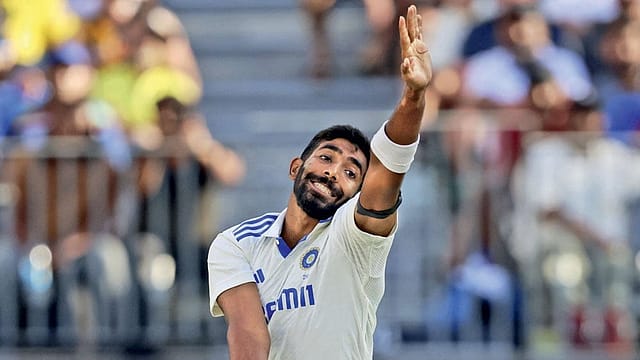
First, picture him the way the world knows him.
Short steps, measured, almost polite.
The ball is cupped in both hands at his belly. His elbows flare out, like the wings of a bird that hasn't decided to fly.
The approach gathers speed. Then comes the stutter, a hitch in the rhythm, as though two separate machines find each other a split second before the crease.
Then his hands burst apart.
His left arm flings high above his head while the bowling arm coils behind him and whips over. His front foot slams down, his chest drives towards the batter, and the ball leaves his hand late, later than anyone at the other end would like.

Anatomy Of A Stillborn Revolution
20 Nov 2026 - Vol 01 | Issue 01
Whatever Happened To The Cockroach Janta Party?
A batter gets a fraction of a second to make sense of it. The rest of us have had ten years.
Then came Christchurch, and the hands let go.
BUMRAH'S NEW RUN-UP: THE CLASP COMES UNDONE IN CHRISTCHURCH
A side-by-side clip is racing across Reddit. It's identified there as Wellington on the left and Christchurch on the right.
Press play, then slow it down.
Stride one. On the left, his hands are cupped at his belly, holding the ball like a secret. On the right, they've already split. The red ball rides in his right palm beside his torso, and his left arm swings free.
Stride two. On the left, he's still locked and his elbows still flare. On the right, both elbows bend and start to churn with his stride.

Stride three. On the left, the ball stays hidden between his palms. On the right, it rises and falls with every step, in plain sight.
Then the crease arrives. His arms lift, and both films rush into the same familiar explosion.
The two deliveries hit their final strides at slightly different moments. What the footage clearly shows is a change in how he carries his hands to the crease. Proving a change at release would take a closer, synchronised comparison.
So why has he done it? At the time of writing, there was no on-record explanation from Bumrah or India's coaches.
He has tinkered before. After his comeback from back surgery in 2023, PTI quoted an unnamed NCA Level-III coach who said Bumrah had added two or three strides to his run-up and lengthened his follow-through. The coach read it as an attempt to build momentum and reduce strain. That was one observer's view of an earlier comeback.
And Bumrah is far from the first great fast bowler to take apart the movement that made him famous.
Ask James Anderson what that costs.
JAMES ANDERSON'S ACTION CHANGE: THE FIX THAT BROKE HIM
England had a young bowler who could bend a ball like a banana. They also had a list of things to fix.
According to Wisden, coach Troy Cooley wanted more accuracy and less injury risk, so he went to work on Anderson's action. In Anderson's own telling, there was also a push for extra pace under Duncan Fletcher.
The tinkering stripped him of consistency. A stress fracture in his back followed in 2006.
Eventually, he went back towards the action he'd grown up with.
"Everything felt more natural," he told the Sky Sports Cricket Podcast in 2020.
Sit with the relief in that sentence.
Imagine running in to get a batter out and having to stop and think about where your own arm should go. The batter waits at the far end while you argue with a movement your body once did without asking.
Anderson linked the changes to his injury. His story is a warning: try to perfect a method a bowler built as a boy, and he may end up searching for something he already had.
DENNIS LILLEE'S COMEBACK: REBUILT FROM THE BACK UP
Dennis Lillee didn't get to choose.
In 1973, a debilitating back injury stopped him cold. According to the Sport Australia Hall of Fame, he threw himself into brutal strength and conditioning work and remodelled the parts of his run-up and action that were punishing his body.
He came back in 1974.
He had already learnt how to frighten the world's best batters. Now he had to learn how to keep doing it without breaking.
Every walk back to his mark carried two questions. Would his body hold? And would the rebuilt action still produce the bowling Australia needed?
It held. The comeback became part of his authority as a mentor. Years later, a young Australian quick with a sensational debut and almost no Test cricket since went looking for him.
PAT CUMMINS AND LILLEE: THE CONCRETE STRIP IN PERTH
Pat Cummins took six wickets in South Africa's second innings on Test debut in Johannesburg in 2011.
His second Test didn't come until 2017, in India.
Six years. In between came injuries, rehab, and comeback after comeback that never quite arrived.
According to Cricket Australia, Cummins paid his own way to Perth in 2013 to work with Lillee, on Mitchell Johnson's advice. Rain washed out the nets, so they started beside the South Perth Cricket Club pavilion, stepping through the changes on a strip of concrete. The run-up came first.
"I felt like I was literally a workload number," Cummins later recalled of those years.
Lillee didn't just want to fix him. He wanted Cummins to understand where his movement was going wrong and how to correct it himself, so the knowledge would travel with him long after the coach had gone home.
That's the patience a rebuild demands. The new movement has to become familiar, and the body has to bowl enough overs to trust it when a Test match is on the line.
MITCHELL JOHNSON'S FIX: STOP WATCHING YOURSELF
For Mitchell Johnson, the problem wasn't only in his body. It was in his head.
In a 2014 Cricket Australia interview, he described what happened after a bad ball. He'd start thinking about his front arm, or some other technical detail. While he inspected himself, he lost sight of the batter.
The fix was a longer run-up and a smoother movement through the crease. Spending less time rocking on his back leg straightened the path of his bowling arm and made him more consistent.
"So not having to think about it (bowling action) has been a big change," he said.
The work had to disappear from his own view. Johnson needed to reach the crease thinking about only two things: where the ball was going, and what the batter would do about it.
To a spectator, the run-up is just the journey to the important bit. For Johnson, getting that journey right freed his mind to bowl.
ISHANT SHARMA AT SUSSEX: THE BALL THAT REFUSED TO MOVE
Ishant Sharma arrived at Sussex in 2018 wanting more.
Working with Jason Gillespie, he chased a cruel delivery: one that would tempt a right-hander to play for movement into him, then hold its line and do nothing.
Gillespie told Cricbuzz they changed his grip, his wrist and his finger positions at release. They worked on staying tall and following through towards the batter.
A small change in his fingers forced a big decision at the other end. The batter now had to commit his bat while guessing between two possible paths.
This was another reason to reopen a finished method. It wasn't an injury or a crisis. A seasoned bowler simply wanted more edges, more doubt and more wickets.
WATCH THE HANDS
Back to the Christchurch clip.
The change shows up before the batter even enters the frame. The hands separate, the ball moves beside him, and his arms pump towards the crease.
Is Bumrah chasing rhythm? Setting a trap? Rebuilding for the long haul? Only he can say.
Lillee rebuilt to survive. Anderson rebuilt, and then found his way back. Cummins rebuilt on a strip of concrete. Johnson rebuilt so he could stop thinking. Ishant rebuilt for one more edge.
Every great fast bowler eventually has to take himself apart and trust that he can put himself back together.
For ten years, Bumrah carried the ball to the crease cupped in both hands, held close, like something only he understood.
Until he explains, watch the hands. They've let go of the ball. Now we wait to see what they're reaching for.